 Netwrck
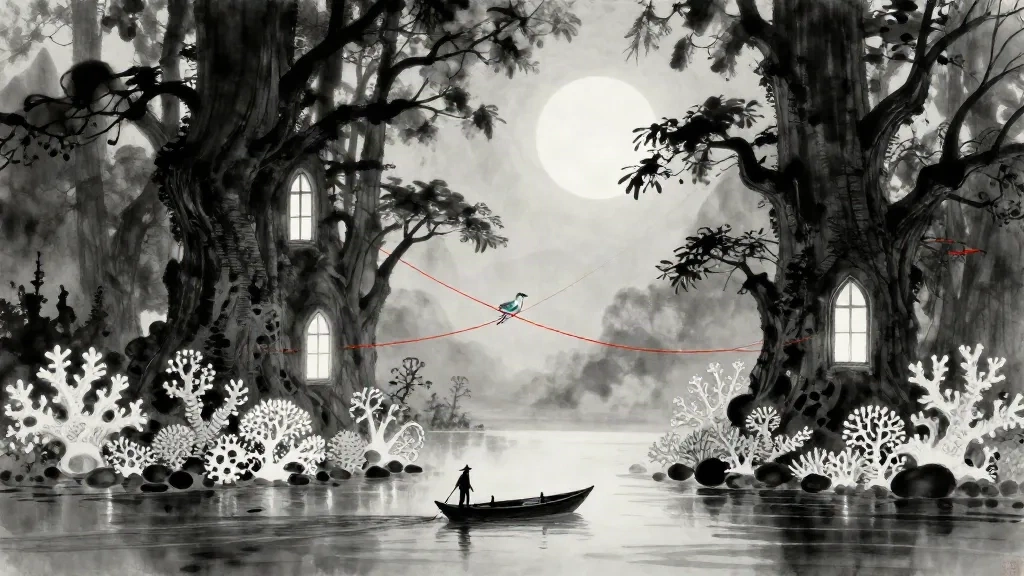
Gothic Fantasy.
The Lake That Came Back
Orren had ferried the black lake since his father died, though the lake came only at the lowest tide. Each morning it vanished, leaving a bowl of white coral, black mud, and snail shells among the reeds. Each evening the water returned without rain, smelling of cold iron and winter apples.
He poled from the western reed bank to the island garden and back. The fare was one story. He never asked what people did with the stories afterward. Some paid with memories. Some paid with names. A widow once gave him a memory of sunlight on a kitchen floor, and he rowed home with its warmth trapped beneath his ribs.
That winter, an old woman boarded at the island and placed a red scarf in his boat. It was knotted around a glass bird no larger than his thumb.
“The garden is taking the doors again,” she said.
“What doors?”
“The ones that should not open.”
The Map Against the Oars
She gave him a map drawn on pale bark. A red thread crossed every page, stitching together the lake, the garden, and a tower marked beneath the word ORIGINAL.
“Find Vey,” the woman said. “She remembers the world before the garden changed it.”
“Where is she?”
“That is the trouble.”
He put the map in his coat. By morning, the route had altered. The red thread ran beneath the lake, then climbed a tree marked DOOR, then crossed out the names of three villages. The tower remained, though its stairway curled in different directions each time he looked.
Orren tried marking the map honestly with charcoal. The ink ignored his hand. He cut away the thread. A new red thread appeared along the torn edge. He folded the bark into his pocket and rowed anyway.
At the island garden, the great tree stood with its roots sunk in coral-white soil. Its bark was black as wet ink. Door-shaped buds opened along its trunk, showing rooms filled with snow, moonlight, laughing strangers, or fields of ash.
Behind one door he saw his father alive, younger and uninjured. Behind another he saw the lake beneath a green sun. Every time he looked away, the doors changed places.
The glass bird in the red scarf began to sing. The song was thin and threaded through the branches, like a needle drawing blood from wood.
The Room That Refused Him
One door opened only when he held the map against it. Beyond it was a chamber of white coral and black water. Vey sat at a table, older than memory, turning the red thread between her fingers.
“You are late,” she said.
“The map changed.”
“It changes for travelers who want a destination.”
She looked at the glass bird. “You brought a witness.”
“I brought a question.”
“No. You brought the reason for asking.”
Orren placed the map on the table. The tower marking slid toward the edge. Beneath it appeared a new name: ORREN, DROWNED BEFORE THE FIRST DOOR.
His hands went cold. He had never drowned. He had never seen the first door.
Vey drew the red thread across the map. It cut through his name and reached for the black water beyond the chamber.
“The world has been repaired so many times,” she said, “that no one remembers the flaw. I remember the morning before the tree. The lake was only a lake. The doors were only doors.”
“Then show me.”
“You will not survive the showing.”
“I have spent my life carrying strangers’ memories. I can carry one more.”
The First Door
She opened the chamber’s last door. Beyond it was the original garden: a young tree, a white shore, and Vey exactly as she had been, laughing beneath a sun without doors. The lake lay quiet. No roots. No map.
Orren entered.
The glass bird shattered against his coat. Its pieces fell like clear rain. The red scarf tightened around his throat, then loosened, becoming a single red thread.
Young Vey saw him. Her smile vanished.
“You came from the other version,” she said.
“I came to remember this one.”
He took the thread. The old chamber, the black lake, and every altered garden vanished. In their place remained the sound of water touching shore as it had touched shore before anything demanded a price.
At dawn, Orren found himself in the real garden, his oar broken across both knees. The map in his pocket was blank except for one red line running from the tree to the western bank.
He followed it home.
When the next tide withdrew, he found a glass bird waiting in the reeds, its wings tied with a red thread. It sang once, then turned its clear face toward the island.
Orren repaired his oar, pushed off, and crossed the black water. Somewhere beneath the door-shaped buds, the world remembered itself.





