 Netwrck
Mystery.
The Film That Had Not Happened
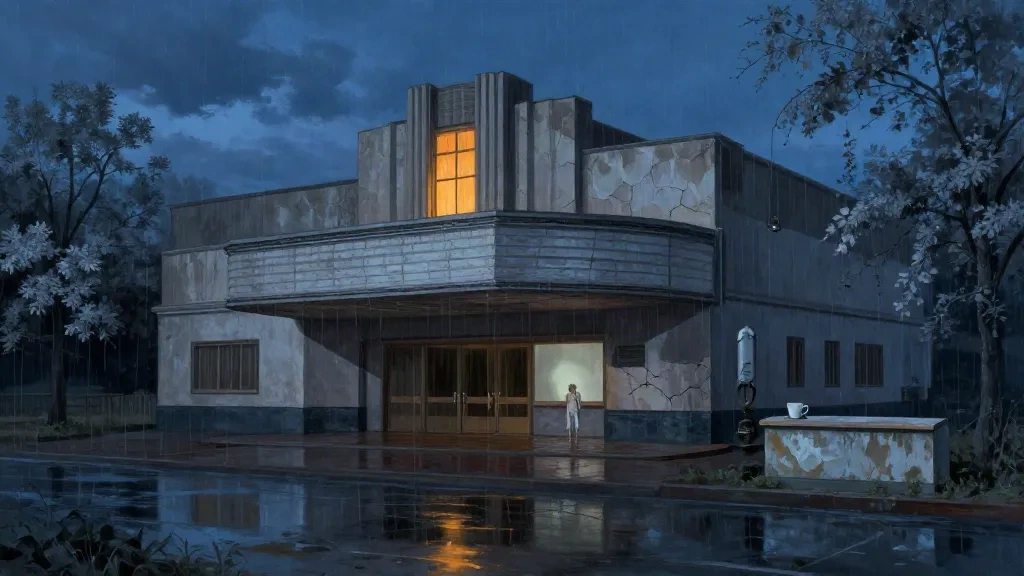
By the time Mara Vale inherited the old Astor Cinema, its screen still played futures that had nearly happened. Rain-slicked cities floated above drowned fields. A woman in silver armor stood before a palace with no doors. Once, every winter, the projection showed a blue house at the end of a street that no longer existed.
Mara had been a librarian in a city that closed its smallest reading room first. She came to the Astor seeking a place that did not require every inhabitant to be ordinary. The building smelled of dust, rain, and scorched film. Above the concession window, one pane remained amber. No matter how dark the afternoon became, that single window glowed like a held breath.
On the counter waited an empty teacup, its rim polished by absent hands, and a cracked bell that rang only when someone lied about where they intended to sleep.
The Same Book
The Astor's library occupied the former manager's office. Mara began cataloguing its books by titles no cataloguer had recorded. Most were ordinary: atlases, novels, repair manuals. One volume appeared whenever she tried to remove it.
Its blue cloth cover bore no title. Its pages held the floor plans of impossible homes: rooms for those who had never been born, kitchens prepared for creatures without shadows, basements sheltered beneath towns that had burned. In the margins, a different hand had written the same sentence: When the last viewer looks directly at what has been agreed away, ring the bell.
Mara lent the book to a woman who had come for the silver-armored future. She returned it with dust on her sleeves and a key to a room inside the cinema. The key opened a narrow cupboard containing a child's shoes.
The next borrower was an old projectionist seeking a future in which he had never lost his daughter. He returned the book with a small brass gear. The gear turned in a film canister and revealed footage of the Astor intact, its sign lit, its seats full.
The Boy in the Balcony
On the third night, a boy appeared in the seventh row. He was perhaps nine, dressed in a coat too large for him, watching a future where the cinema stood alone in a field of white grass.
“You don't see the one behind the screen,” he said.
“I see a wall.”
“That's the part you agreed to overlook.”
On the screen, the future flickered. A tall figure stood behind the projection booth, its face hidden by the amber window's reflection. Everyone else in the auditorium seemed unable to perceive it. Only the boy turned toward the boy-shaped shadow.
Mara took out the blue book. The shadow moved first.
“Don't ring it,” the boy whispered. “Not yet.”
He crossed the aisle and handed her a page torn from an atlas. The map showed the Astor, a river, and a narrow path labeled Places That Will Accept You. The route ended at a house drawn in blue ink beneath the word HOME.
“It isn't a place,” the boy said. “It's a decision.”
A Door in the Future
Mara understood then. The cinema had preserved futures that almost happened: the towns that could have sheltered the strange, the families that might have adopted the lost, the doors that might have opened for whatever could not explain itself. People came to borrow a future because they could not bear their own.
The cracked bell began to tremble.
“Do you want a home too?” the boy asked.
“I want to know whether one will accept us.”
She rang the bell.
The amber window flared. The hidden figure stepped from behind the screen, carrying a child-sized shadow beneath one arm. No face. No uniform. Nothing dangerous except the loneliness folded into its shoulders.
Together they entered the film. The boy found his shoes. The woman found the room behind the wall. The projectionist saw his daughter turn toward him in a future that finally had a door.
At dawn, Mara stood beneath the warm window, the blue book open in her hands. On a fresh page was a new floor plan: one small room, one low table, and enough space for every impossible resident who had ever been told to wait outside.
She wrote beneath it:
Home is not found. It is made wide enough.





