 Netwrck
Weird Fiction.
Smoke Beneath the Saffron Sign
Mara arrived at the cinema because the Orchard House had called her. She tended homesick houses throughout Bellwether, pressing warm palms to chimneys, loosening stiff windowframes, asking where each room had been happiest. Usually the answer was a street, a sea, a kitchen before an argument. This time the house said only, through its pipes, Basil says the last train is at midnight.
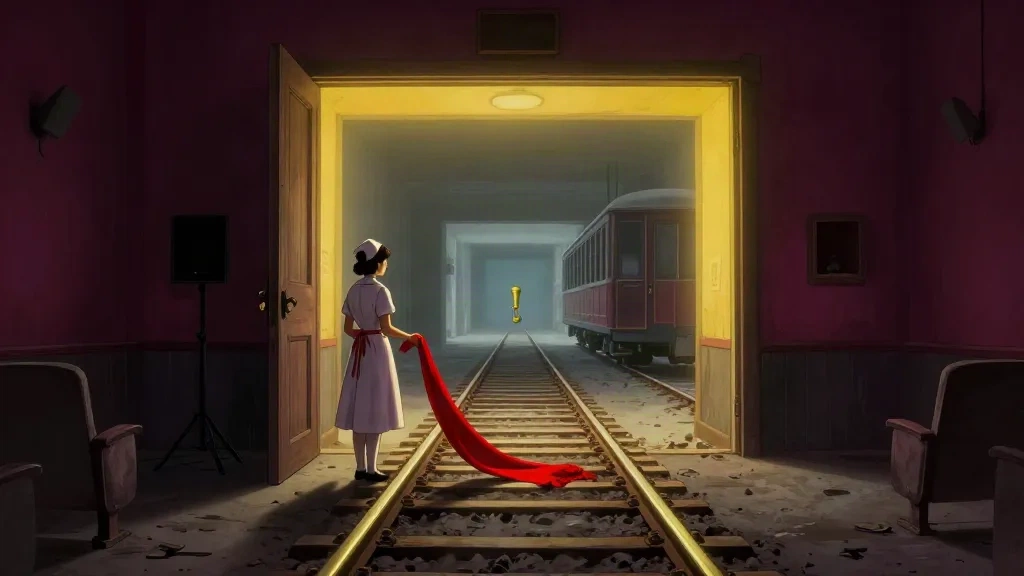
Beyond the abandoned cinema, saffron posters peeled in smoke-grey air. The marquee, dark for twenty-three years, burned faintly: ENDINGS ADMITTED FREE. Mara entered carrying her black medical bag. A red scarf lay across the ticket booth, damp at both ends as if recently pulled from two different throats.
Inside, the screen showed a railway carriage filmed from above. In every seat families quarrelled, forgave, or left with luggage. At the platform, a stationmaster struck tickets with a silver punch.
Every ending is a scheduling error.
The stationmaster was alive, though the film placed him in his coffin by three. He climbed from the projection booth without hurrying.
“You’re early,” he told Mara. “The Gregory sisters’ future begins in nine minutes.”
The Argument in Carriage Nine
On the screen, red-haired Lio Gregory faced her sister Nessa across a table marked with decade-old mustard stains.
“You turned the farm into a museum of your own childhood,” Nessa said.
“You turned leaving into a moral verdict.”
Mara closed her eyes. She knew that argument. She had heard it through the walls of her mother’s house, every evening for nine years, until her mother boarded a bus to the coast and her father stopped mentioning her. The last thing they had exchanged was a train ticket. His mother had found it in the sugar bowl, unused, with DEPARTURE printed in blue ink.
Now the film advanced. Nessa removed the scarf from Lio’s neck. A train whistle sharpened. In the row behind them, a boy began folding paper cranes, faster and faster.
“She has forty-three minutes of unanswered messages,” Mara said.
“Then give her forty-three minutes.”
“And the others?”
The stationmaster tightened his punch. “One ending at a time. Or none.”
Mara climbed onto the screen. Saffron light broke beneath her boots. She found the cinema floating in smoke-grey darkness, rows of seats extending without walls, tracks branching through the aisles. Above her, the Gregory sisters repeated their accusations with the cruel precision of people who had rehearsed them privately.
She entered the carriage.
One Ticket Between Two Mouths
Lio looked up. Nessa’s face had become a passengerless blur.
“You’re the nurse,” Lio said.
“You left the orchard locked around your childhood,” Mara replied. “It’s been trying to follow you.”p>
The carriage shuddered. Outside, the stationmaster walked beside its wheels, collecting abandoned endings from hedges: a quarrel at a wedding, a hand withdrawn before a door, a letter returned unopened. He fed them into his punch.
Mara had one red scarf and one train ticket. She could return the scarf to the sister who had stayed, or give Nessa the ticket before she left. Not both.
“There,” Nessa said. “That is the whole trouble.”
“No. That is the day you chose.”
Mara unwound the scarf. One end smelled of Lio’s woodsmoke kitchen. The other smelled of Nessa’s winter garden, where mint grew beneath cold glass. She looped it through both sisters’ hands.
“Tell her the museum is wrong,” she said to Lio.
Lio swallowed. “I kept your harvest dress.”
“Tell her you kept nothing.”
Nessa looked at the red wool. “I thought you wanted a place without me.”
“I wanted a place large enough for what we failed to say.”
Twenty-nine minutes remained. Lio began speaking. Not an apology. She described the empty south field, Nessa’s bicycle in the weeds, the year their mother died and Nessa baked a lemon cake because grief had made everything taste of duty. Nessa answered, correcting dates, adding names, admitting her silences.
The paper cranes stopped folding.
Arrival
At midnight, the whistle failed. The stationmaster stared at his silver punch, which had opened a round bright flaw in his palm.
“Then I missed the departure,” he said.
“No,” Mara told him. “You missed the invitation.”
Nessa pressed the unused ticket into Lio’s palm. “Come home. I won’t call it a promise.”
On the screen, their train rolled into Bellwether under a plum-coloured sky. Lio followed Nessa down the platform. The carriage did not vanish. It stopped at the next station, where passengers boarded carrying tools, seeds, and awkward expressions.
Mara stepped back into the smoke-grey aisle. The stationmaster began rescheduling the other endings, but left one line blank: departure postponed, arrival chosen.
Outside, the red scarf lay across the booth window, divided equally by a fold of light. Mara took one end for herself. The other curled toward the tracks.
At dawn, the marquee read, THE SCREENING WILL BEGIN AGAIN.





