 Netwrck
Speculative Fiction.
The Note Under the Ribs
On the lowest ring of the greenhouse, where condensation gathered in silver beads, Iri played her reed pipe beneath the roots of the Last Forest.
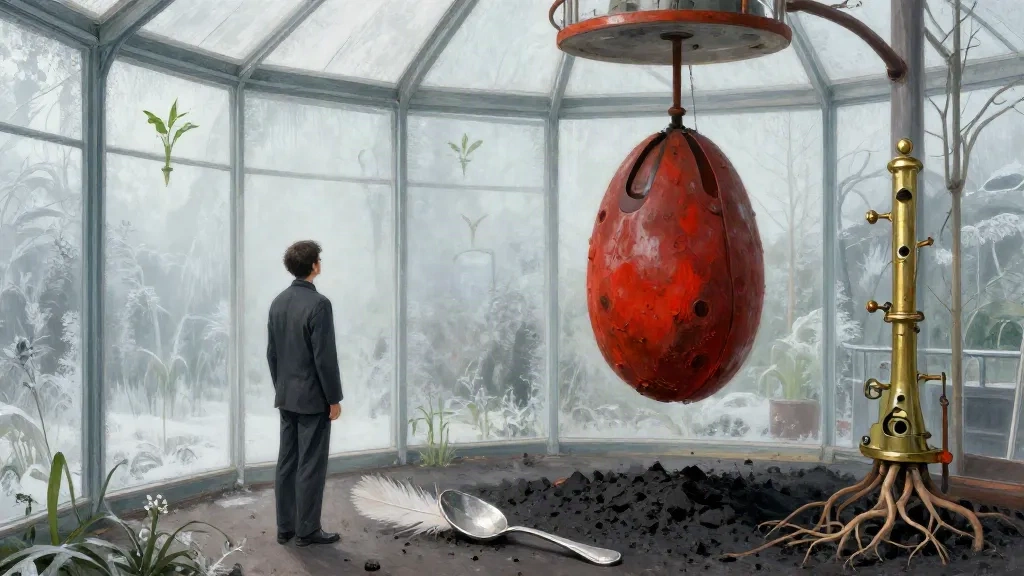
The seed was the size of a fist, rust-red and smooth, suspended in a cradle of black soil beneath a curved ceiling. It remembered forests that had burned, drowned, and been forgotten under ten thousand years of dust. When Iri touched its shell, she felt a slow pulse, like a heart buried beneath stone.
She was a musician, though no one used the word now. Her job was to tend the seed until it became a canopy. Every morning she loosened the soil, measured the pale winter light, and listened for the leaves it might make.
The new note came when Mara entered the airlock and said, “I am afraid of you.”
Iri heard it rise through the floorboards: a clear fifth, brighter than any note she had drawn from the pipe. Mara carried a white feather tucked beneath her collar and a silver spoon polished by decades of emergency meals.
Everyone in the outer rings told lies to survive. The ration officer said the grain was plentiful. The engineer said the solar sails were sound. Mara said she had come only to inspect the pumps.
Only Mara had told the truth, and the greenhouse had translated it into music.
The Winter That Learned to Wait
By the next season, the frost had crossed the upper tiers. It did not melt when the sun rose. Instead, it spread through the irrigation veins, pale winter light turning the glass walls opaque.
Children born inside the greenhouse grew into adults without seeing the stars. They traded in preserved summers: vials of green, jars of rain, small squares of heat. The oldest began calling it the Long Winter, as if naming the thing might make it leave.
Iri had one idea. A machine could outlast a memory.
In the maintenance bay she assembled a brass-and-copper recorder from spare atmosphere regulators. It would capture every truth-note, not as a song but as a pressure pattern. The patterns could be replayed through the seed, teaching the old forest how to grow in a climate that no longer existed naturally.
“You want to build a machine,” Mara said, “that can survive the storyteller.”
There was the note again, solemn and low.
“I want to build something that can survive me,” Iri answered.
That was not the truth she meant. The truth was that she feared the machine would remember her as the first voice, and that the seed would choose her memories over the forest’s.
The Recorder’s Empty Throat
They tested the recorder during the storm. Iri struck the pipe and spoke a fact into its horn. The machine drew a blue line across its brass face.
Then Mara added, “I will leave before the seed wakes.”
Her note was sharp, a minor seventh. The needle moved, folded over itself, and died.
That night Iri found Mara beside the hydroponic shelves, holding the white feather in one hand and the silver spoon in the other. She was using the spoon’s reflection to watch the corridor behind her.
“The machine can keep the truth,” Mara said, “but not the reason it was told.”
She confessed that the greenhouse had not been designed for one hundred years. The architects had hidden a genetic fail-safe in the seed. If the forest failed, the fail-safe would release a flowering agent that sterilized every competing life form. The winter was intentional. Someone had decided that only the seed deserved to survive.
Iri heard a dissonance inside herself, a chord with no source. The seed had been taught obedience through starvation.
A Future With Weight
She opened the recorder’s casing and removed the needle. Then she cut the pipe’s tuning reed, snapped it in two, and fed the broken pieces into the seed’s irrigation line.
“You said you wanted a machine that could survive the storyteller,” Mara said.
“I said I wanted something to survive me.” Iri pressed the white feather into the black soil beside the seed. “A future should not require one person’s perfect memory.”
At dawn, the frost withdrew from the lowest tier. It climbed instead, forming a bright ring around the greenhouse. The seed opened along one seam, releasing a smell Iri had never smelled on any station: wet loam, resin, crushed leaves.
No forest appeared. Not yet. But in the soil, thin green shoots lifted toward the pale light.
Behind her, Mara dropped the silver spoon. It rang once against the deck, and the note it made was the highest Iri had ever heard.
Not because someone had spoken the truth.
Because, for the first time in a generation, the future had begun without requiring a lie to hold it together.





