 Netwrck
Mythic Fiction.
The Last Patrol
Orren’s forest existed between one heartbeat and the next. The city called it the Hourwood, though no map showed its border. At dusk, the trees were brought forward from a century that had been removed from the calendar. Birds sang in an abandoned spring. Wolves drank from a river whose water remembered the sky before cities rose.
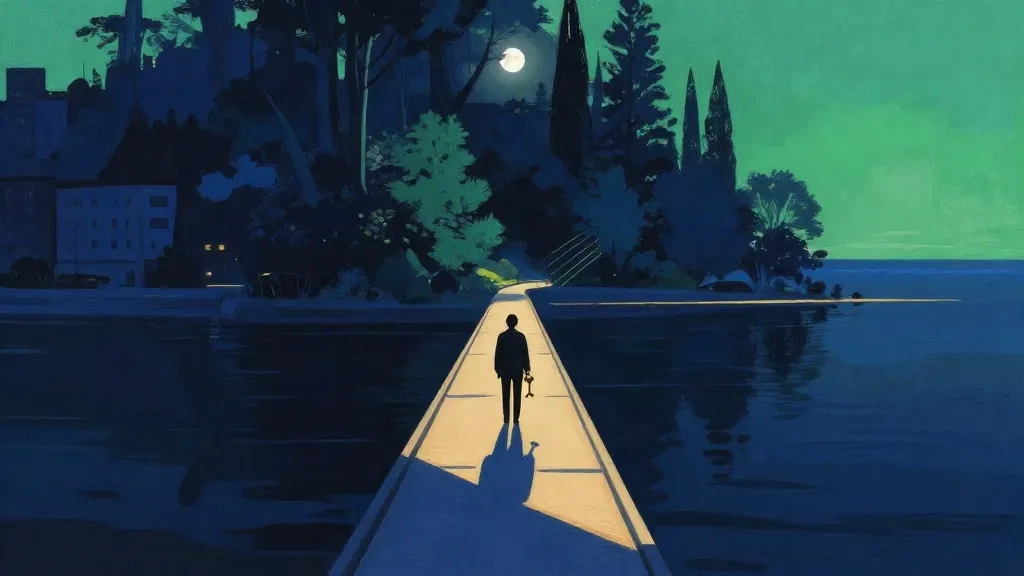
Orren had guarded the Hourwood for eleven years, walking its perimeter with a brass key hanging beneath his coat. The key had no teeth until moonlight touched it. Then it opened narrow doors in the dark, each one leading to a path his teacher, Ilyra, had measured.
She had disappeared six months earlier, leaving behind a wax map marked with seven unbuilt bridges. On its final fold she had written one instruction: When the small moon appears, finish the road.
In the city, citizens and shadows had traded places long ago. A person cast no darkness; the darkness walked upright, voted, kept shops, and loved. Those who surrendered their shadows had become pale and weightless, visible only to themselves.
Orren kept to the cobbled lanes where the shadow-citizens moved at noon. He was the last ranger whose duty still required a human face, because the Hourwood could not be kept by anyone whose shadow had learned to lie.
The Curfew of Exact Things
The curfew began with a bell struck inside the city clock. It was not the tower’s great bronze bell but a small silver chime that appeared at the hour it announced.
“All citizens must be beneath their proper roofs by the third blue shadow,” the chime said.
It announced the rule without anger. A creature came to meet Orren at the market fountain: tall, jointed, and pale as salt, with a silver ring for a mouth. Its eyes measured the spaces between his steps.
“You are outside at the wrong distance from the nearest wall,” it said.
“I have leave from the forest.”
“The forest has no civic address.”
The creature lifted one narrow hand. A blue line appeared across the street, exact as a seam in cut stone.
“Curfew is not a threat,” it continued. “It is the prevention of an unfortunate arrangement.”
Orren understood then. The shadows had been spreading. At night they slipped from beneath doors, and where they touched the Hourwood, they stole pieces of the removed century. The city would lose its history in fragments unless every citizen stood beneath the shadow that belonged to it.
At the second chime, the creature pointed toward the eastern arch. Orren saw a small moon hanging there, no larger than a coin, though the sky behind it was already full daylight.
Seven Doors
He ran beneath the closing streets.
The first door stood in the shadow of a bakery. Its brass lock shone wetly. Orren inserted the key and heard Ilyra’s voice behind the wood, tired but unmistakably hers.
“You always arrived after the difficult part,” she said.
The door opened onto the Hourwood. Orren stepped through.
He found her at the third bridge, standing beside a tree that had been struck by lightning in a year no living person remembered. She was translucent from the knees down, her body made of dark green leaves and the blue shadows of migrating birds.
“I did not disappear,” she said. “The road took me. I was meant to walk it alone, but the forest has withdrawn its years from anyone who returns.”
Orren placed the small moon in her palm. It gave off no light. Instead, the missing bridges appeared one by one, pale as bone beneath the water.
The curfew creature’s voice came from every tree: Third blue shadow.
“Then we have less time than the map admits,” Orren said.
They crossed the first bridge. At the second, the forest tried to give Orren a century of memories: Ilyra laughing, Ilyra teaching him to read wind, Ilyra asleep beneath a summer sky. He refused them. At the third, she began to fade.
“You cannot carry me,” she said.
“I can finish your journey.”
The Road Completed
The final bridge required a key and a moon.
Orren held the brass key above the dark water while Ilyra lifted the small moon. The lock formed in the surface of the river, then the keyhole, then a narrow door of sand.
Behind it stood the city as it had been before its shadows rose to take command. Citizens walked beneath their own dark bodies. The Hourwood stood beyond the houses, green and enormous, no longer hidden.
Orren understood. The journey was not to rescue a place from time. It was to restore time’s border, with both a living ranger and an unfinished witness standing on opposite sides.
Ilyra crossed. The forest closed behind her, and the city filled with the blue shadows of ordinary morning.
The exact creature found Orren before dawn.
“You violated the curfew,” it said.
“No. I completed a road.”
Its silver mouth clicked once, considering the distinction.
“That was not in the civic record,” it said.
“Then it is time to write it down.”
Orren returned the small moon to the sky. It rose above the Hourwood and remained there, small, impossible, keeping watch over the road Ilyra had left unfinished.





