 Netwrck
Surrealism.
The Hour With No Address
By dawn, everyone in the Vesper Apartments remembered what would happen next. Cooks knew which orders would be shouted. Children knew which windows would break. Old women leaned from their balconies and called warnings to streets that had not yet made their mistakes.
Mara Venn was the only ranger awake.
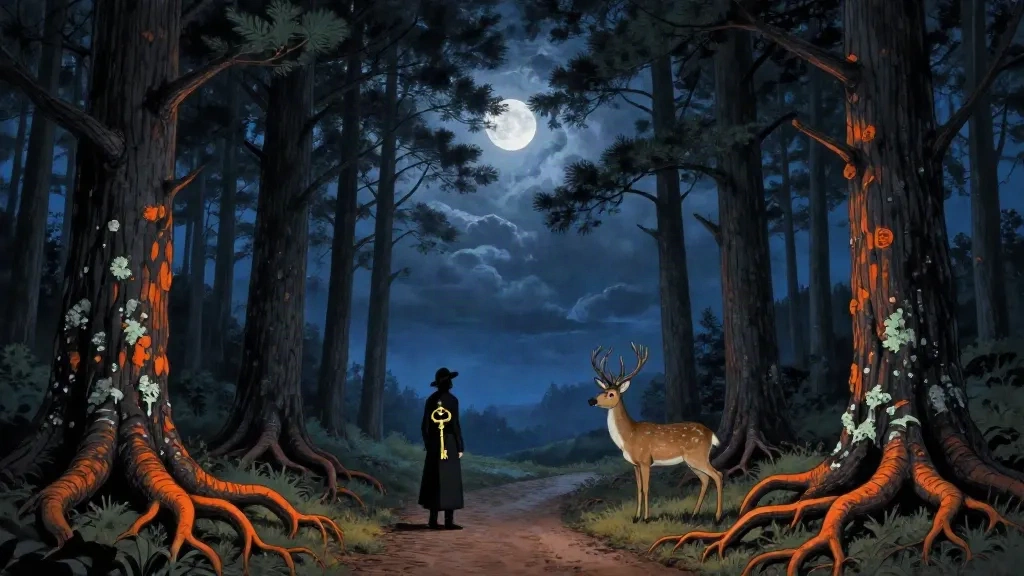
Her forest lay beyond the western stairwell, though no building had a western stairwell. Each morning, at 4:17, the wall opened onto a tract of black pines, lichen, and churned orange earth. The evacuation had taken its animals, tracks, and falling needles. Only the trees remained, standing in a morning without a history.
She had been sent to protect them from people who stepped backward out of regret.
That morning, beneath a boot marked with old red mud, she found a note from Orren Sile, the cartographer who had vanished eleven years ago.
Third root from the burnt fence. Turn the brass key toward blue.
Below it, he had drawn a small moon, though the forest had no moon in its burnt-orange sky.
Orren had begun this journey. He had mapped the apartments backward from their oldest possible futures, carrying the brass key to the forest’s center. Then his name had appeared in the municipal records, followed by a blank space where the date of his disappearance should have been.
Mara tied the paper to a branch. In the distance, the pines chimed with a noise like cutlery in an empty restaurant.
Curfew Measured in Shadows
At noon, the forest changed shift.
A creature stepped from behind the evacuation truck. It had the narrow waist of a deer, a transparent blue throat, and six clock hands folded behind its back. It carried no weapon. It regarded Mara with the mild precision of a clerk correcting an invoice.
“Curfew is 4:17,” it said. “After that, the forest begins remembering what it lost.”
“I have until then.”
“You have until the third root.”
The creature placed one hoof beside a patch of orange moss. Blue storm-light moved through the canopy without lightning.
“Orren arrived at 4:18,” it continued. “He was not late. The minute had not begun.”
Mara showed him the note.
He read it upside down, then produced a little ledger and checked the entry twice.
“This is not authorization,” he said.
“It’s an invitation.”
“Invitations are how curfews become mistakes.”
He struck the ground with one hoof. The forest lengthened: pines bent into corridors, roots curled like sleeping animals, and a path appeared beneath the moss. Along it ran a blue line, vivid as a crack in storm glass.
“Curfew remains,” the creature said. “Precision is not cruelty.”
“Neither is obedience.”
“Obedience is cheaper.”
He moved aside by precisely the width of Mara’s pack.
The Third Root
The third root had grown around a metal post.
Orren’s pack hung from it, stiff with rain that had not fallen. His coat was gone. Inside the pack Mara found eleven notebooks, all dated in the future. The last one ended three hours before he disappeared.
He had written: The center is not ahead. It is below the hour no one owns.
Mara fitted the brass key into a socket beneath the post and turned it toward blue storm-light. The key resisted, then warmed like a swallowed coal.
The forest inhaled.
Every clock in the Vesper Apartments stopped. From the apartments came the voices of people remembering tomorrow, all speaking at once, a noise like rain inside a bell.
Orren stood beyond the roots.
He was eleven years older, though the future had never agreed on a single age for him. His hands were stained with orange earth.
“You came late,” he said.
“The minute had not begun.”
“You borrowed that.”
He looked at the brass key, then at Mara.
“Finish it,” he said. “Carry the forest to the center.”
Behind him, thousands of evicted leaves lifted from soil that had already forgotten autumn.
Mara understood the journey’s cost. Orren had not abandoned it. He had walked ahead to remove the final lock, leaving the key for someone who could legally carry the trees out of curfew.
The precise creature returned at the edge of blue light.
“4:17,” it announced. “Release the forest or be detained with it.”
What the Future Owes
Mara turned the key one final time.
The blue line beneath the roots lit. It ran through the black pines, across the lichen, and into the brick wall where the apartment windows were beginning to glow. One by one, the trees became narrow, shaking lines of shadow in the halls.
Thousands of residents looked down from their balconies. Tomorrow had lost its strangest property.
The creature watched the clock hands behind its back. None moved.
“Curfew is over,” it said.
“No,” Mara answered. “It is exactly 4:17. We simply changed what the minute contains.”
It considered this. Its ledger fell open. Every page filled with a future in which the forest had never existed.
“Acceptable,” it said.
Orren walked beside Mara as the last pine disappeared. His feet made no sound. At the wall, he stopped and offered her the small brass key, now blackened with soil.
“Where will you go?” she asked.
He looked toward the windows, where people were already mourning futures they would never experience.
“Forward,” he said.
Then the lights returned, and Mara was left holding a journey completed by both their hands.





