 Netwrck
Mystery.
The unmeasured hour
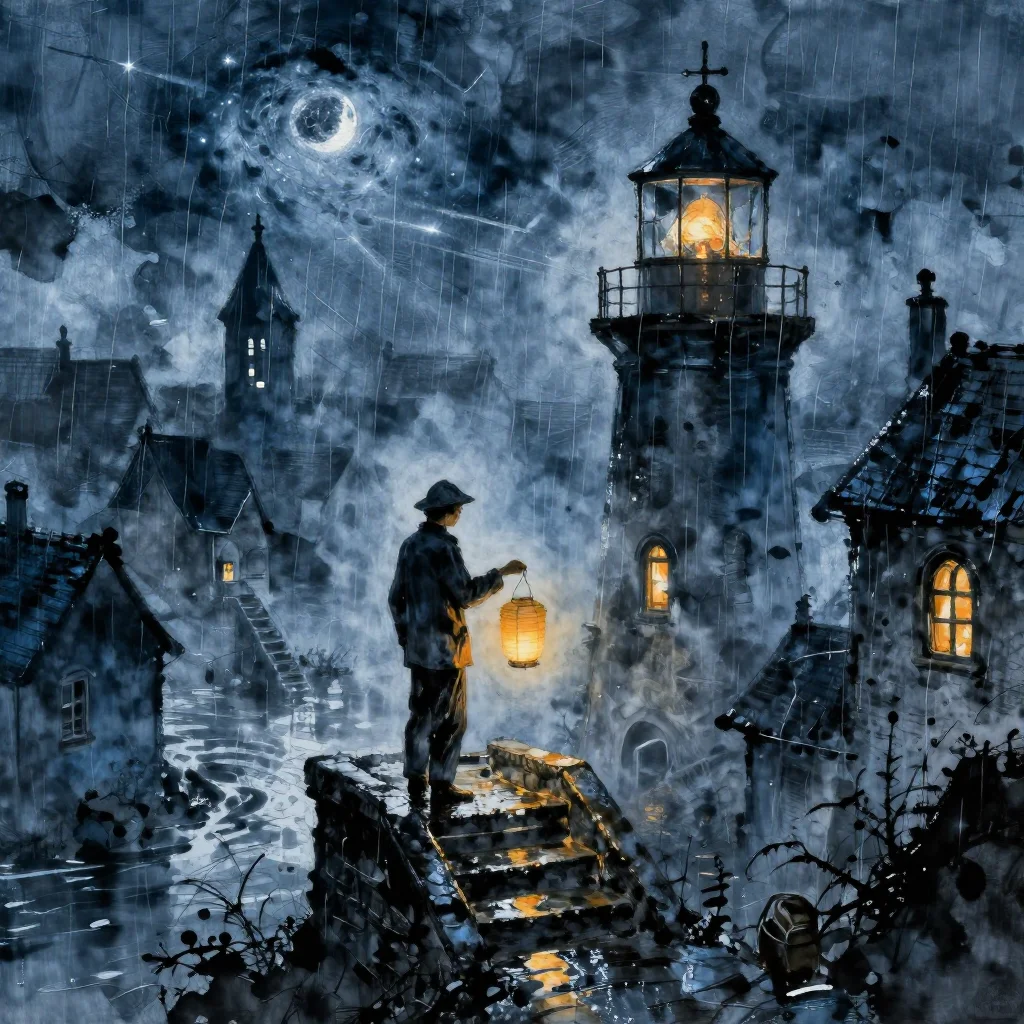
Mara Venn kept the western lighthouse above Bellwether, though the sea had withdrawn three leagues and the tower pointed inland toward a row of chimneys. Her duty was to catalogue weather from other worlds. Each morning she climbed the narrow stair to the copper desk, unwound the clock-glass, and entered whatever the glass had gathered overnight.
Rain from a world of red moons. Silver heat falling upward. Thunder moving beneath the soil in long, deliberate steps. The monastery called these phenomena remotes. The municipal code forbade them, along with unlicensed gravity, borrowed shadows, and the keeping of animals that had not been born.
That morning, the glass showed only darkness. Mara drew a small moon on the margin, its cratered face tipped toward the reader. Then she opened the shutters. Across the valley, Bellwether shone in rain-silver light, its roofs shining, its walls dark, and one window glowing amber.
In that window, a man waved.
Mara knew him. He was the lighthouse keeper before her, missing for eleven years. His name had thinned on the retirement rolls, but Mara still remembered Elias Orr’s hands, scarred by the clockmaker’s furnace.
The rule of impossible things
She descended to the monastery records. Brother Fen, the archivist, listened without moving his thumbs from the brass regulator.
“The code is clear,” he said. “Any phenomenon not admitted to the municipal register is technically unlawful. The keeper who records it becomes responsible for removing it.”
“The remote is already inside Bellwether.”
“Then the remote is trespassing.”
Fen pointed to a notice pasted beneath the window. Its seal was fresh, stamped by the office of civic continuity. ORDER: All unrepeatable occurrences are to be surrendered before dusk.
Mara took the paper lantern from the archive rack. It was small enough to cover with one hand, its paper sides yellowed around the wire ribs. Elias had carried it on his last night watch.
Inside the lantern, instead of a flame, floated a bead of rain-silver water.
They crossed the causeway into Bellwether. At every corner, the municipal officers nailed another notice. People stood motionless beneath them, waiting for a bell that had no hour. A child recited the law: no blue fire, no singing stones, no sky that opened more than once.
“They’re not angry,” Mara said.
“No,” Fen replied. “That is the difficulty. An impossible thing cannot object to its own removal.”
The house that forgot its shape
The amber window belonged to a narrow house at the end of Lantern Street. Mara had passed it every day for eleven years. Now its door fitted the wall too closely. The knocker had become a smooth patch of paint.
She set the paper lantern on the step. The rain-silver bead trembled inside it.
“Elias,” she called.
A voice answered from inside. “Mara?”
The house made a sound like a page being torn. One wall receded. A narrow hallway appeared, and Elias stood at its end, young as she remembered him, holding a weather chart she had drawn for him years before.
He looked at her as if trying to learn her name.
“They are taking the city apart,” he said. “Not the buildings. The memories that prove the buildings were connected.”
Mara opened her catalogue. The entry for Bellwether had been altered overnight. Beneath the ink-blue sky she had recorded on her first watch, someone had written: there was no town here.
Elias’s disappearance had not been an accident. He had found a remote that arrived without a cause: a weather from a world where the city’s name was the only fixed thing. The municipal rule had classified that weather as impossible. Erasure was its remedy.
She held the paper lantern high. The bead rose, struck the glass, and opened into a clear circle of storm. Inside the circle lay the vanished street, Elias’s first watch, and the lighthouse door before the sea changed its mind.
The hour that remains
At dusk, the officers came with ledgers. They ordered Mara to classify the storm. She wrote instead the first entry she had ever entered in Bellwether:
Weather origin: here.
The rule recoiled. Ink ran from every posted notice. Bellwether returned in fragments: a bakery bell, a cracked blue step, the names scratched under the monastery clock. Elias crossed the threshold. The house regained its door.
The paper lantern went dark. Mara kept it anyway.
At sunrise, the municipal code had lost its newest amendment. The old laws remained, severe and ordinary. But beneath them, Fen added a line in his careful hand: No occurrence shall be removed until another witness has named it.
Elias resumed his place beside the copper desk. Mara entered his weather: rain arriving from nowhere, followed by a warm amber light that did not belong to any sky.
Then she drew the small moon again, and this time she gave it a name.





