 Netwrck
Folk Horror.
The Rumour of Earth
Mara had left orbit once, when leaving meant returning.
She had been an astronaut then: helmet sealed, launch checklist exact, Earth reduced to a blue instrument below her. The planet rose over the horizon every ninety-three minutes. Through those years she had heard a voice in the ship’s static, a low human murmur buried beneath machinery noise. It called a name she did not recognise. Before launch, the ground team said the signal was interference. History, they called it. Background noise.
Now the orbit was crowded with dead stations and the voice was still there. Mara refused the return capsule. She cut her tether, watched the ship go dark, and kept drifting.
Then the archive answered.
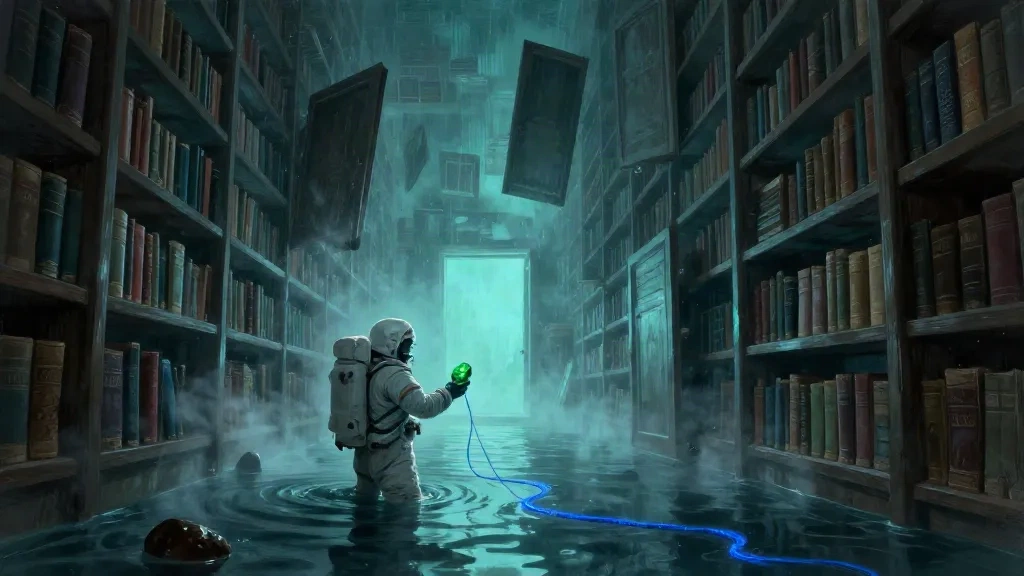
It arrived beneath her as a green stone spinning in the black, wet at the edges though space had no weather. The stone opened into a corridor of shelves. Water stretched from the first shelf to the last, clear and cold as glass. A librarian rowed between the stacks in a narrow boat, wearing a coat made of old catalogue cards.
Librarians of the Drowned Stacks
“You are late,” the librarian said.
Mara climbed down. The water closed over her boots.
“I heard a voice.”
“Everyone does.”
“You don’t understand. It was buried in the signal. Background noise.”
The librarian stopped rowing. Along the shelves, blue thread hung from shelf-number plates, trembling although the air was still. Mara had found the stone in the return capsule’s emergency drawer, tangled with one bright strand.
“What is this place?”
“Where discarded things are kept.”
“Earth?”
The librarian looked at her. “Earth is a rumour. A story people repeat to explain the noise.”
She said it without cruelty. Mara felt the words strike her ribs.
She had been born beneath that blue. She remembered rain on a train window, her mother’s hands, the smell of hot metal after lightning. None of it had been recorded in the ship’s logs. Perhaps that was why it had become a story.
The voice, however, had carried a name: Elian Vey. Mara had searched the public archives and found only an empty personnel file, its photograph scraped away.
“He is here?”
“If you know which door he went through.”
The Storm Inside the Walls
The storm came without thunder.
It entered through the windows as white mist. Books lifted from their shelves and flew sideways through the water. The librarian pulled the boat around a pillar, but the doors began to move.
A brass door stood ahead. Then it was behind them. A black door opened onto a library that had not existed, its shelves bending toward a green horizon. Every time Mara looked away, the door handles changed hands.
“The storm rearranges doors while people are inside them,” the librarian said.
“How do we stop it?”
“You don’t. You choose what you follow.”
Mara held up the green stone. It pulsed once. From the nearest shelf, a blue thread pulled taut.
“I found this beside the voice.”
The librarian frowned. “Then the voice has been trying to be found.”
Mara followed the thread through the water. It led beneath a shelf marked ORBITAL RECORDS and into a narrow aisle between two enormous doors. One was labelled BEFORE. The other AFTER.
The voice came again, clear for the first time.
“Mara, do not let them call this background.”
She understood then. The archive had not hidden the voice. It had crowded it beneath centuries of departures, alarms, explosions, static. Every record treated the speaker as interference because the record had been built that way.
The Name Not Filed Away
She seized the thread and pulled.
The storm tore the aisle apart. Water rose around her knees. The librarian shouted from somewhere beyond the shelves. A door opened beneath her feet, and Mara fell through.
She landed in a small room above the waterline.
There was no archive there. Only a broken radio, a green stone on the floor, and a blue thread running from its dial to the window. Beyond the glass, a city burned beneath a pale cyan dawn. The sun rose in the wrong direction. The streets were full of people walking backwards.
Elian Vey sat before the radio, older than any photograph Mara had imagined. He held one finger to the microphone and waited.
“Earth is gone,” he said.
Mara’s knees weakened.
“No,” she said. “They are saying it so they don’t have to listen.”
He nodded. The radio hissed between them.
Outside, the impossible dawn brightened. Frost silvered the glass. Iron rigging groaned beneath the floor.
“Then speak,” he said.
Mara sat beside him and picked up the microphone. She remembered Earth not as a map or a rumour, but as the noise beneath every silence: her mother calling from a kitchen, rain on a roof, a train arriving late.
She spoke until the room filled with light. The voice rose through the archive, through the drowned shelves and the doors that had learned to lie, until every discarded thing in the flood remembered where it belonged.
In orbit, the static changed.
For one signal, every channel carried the same low human murmur. It was not background. It was an answer.
When it ended, the archive became quiet. Mara looked at the green stone in her hand. The blue thread had knotted itself into a small blue star.
She did not return to Earth. She went back into the water.
Behind her, the librarian rowed on. Ahead, the doors waited to be named.





