 Netwrck
Speculative Fiction.
The Future That Failed
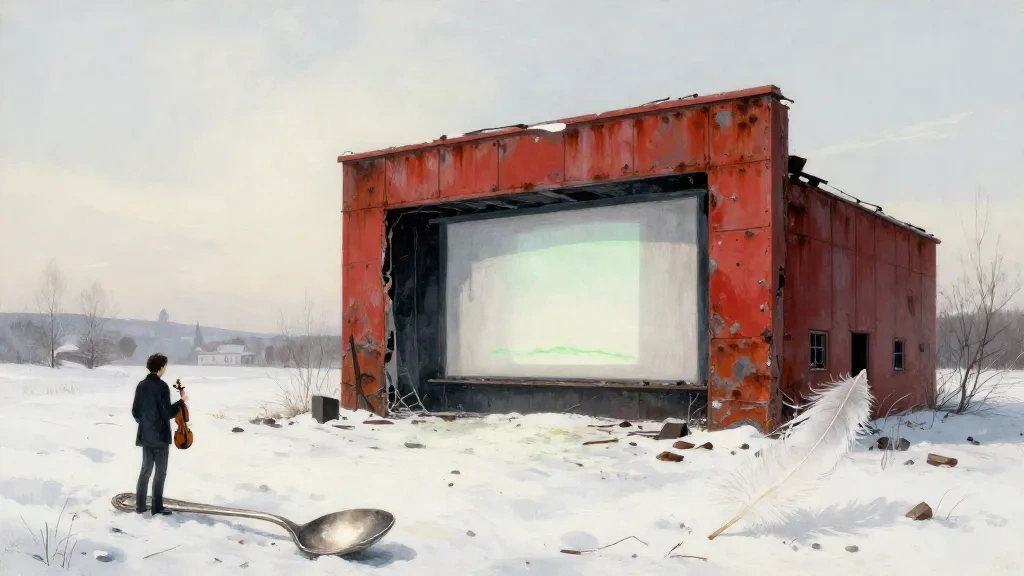
The abandoned cinema had no marquee, only three rusted letters: OR. Mara found it beyond the tram tracks, where pale winter light lay across the broken forecourt like a sheet waiting to be folded. Inside, the air smelled of dust, grease, and snowmelt. The projection booth still smelled of hot film, though the projector had not run for years.
She opened the auditorium door and heard a low mechanical breath. On the screen, a city burned cleanly beneath a blue-white sky. People crossed a square carrying paper boats. A child waved to no one.
“That was Tuesday,” the usher said from the last row.
Mara stopped. The usher was a thin woman in a charcoal coat, holding a white feather between her fingers. On the armrest beside her lay a tarnished silver spoon.
“You heard a note,” the woman said.
Mara’s hand lifted toward her throat. She had carried her violin for years, but she had not played since her mother died. Music had become a room with no doors. A true sentence opened it: a clear, difficult sound between the ribs.
“Everyone hears their own kind,” Mara said.
“Yes.” The woman smiled without moving it. “You need a place to put them.”
One Generation of Snow
The cinema showed futures that had almost happened. Every reel began with an ordinary event. A ferry missed its departure. A boy returned home. A woman opened a letter. Then the ordinary choice became a fault line, branching into weather, war, a city emptied by noon.
Mara stayed because she wanted to build something that could survive the storyteller.
She had been composing an elegy for her mother, but each performance made the grief smaller. Once it was finished, it would belong only to her. She imagined a hall where strangers could bring the truths they had never spoken and leave them in the walls. Not a memorial. A structure. Something that would continue making its own sound after the musician was gone.
She began testing the cinema. She set six empty brass tubes beneath the screen and asked visitors to speak plainly. The first confession produced a low C, blunt and quiet. The second produced a glassy E. Truth was not a single pitch. It changed with the mouth that released it.
Outside, winter gathered another layer.
By autumn, the ground had frozen beyond sight. By the first anniversary of her arrival, the trees wore ice instead of leaves. Snow began before noon and fell after dusk, year after year, until children born inside it reached adulthood and learned to cross the frozen river without wondering why it had stopped moving.
The future films grew stranger. Their skies held no seasons. Their people kept warm by remembering the sun. In one, Mara saw herself dying alone in the projection booth. In another, she heard a note so high it split the screen.
At the center of the collection, a blank frame waited beneath the words THE STORY YOU HAVE NOT LIVED.
The Spoon and the Feather
The usher’s name was Ilyra. She had been the cinema’s keeper for forty years. She said the first winter had begun on the night the last child was born, though no calendar recorded the hour.
“Why does it refuse to end?” Mara asked.
“Because someone keeps retelling it.”
Ilyra placed the white feather on the silver spoon. The spoon reflected both: feather and flame, though no flame burned in the empty hall.
“The cinema preserves possibilities,” Ilyra said. “That is its cruelty and its promise. It cannot show what never occurred. So it shows what nearly did, over and over, until the people inside begin believing they have escaped.”
Mara watched the blank frame. “And the winter?”
“A future everyone tells themselves will end.”
She touched the feather. A sharp blue note rose inside her, high enough to make her teeth ache. It was the first honest sound she had heard from Ilyra.
“I have lied,” the woman said. “I did not keep the cinema. It kept me.”
Mara understood then that the building was not presenting an archive. It was building an audience. Each spectator supplied a little belief, and belief made the images heavier. The winter had continued because a generation had repeated the same promise: that there would be another spring.
She took the feather and spoon to the booth. The machine waited beneath dust. She loaded no film. She connected her violin’s strings to the brass tubes and drew one bow across the strings.
The sound entered the blank frame.
What Could Be Carried
The cinema shook. Onscreen, snow began to fall over a city that had never existed. Mara’s mother walked beneath it, younger, carrying a red umbrella. Mara wanted to reach through the image and call her back. Instead, she played the note of every truth she had failed to say: I was afraid. I was angry. I wanted to leave. I wanted you to stay.
The winter cracked from the sky.
It did not melt. It broke, revealing a narrow green line beneath the horizon.
In the morning, Mara stood outside while sleet struck the rusted letters. A child from the frozen neighborhood pointed toward the tracks. Beyond them, the river carried a silver spoon and a white feather in opposite directions.
She entered the cinema with her violin. Behind her, the screen began to flicker. The next future was already forming.
This time, it had no winter.
Mara stepped inside. The door closed, but the building remembered her.





