 Netwrck
Fantasy.
The Lake at Low Tide
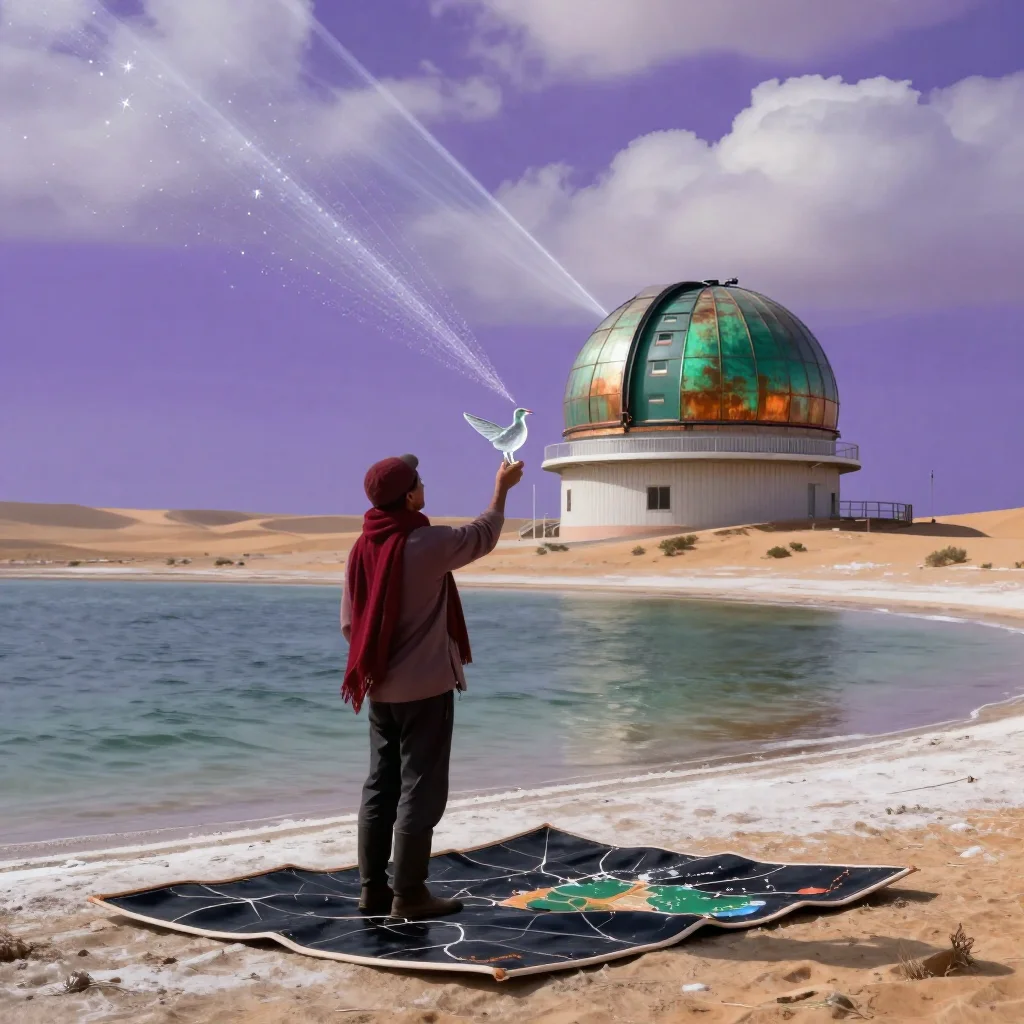
At low tide, the lake appeared beneath the observatory, shining with the last violet of evening. It lay in a basin of oxidized copper, its shore marked by pale stones and the ribs of ancient boats. Above it, the observatory tracked stars that sent messages in silver pulses: arrival, departure, memory, warning.
Its only ferryman was Ilyan Vey, who carried the red scarf knotted at his throat and a glass bird beneath his coat. The bird had no feathers except a seam of cloud-white light along its wing. It had belonged to the vanished world, though Ilyan never knew whose hands had made it.
He wanted one thing: to find the person who remembered the original version of the world. Not the histories in the observatory, which had been corrected whenever the sky disagreed. He wanted a living memory, someone who could say how the mountains had stood before they moved and why the sea had once been called the First Road.
The Map That Refused Truth
The map appeared in the ferry kiosk whenever the lake returned. It was painted on a strip of black hide, its roads white as salt. Ilyan knew the shape of every crossing. He knew where the wind turned and where the bottom dragged at the hull. He did not trust the map.
It changed whenever someone tried to use it honestly.
Once, Ilyan marked the shortest route to the eastern reed beds. The line curled beneath itself and became a road leading nowhere. When he erased the mark, a new route appeared toward the observatory’s western door, where no door had been built.
He tried folding the map along its true bearings. It changed into a portrait of a woman with her face turned away.
He tried tracing the route with a dishonest intention, planning to leave after only half the journey. The map opened a clean passage across the lake. At its far shore stood a woman holding a lantern.
Ilyan rowed toward her, but the lantern revealed no face. It cast a ring of white light around a body made of wind.
You cannot arrive by wanting.
The voice came from beneath the hull. The map burned cold in his hands.
The Observatory’s Last Message
That night, the observatory received a message without a sender. Its star-light gathered into letters over the copper dome:
THE FIRST SHORE WAS NOT A PLACE. IT WAS A PROMISE.
Ilyan climbed the observatory steps with the glass bird warm against his ribs. Inside, the astronomers had abandoned their instruments. Their chairs faced the walls, and every lens had been turned toward a narrow window where the desert sky showed no stars.
He found the keeper there: an old woman wrapped in a red scarf.
She reached for his scarf. Their knots were identical.
“You remember,” Ilyan said.
“I remember a lake beneath this desert,” she whispered. “I remember birds made of daylight. I remember you, before the crossing made you a ferryman.”
The glass bird burst from his coat. It flew toward the window, and a second bird emerged from the darkness: solid, feathered, alive. The two touched beaks and shattered into a storm of glass.
The Shore Beneath the Shore
The keeper told him the original world had not vanished. It had been overwritten by a promise made to someone who never came. The lake was the wound beneath the wound, and every honest map tried to close it.
At dawn, the water withdrew.
Ilyan untied his red scarf and placed it on the dry lakebed. The keeper held the other end. Between them, the scarf became a red line across the copper basin.
He walked over it. The ground held.
Behind him, the lake began to rise without wind, its surface cloud-white beneath the violet sky. Above, the observatory’s stars answered in a language he could finally read: not a message from elsewhere, but a message from home.
The keeper stepped onto the shore beside him. The red scarf remained between their hands, bright as a wound finally allowed to close.
Then the ferryman laughed. Not because the world was restored, but because at last he had found a passenger who remembered the journey.





