 Netwrck
Science Fiction.
The Lake Between Mornings
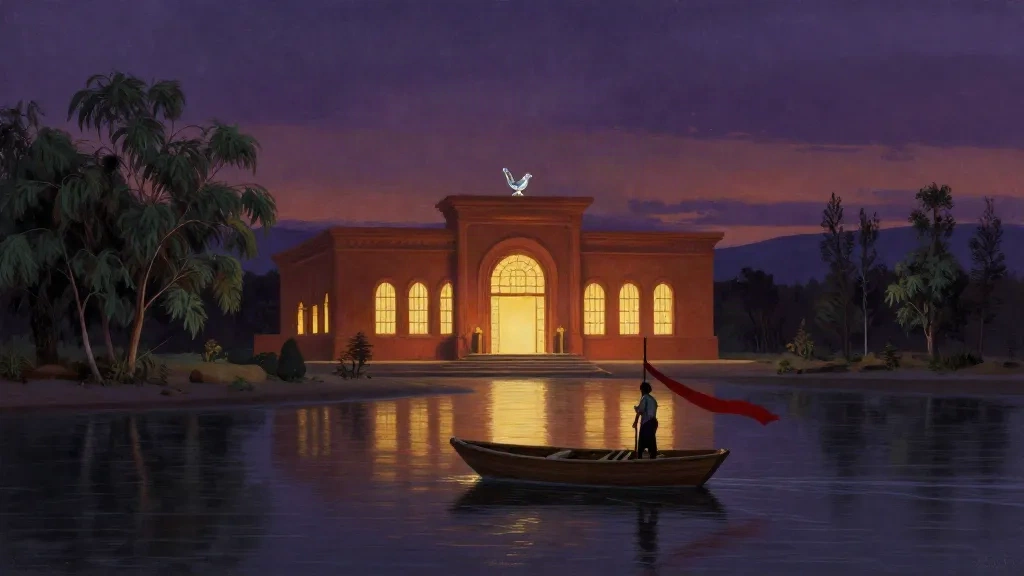
At low tide, the lake came up beneath the eastern cliffs, black water widening through the eucalyptus grove. People said it was a trick of the moon, but I had crossed it since my father’s death and knew its rules. It appeared only when the world had nearly decided itself, when tomorrow’s roads had been built and then abandoned before anyone walked them. By dawn the lake would vanish, leaving wet stones and a rusted gate.
I was the ferryman. My boat had no motor and no sail, only a lantern in the bow and a red scarf tied around the mast. The scarf had belonged to my sister, who vanished when I was twelve. Every voyage, I asked the passengers what they had lost. Most said a job, a lover, a country. None understood that the lake carried no memories. It carried endings, and endings were heavier than grief because grief at least had a body.
The Theatre Below the Waterline
On the far shore stood a theatre with terracotta walls and windows full of yellow light. Its sign had no letters. Above the door hung a glass bird, translucent and intact though the morning had no sun. I had seen that bird in three endings: crushed beneath a balcony, filled with seawater, and singing on a balcony above a city that had vanished. This time it watched me with one black eye.
Inside, actors repeated the lives the lake had discarded. A woman married a man who was never born. A boy opened the wrong door and found his mother waiting on the other side. A general surrendered to an enemy who had not yet been invented. Between scenes, ushers collected applause from empty seats. At the back of the auditorium sat a woman in a red scarf, her face hidden by the brim of her hat.
The Map That Would Not Tell the Truth
I asked her for the person who remembered the original version of the world. She pointed beneath the stage. There I found a map drawn on vellum, its shore lines shifting whenever I tried to follow them honestly.
When I traced the route to the west, the theatre moved east. When I marked the theatre, the map erased it. When I folded the vellum, it opened inside my coat, showing a path across a lake that was not there. I understood then that the map was not concealing the destination. It was protecting the only truthful route from anyone willing to use it plainly.
So I began to lie with it. I traced a path to a dead star, a drowned city, the first room of my childhood. Each false route opened a true one. The woman in the red scarf followed me through the wings, beneath a floor that breathed like a sleeping animal. She never removed her hat. Her scarf’s loose end brushed the glass bird whenever we passed.
The Audience of One
At last the map led to a small stage behind the theatre, where a single child sat watching an empty auditorium. The child had my sister’s hands, though the face belonged to no one I knew. On the floor lay the first map, its ink still wet. It showed the lake, the theatre, the town, and a sun rising over all of them.
“You remember?” I asked.
The child nodded. “I remember the first version. It had no theatre.”
“Then tell me where it ended.”
“It didn’t.” The child looked at the red scarf around my neck, then at the glass bird above us. “It kept going.”
The map in my hand changed. For the first time, its lines did not move. Outside, the lake began to recede, dragging the theatre toward the coming day. I could stay and hear the final act, or cross once more before the water vanished.
I stepped into the boat. The woman in the red scarf followed, her hand closing around the scarf’s other end. Behind us, the child lifted the first map and held it to the yellow light.
At the near shore, the lake disappeared. The gate remained, no longer rusted. Beyond it, the town was waking, and somewhere in the eucalyptus grove a glass bird sang.





