 Netwrck
Science Fiction.
The Lake Beneath the River
At midnight the river turned backward.
By dawn it had left the old bridge stranded on its eastern bank and spread itself across the town, smelling of iron, eucalyptus, and winter mud. People gathered at the quay with buckets and boats, shouting across the new water for houses that had not moved.
Ansel Kade had rowed the border for thirty years. He knew every eddy, every submerged stone, every place where the current cheated a passenger and left their luggage on the wrong shore. He had buried two men in the crossing and one in the ferry house, and he could still say the name of the third without stopping, which he counted as the only skill a ferryman needed that could not be taught.
He did not know the lake that appeared when the reversed river sank below the weir.
It arrived at low tide, a flat sheet of blue-black water beyond the salt grass. The town clock struck twelve, and the river ran uphill toward the hills. Then the lake opened, without sound, the way a mouth opens around a word it has already decided to swallow.
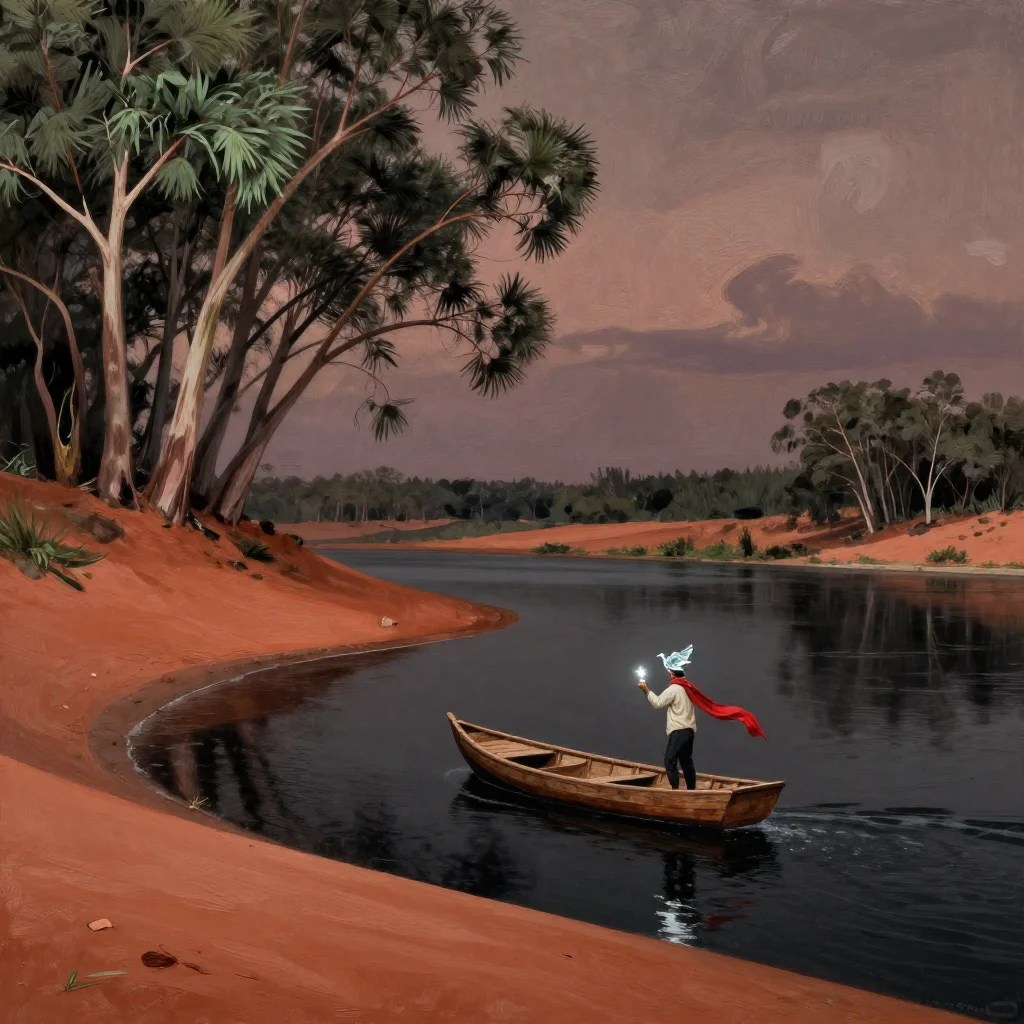
Ansel carried his skiff down the empty bank. A glass bird hung from the bow, its wings clouded by age. Around his neck, beneath his coat, he kept a red scarf folded into a square. He had carried it thirty-one years and never worn it. His mother had tied it around the glass bird before placing both in his boat, and had told him, in the way of the recently bereaved, that she would explain the rest at the far side, and the far side had never come.
He was looking for one person: Elian Voss, the old woman who had once claimed the world began at the eastern stone. Everyone else remembered a different beginning. Ansel had heard the stories in taverns, from children, from men who had crossed the river with names burned from their tongues. He had never asked the ferry's passengers a question he could not afford to hear answered.
The Map That Refused Him
At the lake's edge a brass kiosk stood where no kiosk had been. Its glass was fogged from the inside. Its map showed the border as a clean black line, four inches wide, running north to south with the confidence of ink that has never met a doubt.
Ansel unfolded the red scarf and laid it over the glass bird. The bird's beak turned north. On the map a new line appeared through the lake, pale as a seam in fabric.
He followed it.
At ten paces the map changed. The line bent around a grove that was not there. At twenty paces the lake filled with white islands, each one the size of a hearth. At thirty, every route ended at the same word: LISTEN.
Ansel tried drawing the river with charcoal. The paper drank the mark and gave back a plan of streets he had never seen, laid out in the grid of a city that had been levelled before he was born. He tried remembering the crossings he had made, each one in order, the way his father had taught him to splice line. The map erased the first seven and left the rest unwritten, as if the ledger had been balanced and his name called out.
He was not a superstitious man. He was a frightened one holding a superstition, which is a different animal and worse company.
Then the map offered a path across the lake.
He launched the skiff. The oars moved through water without resistance, the way an oar moves through a promise. The glass bird warmed in his hand. Somewhere beneath the hull a bell rang once, and the sound arrived after the ringing, as if it had been struck in a room he was remembering.
The reversed river appeared ahead, flowing back toward town with the purposeful grace of water that knows where it has been. Across it stood a woman in a white coat, holding an umbrella against a sky the colour of bruised fruit. She raised one hand.
Ansel could have rowed to her. The map showed no obstruction.
He turned toward her.
The lake rejected him. The skiff's ribs cracked against a hidden reef and the water took his coat, his boots, the parcel of bread and salt he had packed for the crossing. The map reappeared beneath his feet, laid flat on the water like a sheet dropped from a height, now showing a black border running through the middle of the lake and dividing the woman from the shore she stood on.
He had wanted her. He understood, kneeling in water to the knee, that wanting was the flaw and not the error. He had wanted the answer more than he had wanted the arriving, and the lake, which was not a lake, had simply declined to pretend otherwise.
What the River Kept
The woman crossed the current in three strides, which should have been impossible and which Ansel did not remark on, because in his trade you did not remark on the impossible in front of passengers.
She took his skiff by the bow and brought it in against a bank that had not been there a moment before.
“You used the map honestly,” she said.
“I followed it.”
“That is not the same.” She looked at the scarf he had wrenched from the glass bird and now held dripping in his fist. “That was hers.”
His mother had worn it on the morning the river first changed direction, which was not the morning he was born, and he had been six, and he had been told his whole life that this was a confusion, a child's error in the telling. She had tied the scarf around the glass bird before placing both in his boat. Then she had gone up toward the eastern stone and not come back down, and the town had agreed by evening that she had never gone up at all.
“Elian Voss?” he asked.
“I was there when the world was new.” She said it without vanity, the way a surveyor states a distance. “I am the last person who was not corrected. Everyone else has been handed the version that fits inside the border. You were handed a small piece of the wrong one and kept it, because you were six, and six is the only age at which the mind will hold a thing it does not understand.
On Bread and Salt
“The bread and salt was for the crossing,” he said, because his mother had told him that, and because saying it was a way of testing whether she was a hallucination the lake had provided out of politeness.
“The bread and salt was for the far side,” Elian said. “You have been carrying it for thirty years and have not once been hungry at the far side. Ask yourself why that is, before you decide you are owed an answer.”
He had been hungry. He had been hungry every day of the last three decades and eaten the bread anyway, at his own table, alone, in a house where no one could see it and the accounting was therefore perfect.
She pointed toward the eastern stone. A thread of eucalyptus trees marked the far shore, though the map insisted they were three miles away and the map had, until recently, been the most reliable thing in his life.
“The river changes because everyone agrees it does,” Elian said. “It turns when people wake believing a different border. Not when the border moves. The belief moves first. The border is only the shape the belief has agreed to wear.”
“And the lake?”
“The lake is what remains after the agreement breaks. Sediment. What the town could not agree to be, put where it will not be looked at.” She said this without contempt, and he respected her for it, and was grateful, and understood then that this was the shape his feeling would take: not grief, but debt.
The Original Shore
They rowed west, against the current. Ansel no longer carried the map. It had gone blank and then had gone, and in the leaving he understood that the kiosk was not a place that showed borders but a place that needed one maintained, and that it had been feeding on him, politely, for thirty years, the way a leech feeds on a sleeping man.
The lake closed behind them, swallowing the kiosk, the salt grass, and the black line.
The glass bird pointed steadily toward a low terracotta shore.
At the final crossing Elian stepped onto land that should have been impossible: a hillock of dry clay with no path, no fence, no evidence of ever having been reached. A single eucalyptus stood there, its bark peeling in pale ribbons that came away in the wind and did not break. Beneath it rested a stone, the size of a bread loaf, marked with a handprint.
Ansel recognised the fingers. He recognised them the way a man recognises his own handwriting in a hand he has never seen, and the scar across the third knuckle, and the way the little finger had been broken and set crooked by a fall from a mooring post when he was eight.
“I came here before,” he said.
“Yes.”
“No one believes me.”
“Belief is a border drawn after the fact. You were not believed because the town needed the version in which the eastern stone is a landmark and not a witness. A witness has to be believed. A landmark only has to be measured.”
He pressed his palm against the stone. Warmth passed through him, carrying the smell of wet earth and eucalyptus smoke, and for one clear instant he saw the town without walls, the river flowing both ways at once and neither of them tired, and a woman at the eastern stone counting the stars as if they were seeds she meant to plant and not to catalogue. Behind her, a boy of six stood in a boat with a glass bird on the bow, waiting to be told what the crossing was for, and she turned and said: not yet. He could hear the shape of the sentence without its sound. Not yet meant: I am about to lie to you gently, and I need the days to do it, and you will believe the lie because it costs me more than the truth would have cost you.
Then midnight came.
He felt it before he saw it, the way a man feels his own name spoken at a distance. The cold turned in the water. The eucalyptus ribbons stopped.
The river turned. The lake appeared, flat and black and utterly without negotiation, and the sky over the far bank went the colour of a bruised fruit and had probably been that colour for hours.
On the far bank, Elian's white coat vanished into the crowd. He saw her shoulder. He saw her raise one hand, the same hand, the same gesture from the reversed river: not a wave, not a farewell, an instruction to wait where you are.
Then the crowd closed over her and he could not find her again, and the crowd was not cruel, which was the cruelty: three thousand people, none of whom saw anything unusual, walking home from a market that had not been there in the morning.
The Anchor, the Verse, the Line
He did not chase the map. He did not chase the white coat. He remained beside the handprint until the light came up grey and ordinary, and then he did the work that had taken him his whole life and that no one had ever seen him do.
He rowed home. The reversed river carried him east, which was the wrong way, and he let it, because the river was no longer his to argue with and a ferryman who argues with his water is a man who has already chosen a shore. When the current slackened near the weir he took the skiff into the reeds and stitched the crack in the ribs with wire he took from his own coat, and the stitching was ugly and it held, and it held because he had done it well rather than because the lake permitted it.
The Wager
He put the bread and salt on the sill. He put the red scarf, dry again, folded into its square, beside it. He kept the glass bird. He did not decide this; the bird decided, in the way that objects decide, by being the only thing that had never lied to him.
“I will not hold the border,” he said to the empty crossing, and the water repeated it in a voice like a hull turning over, “but I will hold the line. If the border moves I will set the stakes where the water is honest and I will sound the bell and I will tell them which way the current really runs, even when it is uphill, even when it is inconvenient, even when it makes me the man nobody hires.”
“Do you understand,” Elian had said, one long time before, on the far side of a river that no longer existed in that order, “what that will cost. You will be the man who tells the truth about the water, and everyone who needs a lie to keep their house will be your enemy. You will not be believed. You will be believed against, which is worse, and which is what your mother found out, and which is why she dressed a bird in red and gave it to a six-year-old: not a gift. Instructions. She could not keep the truth in her own hands, so she put it in an object, and the object put it in yours, and the river came and took her before the instructions were finished. That is what the bread and salt is for. You are not to arrive. You are to be the last one still carrying, which is a different job, and worse, and does not end.”
He had not understood that then.
He understood it in the reed shadow with the wire in his teeth and the stitch going in crooked.
The Keeper of Stakes
By the third day the lake had spread to the base of the town wall and the councils had begun to meet. Ansel attended. He took no oath and gave no name until the question was asked, and when it was he said it once, plainly, and let the room decide what to do with the fact that the ferryman had arrived on a Tuesday from the far side carrying a piece of a shore that was supposed to be a legend, and a bird made of glass, and a red scarf folded like a square of sealed ground.
He set the stakes along the causeway. Iron, driven deep, one at every hundred paces, and at each he sounded the bell, and he did not tell them what the bell meant because the bell meant the same thing and had always: the current has changed. Come and see for yourself.
They came. That is the part the histories will not have. They came and they stood on the causeway in the rain and they looked at the water running the wrong way, unhurried, unwitnessed by any clerk, and they made up their own minds, one at a time, at their own speed, and the border moved not because a council voted but because nine hundred separate recognitions of a thing cannot be argued with, and the lake, which had been holding the town's sediment for a year, opened and let it go and went back down the weir into the dark country of the reversed river, and the river came back around at midnight and lay down in its bed, and the salt grass came back, and the kiosks went, all of them, and the border came back with them, in a slightly different place than before, drawn by the town itself, honestly, the way a man draws a line he has agreed to.
Ansel buried the two men in the crossing and the one in the ferry house and the one who had drowned on the rock he had warned them about and the one who had drowned on the rock he had not, and the town built him a shed by the causeway and a bench, and his name, which he had kept a single time, for the register, went on the bell.
The Queen
He was seventy-one years old. He had a cough in the wet months and hands that no longer made a flat knot without three attempts, and he remembered every crossing he had ever made, in order, without the map's help, which had always been the point and had finally become a use.
A little girl came out to see the bird on the causeway, where it hung from a post, keeping no one's crossing in particular, keeping nobody's.
“My gran says you went to the beginning,” she said. “The paper said you did.”
“I did,” he said, and it cost him exactly as much as he had promised it would, and not one unit less.
“Do you remember it?”
He did. That was the whole of the trick, the whole of the miracle, the only one he had been given: he remembered all of it, and he had told no one, and he went on telling no one, and every morning he drove one more stake and sounded the bell, and the border came back slightly different each time, drawn by a town that had finally learned how to be its own map.
“No,” he said. “I remember the crossing.”
She accepted this. Children accept the shape of a refusal if the person refusing is standing still while they say it, and she went back to the bird, and the red scarf was still on its wings, and the scarf would outlast them both, which was what it had been for, and which was not the same as a promise, and was worth the fare.





