 Netwrck
Folk Horror.
The Lake at Low Water
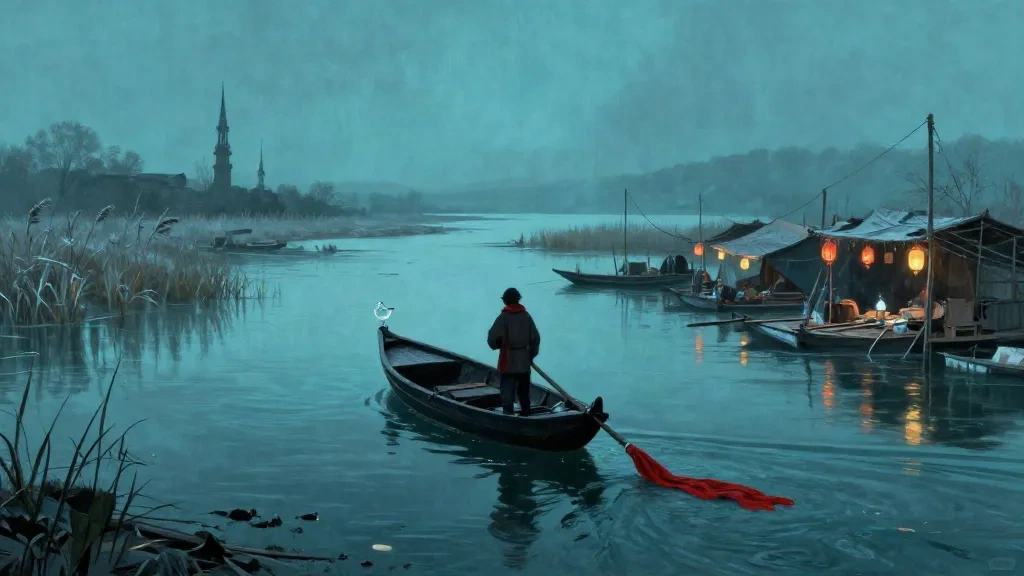
By the time Neral reached the shore, the lake had already lowered itself beneath the mud. It lay there as a black bowl, holding the sky in its bottom, while the tide wandered somewhere beyond the horizon. At low water the market came floating out: flat boats lashed with tarred rope, stalls built from doors taken from drowned houses, and lantern flames that burned without smoke.
Neral was a ferryman. His boat had no mast, only a white pole and an oar polished smooth by the dead. He crossed the lake when the water allowed it, carrying people who could not cross themselves. Most paid in memories. A childhood dog. A mother's voice. The taste of salt on a winter morning. He never asked what a memory weighed until the day he began searching for his own.
He wanted the one person who remembered the original version of the world.
Not the true world—Neral had no proof such a thing existed—but the first telling, before the villages renamed the river, before the hills were cut for roads, before the dead were folded into songs with tidy morals. Someone had witnessed the beginning. Someone had kept it.
The Market That Would Not Hold Still
The market traded in what had lost its owner. There were jars of laughter, shelves of abandoned names, and a weatherboard on which someone had written every apology they had never delivered. Children chased a fox made from a forgotten promise. At a stall beneath a blue awning, an old woman sold the sound of church bells to anyone willing to return before sunrise.
Every stall had a map.
They were painted on skin, bark, sailcloth, and the broad leaves of plants that grew from the lakebed. On Neral's map, the market floated between two black spires, and a red mark trembled at its center.
The stallholder warned him. “A map that answers truth is already looking for a new owner.”
Neral unfolded the map. The red mark moved. The ink ran uphill. The two spires became a gate, then a bridge, then a pair of hands holding a glass bird.
He tried reading it honestly.
Again it changed. The honest road became a field of white reeds. The field became a wall. The wall became the back of his own coat.
“You are using it,” the stallholder said. “That is enough.”
Neral paid with the memory of rain on tin roofs. The map went still.
The Woman in the Red Scarf
At the far end of the market, beneath a lantern shaped like a split moon, he found a woman sitting alone beside an empty cradle. A red scarf was wound around her neck, its ends trailing into the water. In her hands she held a glass bird, clear as frost, with a black stone for an eye.
“You are late,” she said.
Neral knew her voice. Not from memory. From the place beneath memory, where the body keeps what the mind has burned away.
“Do you remember the world before it was named?” he asked.
The glass bird turned its head. The black stone caught the impossible cyan dawn.
“I remember the fields before they were fields,” she said. “The water before it learned our names. I remember you carrying me across the lake while the moon was still burning on the horizon.”
“Then take me there.”
She unwound the scarf. Beneath it, her throat was a seam of pale scars. The map in Neral's hands burst into flame, though no heat touched his fingers.
“You think finding the first world will return what you lost,” she said.
He looked at the market: the stolen faces, the abandoned voices, the small boats rocking beneath the false stars. Then at the black lake, where dawn had begun without night.
“I need to know it existed.”
The Water Remembers First
The woman stood. The scarf snapped taut around the neck of the empty cradle. The glass bird opened its beak and released one clear note.
Every boat in the market turned toward it.
“Bring the map,” she said.
Neral held it out. She dropped the glass bird into his palm and stepped onto the ferry.
The lake began to rise.
As the water climbed over the stalls, the lost memories surfaced and joined it: dogs, voices, apologies, bells, the smell of rain on tin roofs. They passed through the ferryman without filling him. He understood then that they had been waiting not for a buyer, but for a witness.
The woman looked back at the market.
“Will I remember you?” she asked.
“No,” Neral said.
“Good.”
The ferry struck the first pale water. Below them, the lake unfolded into fields without names, reeds without wind, and a horizon burning softly cyan. In his hands, the map had become blank.
Neral rowed toward the original light. The red scarf streamed behind him, red as a wound.
And behind the boat, the water kept its first shape.





