 Netwrck
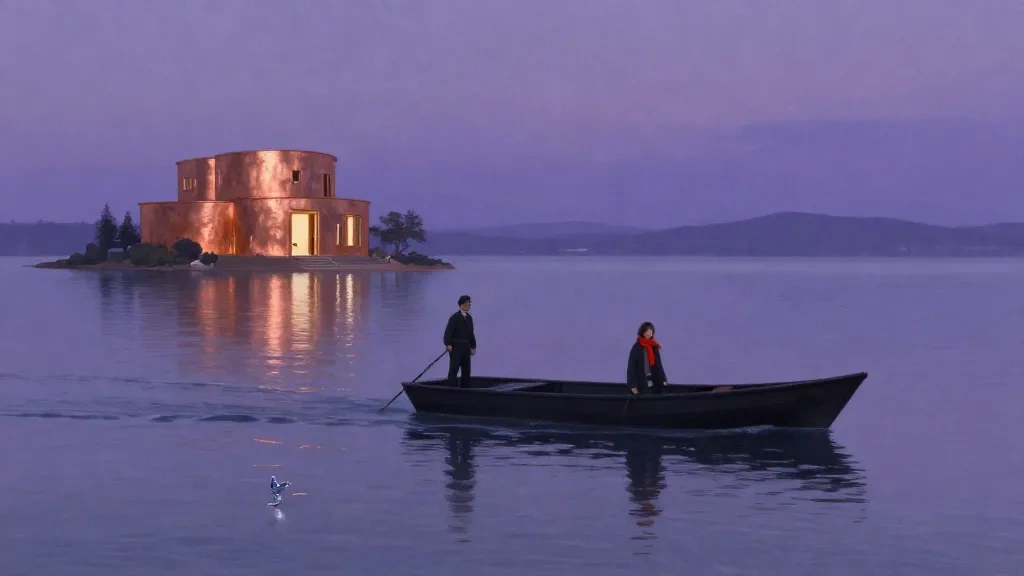
Fantasy.
At low tide, the lake came out from under the theatre.
It arrived without waves, a violet sheet folding itself between the black pilings. The water smelled of wet stone and hot metal. Along the shore stood the theatre’s forgotten stage, its copper roof split open to the cloud-white sky, and from its doors came the soft percussion of actors rehearsing deaths that had not yet happened.
Ferryman Vale crossed the lake at dusk, poling a flat boat toward the island where discarded endings were stored. Each morning, the island received the theatre’s rejected final acts: a king dying before his coronation, a city spared by a lie, a girl who opened the door and found the house empty. The endings were not performed for the public. They were performed for one audience only: the person who might have lived them.
Vale had crossed for nineteen years. He knew every route, every silver ripple, every place where the water turned the color of an old bruise. He had one destination left in him.
The first person who had ever boarded his boat, years ago, had said the world had been written twice. In the first version, she claimed, the lake had never appeared at low tide. The theatre had been a bakery. The ferryman had been her brother.
Her name had been Ilyra. She had left behind a glass bird and a red scarf, and no one at the theatre could say what had become of her.
The Map That Refused the Truth
Vale carried Ilyra’s map in the inner pocket of his coat. It was a square of vellum, soft as skin, and had belonged to no theatre company he knew.
The first time he opened it, it showed the island in the center, the theatre at the west, and a narrow channel leading north. He followed the channel.
The lake rearranged itself. The channel curved back on itself, and the island vanished behind a curtain of rain. When Vale unfolded the map again, the channel had moved south.
He tried marking the route with charcoal. The line bled into the vellum. He tried tearing off the corner bearing the theatre’s name. The corner grew back.
At last he understood the map’s condition. It would show the truthful route only to someone willing to travel falsely. The longer he used it honestly, the farther it drew him from the place he sought.
So Vale turned north when the map pointed south. He crossed against the black current, past drowned streetlamps and the ribs of boats that had never been launched. Every time he opened the map, the red ink on the theatre roof had faded a little more.
The Theatre’s Discarded Endings
By the third night, the theatre had begun rehearsing without him.
Through its open doors came lines spoken in voices he knew. A woman sold winter apples beneath a violet moon. A boy counted doors in a city with no streets. Someone laughed, then said the name of a sister who had died before either of them was born.
Inside, the stage was a shallow lake under copper lights. Actors moved through scenes with no beginning, bowing to empty seats. A playwright in a black coat stood beside a table covered with knives made of paper.
“You have brought the wrong ending,” he said.
“I brought none.”
“Everyone brings one.” He pointed to Vale’s coat. “Especially when they bring a map.”
Vale showed him the red scarf.
The playwright touched the fabric, but his face closed. “She came here. She asked for the first version.”
“Where is she?”
“You have already forgotten her answer.”
At that moment, the glass bird appeared on the stage.
It was no larger than a thumb, its beak cloud-white, its body violet beneath the copper light. Vale recognized the crooked wing from his childhood, though he had never seen the bird made whole.
He crossed the stage in three strides. The bird did not fly. It walked into his hand, warm as a living thing, and the theatre fell silent.
The Name Beneath the Applause
“She is not here,” the playwright said. “She is in the version that was erased.”
“Then bring it back.”
“That is not how endings work.”
Vale unfolded the map. It showed a route through the theatre itself: a line crossing every stage, every painted moon, every discarded scene. At the end stood a tiny boat.
He climbed into it.
The theatre rose around him. Scenes from abandoned endings peeled away from their sets. A king accepted the crown and found his hands covered in ash. A city woke beneath a red sky. A girl opened her door, and beyond it stood Vale’s own house, with smoke rising from the chimney.
In the final scene, Ilyra sat on a riverbank beneath a violet dusk, winding the red scarf around her fingers. The glass bird flew from Vale’s palm and landed beside her.
“You came by the wrong road,” she said.
“I know.”
“Did you use the map honestly?”
Vale looked at the vellum, now blank except for a dark stain shaped like a door. “No.”
“Then it has finally told the truth.”
Low Water, First Light
They crossed together when the lake began to withdraw.
The theatre rose behind them, its copper roof flashing once as the water pulled away. Vale rowed toward the mainland, and Ilyra held the glass bird beneath her scarf.
“I remember the bakery,” she said. “I remember the flour on your hands. But I do not remember how the story ended.”
“Neither do I.”
“Then perhaps that is the original version.”
At the shore, the map lifted itself from Vale’s hand. Every line vanished except one, leading to a place that had never appeared on any chart. He folded it shut without opening it again.
Behind them, the lake disappeared beneath the theatre, taking with it the last violet reflection. The glass bird sang once, a clear note over the morning.
Vale kept the red scarf, and Ilyra kept the map. Between them, they carried the only ending that required no audience: a beginning, uncertain and bright, walking home.





