 Netwrck
Folk Horror.
What the House Asked
Mara Venn had spent nine years tending houses that grieved in human voices. The rich talked through their chimneys. Lonely farms repeated one name in every room. Once she had found a cottage folding its laundry into tiny birds and heard it ask whether dead children still preferred blue ribbons.
On the last Thursday of October, a white house at the edge of Sleet Fen opened its front door before she knocked.
Its walls were damp with frost. Iron keys hung from the lintel, each turning by itself. On the hall table lay a red scarf and a train ticket marked for the following morning.
Inside, twelve-year-old Elsie sat beside her mother, Ada, while Ada stitched a bloodstain into the floorboards. They had not spoken for three days. Their quarrel had been ordinary at first: Elsie wanted to study maps, Ada wanted her to take over the dairy. Then Elsie said she would leave for the coast, and Ada had answered, Good.
The house breathed through its chimneys.
Please mend us before one of us goes.
Mara was a village nurse, not a confessor, but the failing tended whatever lived inside a body. The house had pulse enough.
Elsie showed her the ticket. The mother’s red scarf lay folded beside it.
“She means to leave alone,” Elsie said.
“You mean to leave without an answer.”
The Theatre Below the Tracks
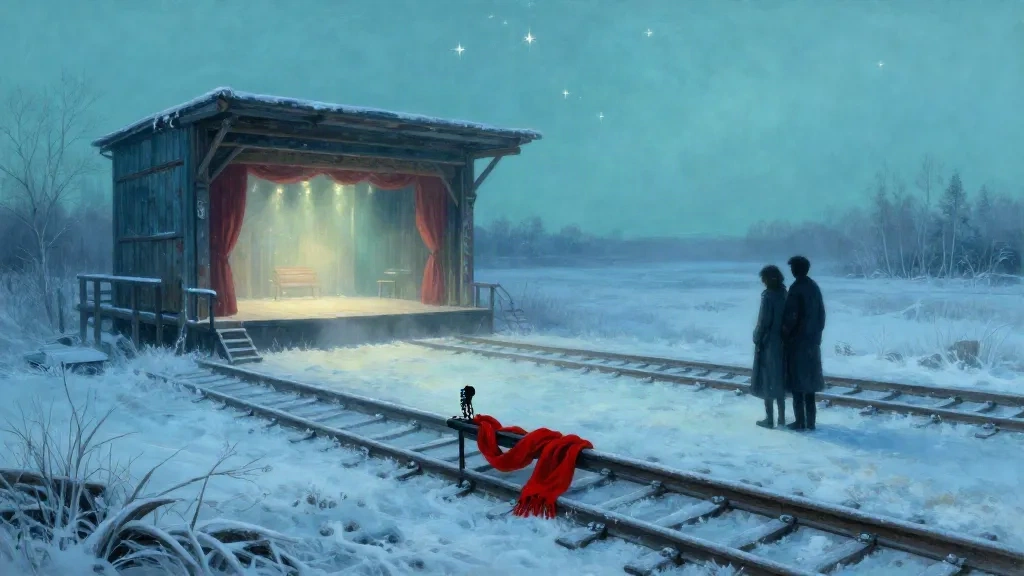
Beyond the reeds stood Frost Hall, a theatre without a town. Lantern light shone beneath its closed doors. Above them, boards declared that each performance consisted of tomorrow’s discarded endings: last words missed, journeys abandoned, letters burned before they were sent.
Mara brought mother and daughter there after dusk. Inside, empty seats rose around a stage where three actors waited with their faces hidden.
One wore the red scarf.
Another carried Elsie’s ticket.
The stationmaster, a narrow man with a silver timetable across his waistcoat, barred the stage.
“No performances tonight,” he said. “Departures at six, ten, and midnight. The first train belongs to a governess who was never offered. The second to a soldier who died before he could apologise. The third—
He looked at Ada.
“—has been delayed by misunderstanding.”
Ada folded her hands. “There is no misunderstanding. She wishes to go.”
“Every ending is a scheduling error,” the stationmaster said. “People leave before the proper sentence has been entered. If the last one is corrected, the ending stands.”
The Missing Last Words
The actor in the scarf climbed onto the stage and began Mara’s case.
Ada stormed out after Elsie. The diary door slammed. In the rafters, the house folded itself small.
“What was her last sentence?” the stationmaster demanded.
Mara had heard it in the kitchen: You think I leave because you are impossible.
“That was the sentence before the ending,” she said.
He frowned. “There is a difference?”
Below the boards, wheels began turning. Frost spread over the rows, iron handrails blossomed along the aisles, and the theatre filled with a cyan light that had no dawn behind it.
The actor in the scarf continued.
Ada packed her case. Elsie watched from the landing. Mother and daughter circled the house all night, leaving notes beneath plates, in drawers, inside the red scarf’s hem. Neither read them.
Then dawn entered beneath the doors, soft and impossible.
Elsie descended. She picked up the ticket.
Ada descended. She picked up the scarf.
Still they said nothing.
The stationmaster smiled. “There. Every ending confirmed.”
The 6:10 Departure
Mara opened her medical bag and took out a spool of red bandage. She tied one end to the brass rail and the other to the two iron keys hanging above Ada’s kitchen table. Not a cure. A bridge made from what the house had left lying unused.
“Say the sentence you withheld,” she told Ada.
“You are not impossible to love. I only became frightened because loving you has always felt like standing at an open door.”
Ada held out the scarf.
Elsie crossed the line between them. The ticket tore in her fist.
“I didn’t want the coast without you,” she said. “I wanted to see whether you would ask me to stay.”
“I should have asked.”
The stationmaster lunged for the timetable. But the red scarf had caught the cyan dawn, and its light burned through the iron staples holding every ending in place.
All across the theatre, doors opened. Voices rushed through them, unfinished and newly permitted.
Ada fastened the scarf around Elsie’s neck.
They left together before the 6:10 train.
At dawn, the stationmaster found only a ticket beneath his schedule, marked for a place he had spent his life insisting did not exist.
Home.





