 Netwrck
Mystery.
The Empty Place
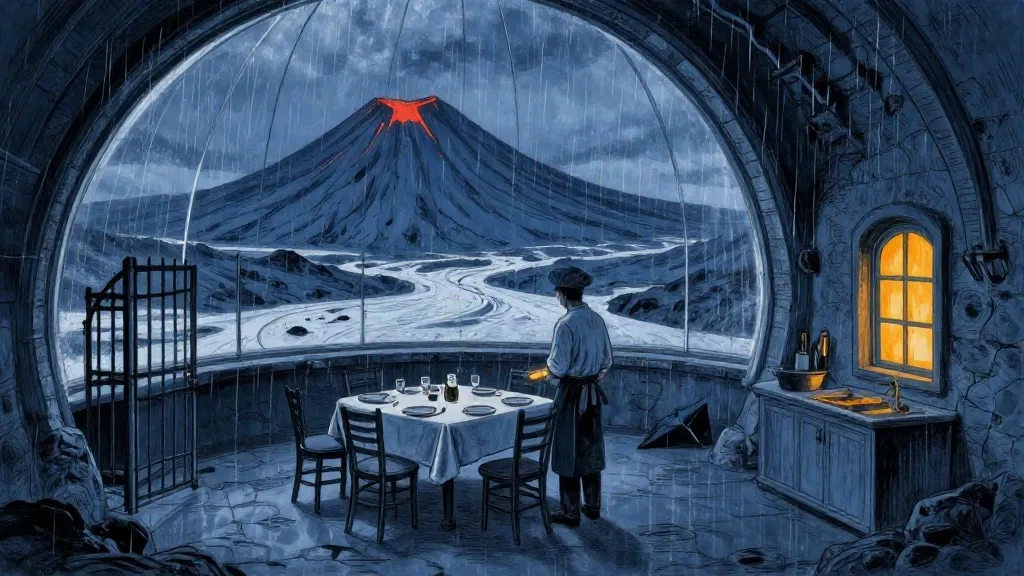
Mara Venn arrived at Cinder Observatory with a black umbrella folded beneath her arm and a tin box of salt in her coat. Rain silvered the mountain’s shoulders. Below the old dome, the volcano slept behind walls of black glass, its heat reduced to a distant mutter.
Her mother’s kitchen occupied the highest room, where one amber window burned above the sink. Seven places had been laid there when Mara was a child. The eighth place was always empty.
“You never set it,” Mara said.
“Someone was expected,” her mother had replied, before disappearing into the weather with a recipe written on the back of a storm warning.
Now the observatory belonged to Mara, and the family legend had followed her up the stairs: a meal prepared without fault could summon every person who had once eaten in the room. Her grandfather had seen his dead brother reach for the bread. Her grandmother had heard a childhood friend laugh beneath the table. Mara wanted proof before winter closed the mountain road.
She unpacked dried barley, smoked eel, bitter greens, and a jar of honey gathered from the observatory’s southern slope. As she worked, the room filled with the scent of wet stone and orange peel. The volcano breathed through the vents. Rain ticked against the dome.
The Seventh Guest
At midnight, Mara set the table.
The first guest arrived as steam: a broad man with a flour-dusted sleeve, already reaching for the bread. He was her great-uncle Tomas, who had died before her birth. Mara dropped her knife.
He ate, spoke of a winter road, and vanished without leaving a wet mark on the floor.
Then came Elin, the observatory’s first cook, carrying a child by each hand. After them came three engineers, a nun, a girl with a red scarf, and a thin man who said nothing but polished the black umbrella until its handle shone.
Every guest returned to the exact moment of their last meal. They remembered the observatory. They remembered Mara’s family. They did not remember dying.
Only the eighth place remained untouched.
On the table, a damp envelope had appeared. Inside was a torn page from her mother’s notebook. When the eighth guest arrives, do not let the door learn your name.
Mara checked the rain-damp windows. Far below, a dry riverbed cut through the observatory’s western slope, pale stones polished smooth by some vanished flood. The black umbrella leaned against the wall where Mara had left it, though she had hung it by the blue door.
She went to the corridor. At its end stood a gate of iron and volcanic glass, sealed by a narrow black river running through the floor. The current moved uphill.
The Gate
The notebook’s next page was missing. The remaining page showed a recipe written in reverse, followed by a line in her mother’s hand: Payment leaves no receipt.
Mara tried the gate. It would not move. She fed it a coin, a bone, a drop of blood. Nothing answered.
The dry riverbed flickered.
One of the summoned guests appeared at the corridor’s edge: the thin man with the umbrella. For the first time, he looked frightened.
“Your mother paid,” he said. “She opened this gate once.”
“What did she pay?”
“The memory of the meal.”
Mara looked at the amber window. In the glass, the seven guests were eating again, younger and laughing. Her mother stood at the head of the table.
The thin man raised the umbrella. Beneath it, his face was the face of the little girl in the red scarf.
“She could not pay twice,” he said. “The second price is the person who opens it.”
Mara understood then. Her mother had summoned the dead to discover who had closed the gate, then surrendered the memory that had led her there. The legend had survived, but its proof had not.
What the Table Kept
Dawn found Mara at the sink, grating hash into a bowl. The black umbrella lay open on the floor, filling with rain that dropped through the dome. The gate remained shut.
She cooked the barley with eel, honey, and bitter greens. She set seven places. The eighth stayed empty until the last grain was gone.
No guests came.
Then the seventh chair scraped back.
Her mother sat down, younger than Mara remembered. She looked at the food, then at the empty place.
“You found the gate,” she said.
“I found your note.”
“I wanted you to prove the legend.”
“You made me live in it.”
Her mother bowed her head. The amber window brightened, warm against the rain-blue room.
Mara placed a blackened coin beside the plate. The coin was not payment. It was proof. Her mother’s own coin, worn smooth, hidden in the dry riverbed for thirty years.
“You paid the memory,” Mara said. “Not the truth.”
Her mother touched the coin. The volcano shuddered. Somewhere below, a dry river answered with a sound like distant rain.
Mara did not open the gate. She poured the hash into the eighth bowl, and her mother began to eat. The meal was imperfect. The barley was too hard, the eel too salty, the honey overpowering.
No magic was required. No vanished guest returned. The proof was smaller and more stubborn: her mother had once sat at that table, and the table had kept her place.
When the bowl was empty, Mara opened the black umbrella and walked into the rain. Behind her, the amber window remained lit above the sleeping volcano, steady as a single held breath.





