 Netwrck
Historical Fantasy.
The Last Rumour of Earth
Mara Vale had not seen Earth in sixty-one years, yet she still knew the hour when its cities dimmed. At dusk aboard the orbital greenhouse, she would look through the stern glass and remember the old maps: blue coasts crowded with names, black rivers stitched across green, a moon pencilled into every schoolchild’s hand.
Now the planet was a rumour carried between freight crews. The official broadcasts called it a failed inheritance. Her daughter’s last message, sent from a clinic in Marseille before the orbital lifts sealed, had contained only static and a cough.
Mara refused to leave the station. She had come home from the first lunar survey with an officer’s rank, a damaged left shoulder, and no appetite for Earth. Among the gardeners she had learned another kind of courage: pressing seeds into warm soil and waiting without asking what would emerge.
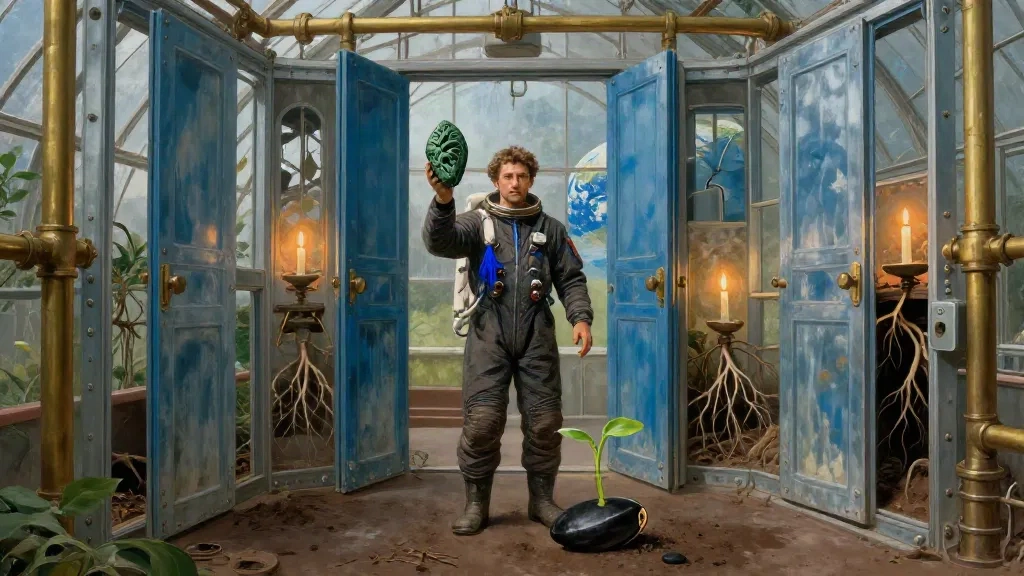
Her task waited beside the oldest bed. A green stone rested on its palm, worn smooth except for one carved notch. Beside it lay a blue thread, stiff with age. The stone had belonged to Oren Vale, a witness from the final forest court. The thread had been spun from flax in the year the forest was declared extinct.
The seed beneath them was black and smooth as a beetle’s shell. It remembered the canopy that had once covered half a continent. When Mara placed the stone against it, the root answered with a slow pulse, like a sleeper remembering danger.
Doors in the Saffron Storm
The storm arrived as a wall of pollen, rust and reflected candlelight. It struck the greenhouse at midnight and moved through the sealed rooms like weather remembering old houses. Every third minute, a door would open where no door belonged.
One appeared behind Mara while she was pouring water into the seed bed. Beyond it stood the archive room, though the archive had been sealed since before her arrival. A second doorway opened inside the tool wall. Through it she glimpsed her daughter’s clinic, its white beds vanishing beneath leaves.
Mara entered the first door. The floor tilted toward the agricultural ring, and gravity pulled her sideways with every step. A door that had opened onto a seed vault now led into a corridor of sleeping quarters. In one room, two gardeners argued over a calendar. In another, a stranger in a forest court’s embroidered coat stripped rust from an oxygen valve.
“The storm is rearranging the doors,” he said.
“That is not an explanation.”
“No. It is a warning.”
He wore Oren’s green stone at his throat, though Mara’s stone remained warm in her palm. He told her the storm was not moving rooms. It was moving consequences. Every door opened onto a choice the station had refused to make: the seed saved or the archive saved, the living tended or the dead recorded.
Mara understood then what history had used as background noise. Voices had not vanished because they were weak. They had vanished because the rooms around them were built without doors.
The Room Without a Threshold
The stranger led her toward the seed’s deepest roots. The corridor narrowed into a chamber whose walls were made of dark soil. Here the storm could not rearrange the door because there was no door. Only a low opening, bright as a coal, and the blue thread trembling in Mara’s hand.
“Oren was the court’s last listener,” the stranger said. “He kept the testimony of the trees.”
“The trees cannot testify.”
“They can. Human beings only become trees when they agree to remember.”
Mara pushed the thread through the opening. In the chamber beyond, roots lifted from the soil. They carried bark-smooth faces, branch-bright eyes, and mouths opening in a hundred forgotten dialects. The forest court had been dismantled centuries ago, its witnesses listed as background noise beneath the legal record of land.
She heard Oren at last. His voice was neither young nor old. It came from everywhere and nowhere, carried by roots that drank the storm’s pollen.
“Mara,” he said, “if you came for my voice, know this: I was not silent. I was waiting for a witness who had not been promised the world.”
The chamber shook. Steel-blue emergency strips flickered across the soil. Mara held the green stone against the seed and drew the blue thread tight around her palm. The root offered her a choice: take the voice into her body, or release it into every door.
She remembered her daughter’s cough. Remembered the maps with their crowded names. Neither memory was proof, but they were doors.
A Name the Storm Could Carry
Mara opened both hands.
The voice passed through the thread, through the stone, and into the greenhouse’s walls. The saffron storm tore apart its pollen lanes. Doors appeared and vanished: a nursery, a courtroom, a battlefield, a kitchen where someone was waiting with warm bread. Each room received a different fragment of the forest court’s testimony.
The stranger vanished when the final door closed. Mara was left kneeling in the dark chamber, her hearing ringing with roots.
When she returned to the observation gallery, Earth was unchanged. A blue storm turned over the planet’s western edge. No coast emerged from the cloud.
Mara placed the green stone beneath the telescope and tied the blue thread around it. Below, the seed split its black shell. A green shoot rose through the soil, carrying with it the faint smell of rain.
She did not know whether it was a memory or a beginning. The distinction had been another background noise. Against the glass she spoke Oren’s name clearly, and the station carried it through every surviving corridor.





