 Netwrck
Historical Fantasy.
The Last Orbit
Captain Sabine Orr had not left orbit in eleven years.
She told herself the distinction was precise. Her body descended each evening in a wicker cabin hung from the western rib. Her mind remained above, where the sleeping giant’s vast ribs became planetary ribs, and the scattered stars turned around her like a quiet audience. She kept an old flight helmet fastened above the cabin window, though no longer flew through the sky.
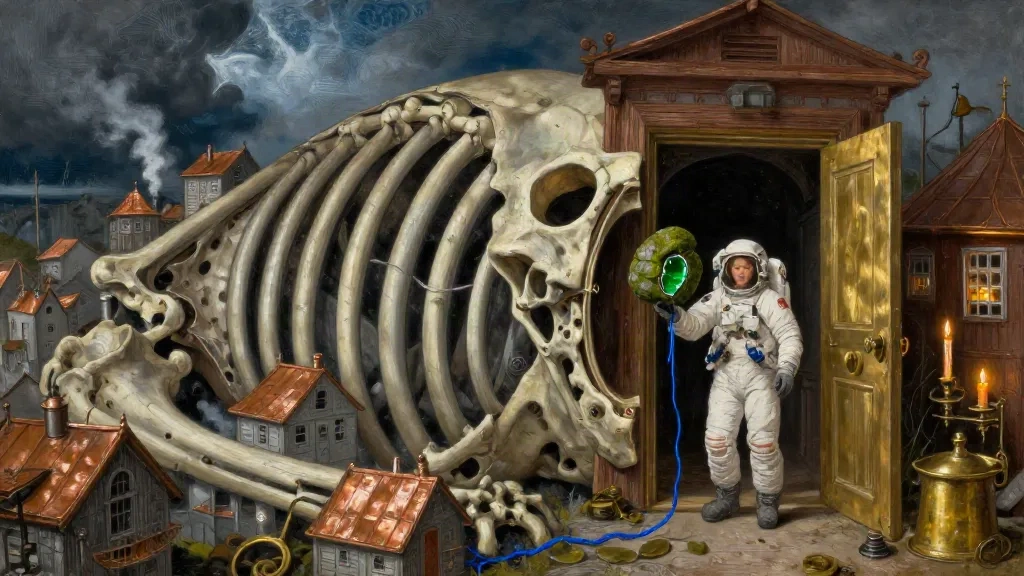
Below, the village of Sternhallow had grown around the giant’s bones: copper gutters along the collarbone, a tavern where the sternum formed its chimney, narrow homes quarried from the spaces between ribs. Its people had heard the story of the captain who abandoned Earth. They had forgotten the rest.
Sabine descended to the Night Office that evening carrying a green stone in one palm and a spool of blue thread in the other. The stone was a fragment of the original expedition marker, dull as moss. The thread had been spun from the emergency sail of her descent capsule, a colour no herald had ever approved.
She laid both upon the brass counter.
“I want one voice recovered,” she told the archivist. “No name for the register. No transcription. The voice itself.”
“Voices do not enter the public record,” said Master Vel.
“That is precisely why it was lost.”
The Storm Moves a House
He retrieved a survey map dated 1816. On it, every door in Sternhallow had been drawn in blue ink.
“On the night of the Iron Rain, the first astronaut broadcast to the giant,” Vel said. “The message was carried from the observatory to every hearth. Officially, it was weather chatter. Someone classified it so.”
Outside, the wind began moving between the ribs with a metallic whisper. Lightning illuminated the vaulted ceiling: generations of soot, copper wire, prayer tags, and old names.
A knock came from inside the wall.
Sabine opened a door that had belonged to the eastern houses. Beyond it waited the western lane. A baker’s oven gleamed where a child’s bunkhouse should have stood. A woman stepped through carrying a basin of milk and emerged beside the tavern, six streets away and entirely undisturbed.
The storm had stopped asking permission.
Sabine tied the blue thread to the door’s hinge, looped it once around the green stone, and crossed the threshold. The corridor lengthened. Candlelight slid along its walls like water under ice. Behind her, the doorway divided into three, each showing a different version of Sternhallow.
“Recover the voice,” one Sabine said.
“Tell the people what you saw from orbit,” said another.
“Go home,” whispered the third.
She entered the middle door.
It opened into the giant’s ear.
What the Giant Heard
A cavern curved before her, lined with balconies and chimneys. On the far wall, a brass instrument the size of a gate listened toward the ground. Green lamps burned behind its lenses. Blue thread ran through the mechanism and up into the bone, taut as a nerve.
The instrument turned.
Static filled the cavern. In it Sabine heard thousands of voices: fishermen counting, children reciting, officials denouncing the expedition, a woman singing behind a closed tavern door. Each had been filed as background noise. The machine had gathered them for centuries, unable to distinguish the essential from the incidental.
Then a young man’s voice cut through.
“This is Lieutenant Amos Venn, lunar survey ship Eider. We have found the sleeping body. We do not know whether its breathing is geological. If anyone below can hear this, do not mistake silence for abandonment.”
Sabine knew that voice. Not from the public record. From the sealed cockpit recording of her own first landing.
She had been twenty-four. She had called him background noise when the mission controller ordered her home.
Storm-bound balconies shuddered. The brass instrument began reversing, pulling the blue thread deeper into the giant’s skull. If Venn’s message was unwoven, Sternhallow’s doors would remain scattered through one another, and no doorway would know which room belonged inside it.
Sabine caught the thread against the green stone.
“I hear you,” she said.
A Room That Remembered
She opened the stone.
Inside was no seed, but a narrow strip of green glass from the first landing beacon. She set it beneath the instrument’s lowest lens. The blue thread caught reflected candlelight, brightening to the blue of an atmosphere seen from orbit.
Venn spoke again.
This time every balcony heard him. Windows opened in the cavern walls. The scattered rooms beyond them became visible at once: infirmary, schoolroom, chapel, kitchen, watch room. Doors hung between them like hinges of one enormous house.
People stared out, astonished to see their neighbours. A child waved from the boiler room. An old soldier opened a door and found the room he had been mourning.
Sabine listened until the final static dissolved.
Then she released the thread.
It snapped upward through the brass gate. A tremor passed through the sleeping giant, and all the mislaid doors swung gently closed.
By dawn, Sternhallow stood whole. The green glass remained in the instrument, no longer buried. On its surface, reflected in the lens, Sabine saw a narrow cabin turning among the stars.
She left the helmet where it hung. For the first time in eleven years, she did not need its reflection to know where she was.





