 Netwrck
Historical Fantasy.
The Observatory at the Edge of Silence
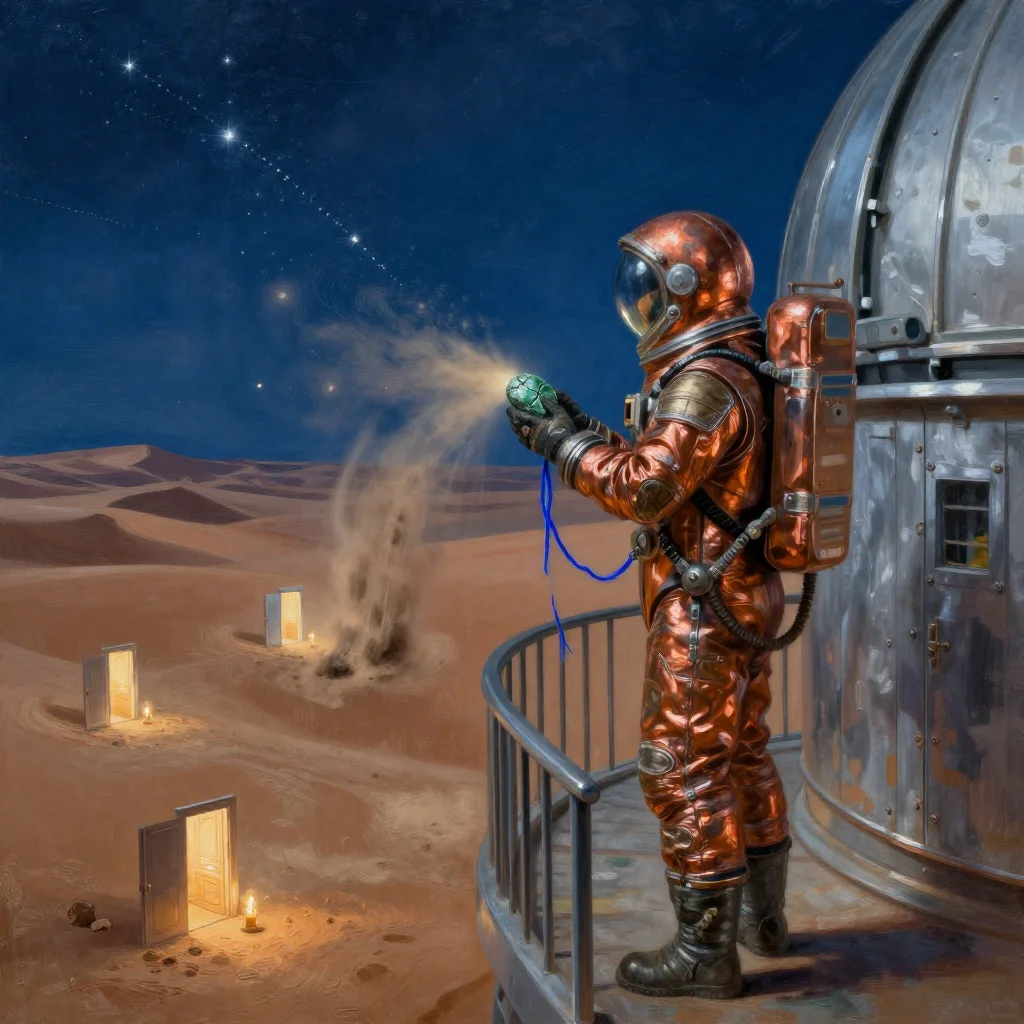
By the winter of 1688, the Ash Observatory stood beyond the last inhabited well, its copper dome green with age and its western wall polished by decades of wind. From its narrow balcony, Neral Venn watched the stars send slow silver scratches across the sky. The instruments recorded their messages as patterns of heat: three bright pulses for rain, seven for locusts, a long tremor for war.
Venn had once worn a pressure suit and orbited the moon on a gourd-shaped vessel borrowed from the Khedive’s engineers. He had seen Earth entire, a blue bead suspended in darkness. Since returning, he had received letters claiming the continents had vanished, or burned, or never existed. The observatory logs disagreed. Beneath every official entry ran an older hand, recording births, harvests, and ordinary grief.
He wanted one voice recovered from that buried history: his sister’s.
Her name had appeared in a marginal record from 1612, followed by a warning against trusting the sky. Then the line had been scraped away. For twenty years Venn searched the ledgers by candlelight, keeping his green birth stone in one pocket and a spool of blue thread in the other. The stone had belonged to Neral and Mira both. The thread had come from their mother’s weaving loom, its colour as stubborn as memory.
When the Doors Changed Their Minds
The storm arrived on Saint Lucia’s morning without clouds. One moment the desert shone beneath a steel-blue sky. The next, thunder shook dust from the rafters and the copper dome began turning against the wind.
Venn was examining a damaged cabinet when the eastern door slammed open. Cold desert air rushed through it, carrying tobacco-brown dust and the smell of extinguished lamps. The door opened onto the balcony. The balcony opened onto the archive cellar. Each time he looked away, another threshold had changed places.
He tied the blue thread around his wrist and marked every doorway with a loop of it. The first knot vanished. The second appeared inside the wall, blue fibres taut as a vein beneath plaster. When Venn seized the handle, the room turned around him. Shelves slid past his shoulders. A ladder struck his ribs. Cold water rose to his knees, then drained through the floorboards.
Do not enter a door that knows your name.
The warning was scratched into the doorframe in Mira’s handwriting.
The Voice Beneath the Static
Venn forced the cabinet shut. Inside lay a brass plate no larger than his palm, blackened by an age of candle smoke. He had mistaken it for a hinge cover. Now he held it beneath the lamp and heard breathing inside.
Every star-message carried a lesser sound: laughter, meals being prepared, dogs barking across frozen fields. Historians had called the noise interference. Venn had ignored it for the same reason sailors ignored birds.
He fitted the plate into the observatory’s receiver. The instrument screamed. Steel-blue sparks jumped between its brass arms. In the chaos he heard Mira saying his childhood name.
“Neral, if this reaches you, do not come looking for me.”
He turned the tuning screw. The voice sharpened.
“They will call the sky a machine. It is not. We built the machine beneath it.”
The cabinet tried to slam. Venn caught it with his shoulder. On the floor, the green stone cracked cleanly in two. He fitted the halves around the plate, and the receiver filled with reflected candlelight: faces leaning over him in a cellar, his mother holding the blue thread, Mira speaking into a funnel of blackened copper.
In the image, the observatory roof burned. Men in leather coats pulled the instrument apart. Mira carried the plate beneath her shirt. The last image showed her fastening the door while the desert storm entered through its windows.
A History That Opened Inward
Venn understood then why the doors moved. The storm was not breaking the observatory. It was testing every boundary between what had happened and what had merely been reported.
He tied the two halves of green stone to opposite ends of the blue thread. Then he carried the plate to the balcony, now a cellar entrance, now a door into a vanished street. Behind each opening stood a different century, each with someone claiming to be Mira.
At midnight the storm stopped.
Only one doorway remained. Candlelight shone through its glass. Behind it, a woman sat beside a loom, older than Venn remembered and exactly as stubborn as her brother.
“You took your time,” she said.
He crossed the threshold. The blue thread snapped, but the plate continued speaking between them, preserving every word the history had tried to reduce to background noise.





