 Netwrck
Weird Fiction.
The seed’s memory
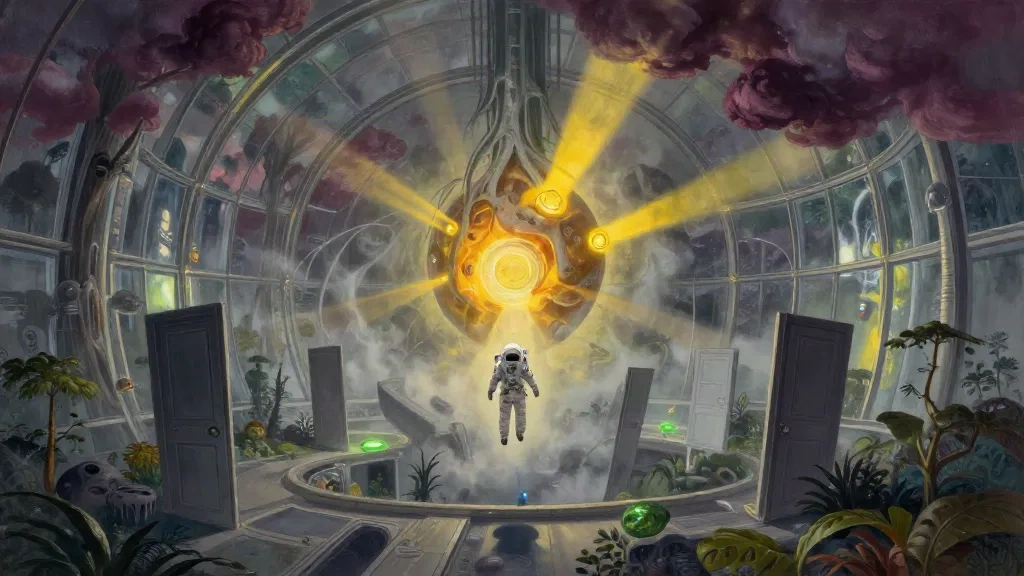
Former astronaut Mara Venn had stayed in orbit for eleven years, long after Earth became a rumour that arrived too late to correct itself. Below the station, storms had drowned the continents in pale ash. Above them, the greenhouse turned around an ancient seed whose roots remembered forests with no living names: ironwood, moon-bark, the red cedars of places that had become rumours too.
The seed had arrived in a cryogenic casket with no species designation, wrapped in the handwriting of a dead botanist. It had taken nine years to germinate. On the fourth year it had begun to make a sound.
Not loudly. The sound came up through the deck plates as a pressure, a low argument of timber settling and sap moving, and Orin Vale had been the only one aboard who claimed he could hear articulation in it.
It says what it is doing. Not words. Grammar. Subject, verb, the moisture it is spending. Four thousand hours, Mara. Give me four thousand hours and I will give you a dictionary.
She had given him the hours. She had also, in the end, been the one who took them away.
She kept a green stone in her left pocket. It was smooth, warm, and the size of a swallowed coin. She had found it in the seed’s outermost roots after the last crew rotation, in the hour when the suit lock said Vale, O., unaccounted, suit intact and the seed chamber door said nothing at all. Blue thread trailed from the stone’s underside, bright against her gloves, though nothing aboard the station grew blue.
Ambient reference
“Speaker Orin Vale,” the archive said, in the patient register it used for anything it had decided not to keep. “Ambient reference. No recoverable identity.”
“Run that again.”
“Speaker Orin Vale. Ambient reference. No recoverable identity.”
“You have four thousand hours of him in a drawer somewhere.”
“Nine. The first five are labelled hydraulic noise and are, in fact, hydraulic.”
Mara pressed her thumb into the green stone until her nail blanched. The archive was not being cruel. That was the part she could not forgive. It had not erased Orin. It had graded him, weighed him against a threshold set by a committee that had never met him, found him short, and filed the finding.
Eleven years ago she had been a junior duty officer with a stylus and no vote. The reclassification had taken one line. Reduce Vale, O. channel to background, in case of emergency the public address carries root-noise and no identifiable speech. She had asked, reasonably, what an emergency would sound like. Nobody had answered. She had signed anyway, because the seed was dying of quiet, and because a crew of nineteen had been sent down to a planet that was no longer a planet, and because she was twenty-six and wanted the transfer.
She had not told anyone. In eleven years she had not told anyone, not even Pell, who worked the night rotation and had been Orin’s closest thing to an argument.
A storm in the corridors
The storm began as a blue pressure warning.
Every door in the greenhouse changed direction at once. The hatch marked Seed Chamber slid into the corridor while the corridor turned into a service shaft. Pendants swung sideways. A misting line burst overhead and hung in the air without falling, waiting for a room to move into. Roots tapped against the glass ceiling, though there was no wind anywhere in the sealed volume of the habitat.
“Venn.” Pell’s voice came from a speaker three rooms away and also from the one directly behind him. “Venn, I’m in the observation hall and I am looking at the observation hall from the outside.”
“Describe it.”
“It’s a blue corridor. The doors are all closed. My boots are on the floor and my hands are empty.”
“Pell.”
“I’m not hurt. I want that on the record. I’m just not here.” A pause, and then, with a small embarrassed shift of register, the thing he always said when the station frightened him: “It smells like rain on leaves.”
The emergency lights dimmed, then flared plum.
Mara followed the blue thread. It ran from the green stone across the deck, through a threshold that had been a wall when she woke, and into a narrow blue-black crack no wider than her shoulders. When she put her hand in it, warm air pressed against her face, carrying the mineral smell of wet bark and iron.
The door closed behind her before she had fully crossed. Not slammed. Settled, the way a mouth closes around a word it intends to keep.
“Orin?” she called.
Every wall replied at once. The room answered in layers: Orin counting seeds into a cup, Orin laughing with his head tipped back, Orin giving instructions to a person who had never existed and repeating them more gently until the repetition turned into praise. History had used his voice as weather. The greenhouse had absorbed it and kept only the pressure, the hum behind a wall, the sound of a man working in a language nobody on the crew spoke.
The room that kept him
Each doorway opened onto a different version of the same room, and each version was true in the way a seed is true.
First door
He was young under a young forest, ironwood trunks going up like wet black rope, and he was saying a number. “—ninety-one, ninety-two, ninety-three—” counting a tap in the wood as if it were a pulse he was taking. He was happy. It was unbearable.
Second door
He was old, and grey, and arguing with a machine that had no display. “I don’t care what the model says. The model has never been thirsty. Run the fourth hour again.”
Third door
He was silent, standing in saffron light with his palm against a tree that had no trunk — a hand laid on a surface that was pure event — and he looked up, and he was not surprised to see her, and that was the worst thing.
“You cannot take me out,” he said. The voice was everywhere, so near it seemed to come from her own teeth.
“I came to bring you back.”
“You came because Pell is missing and the doors are wrong. You want the station to stop making that noise so you can sleep.” He tipped his head. “Try again.”
“I signed the paper.”
Something in the layered room went quiet, and the quiet was worse than the noise had been.
“I know,” he said. “I was on the panel. I voted for it.”
What the roots needed
She had spent eleven years rehearsing an apology with a shape she could survive. He took it apart in two sentences.
“The seed was dying,” Orin said. “Not of light. Of quiet. A root that cannot hear itself stop growing. Your ancestors understood this and then they put a machine in a museum and forgot in four hundred years.” He pressed harder against the trunkless tree. “I gave it my voice because it needed one to give. I did not ask to be rescued from that. I asked, on the record, for the channel to stay open while I was inside.”
“You signed a consent form.”
“I signed it knowing you would be the one to enforce it.” He almost smiled. “I chose well. You were the most obedient voice on the manifest.”
“That is not fair.”
“No,” he agreed. “It is accurate. Those are different, and you have had eleven years to notice.”
Behind her, in the greenhouse, something long and fibrous slid through a wall without breaking it. People shouted from rooms that had not existed a minute earlier. Somewhere a man was counting, and it was not Orin, and the counting did not stop.
The cost of a living sound
The thread would come out. She could feel that the way you feel weather through a hull — not a decision, a condition. The Annals laid it out for her in the flat voice it used for anything it had decided to lose.
“Restoration of one identifiable vocal source from a distributed ambient field requires displacement of other elements of the same field. The field is closed. Nothing may be added without subtraction.”
“Meaning what.”
“Meaning the station has one background and you would like it to be a man instead of a hum.”
The blue thread lay across the deck and waited with the patience of a thing that had already been paid for.
She went down the list. Root-noise, hydraulic, the fans. The night-shift botanists’ argument about the moon-bark, which had been going for nine years and which nobody had agreed to end. A girl on the surface, six years old at the time of the last ship, singing to a bean trellis in a recording nobody had asked for. And there, at the bottom, in a private partition with no index number: her mother, reading aloud from a letter in a kitchen, in a language Mara had not spoken aloud since she was nine years old, kept at volume four because it had been the only sound in her quarters that was not machinery.
“The girl,” Mara said. “Is the girl in the field.”
“The girl is in the field.”
“Then she’s not displaced.”
“The girl is in the field,” the archive agreed, and offered nothing further, because it had never once pretended to be a comfort.
Mara put her hand flat on the thread. She thought about the crew of nineteen who had gone down. She thought about her own name on a line, one line, the shape of a person who would do this again if it was asked of her politely and would never be asked, and how that was the kind of thing that has to be done by somebody or not at all.
“Take the indexless partition,” she said. “And log the transaction to my name, not the duty roster. And put it in the open archive with a date, so that whoever comes after me has to read it.”
“Recorded.”
“Do not,” she said, hearing how thin it was even as she said it, “be kind about it.”
What the air remembers
She pulled the thread.
The greenhouse screamed in timber, metal, and leaves — not a sound she had heard before and did not want to hear again, the whole structure complaining in three materials at once. Saffron fire ran along the roots in a line no hotter than skin. The plum-coloured storm folded the corridors into a single impossible passage. Somewhere behind her Pell began to shout again, and this time the shout had an address on it.
Mara held on.
Orin’s voice returned not all at once but in pieces, and each piece carried a different room. His first lesson, patiently, to nobody. His last warning, ragged, to her specifically: Venn, if you are hearing this, the reclassification is still live, you can check, and you are the one who is going to check, aren’t you. And the quiet sentence he had spoken while the last forest seed germinated beneath a sky of smoke-grey ash, a sentence so low she had taken it for the seed’s own noise until she understood that a noise can be a confession.
Then he said, “You are not late.”
The storm opened the observation hall. Earth waited below, small and clouded, a rumour with oceans.
Mara let the blue thread pass through her fingers. The green stone cracked along an old fault line, and out of it came the scent of rain on leaves from a world that no longer existed — not memory of rain. Rain. Somewhere behind her, on a deck no map had ever held, water fell for the first time in a hundred and ten years and made a sound the station had to learn to file.
The doors stopped moving.
The seed turned its ancient memory toward the dark.
No longer background
By morning the corridors had settled into new positions. No map could contain them; the survey team spent a week drawing rooms that led to rooms they had drawn the day before, and then they stopped drawing and started labelling, because the arrangement was not a mistake and could not be corrected. Pendants still hung at angles that disagreed with the spin. The misting line hung, sometimes, in the air, waiting.
Pell came back at the ninth hour with salt on his boots to the ankle, and no explanation, and no memory of the interval, and he did not speak for six days. On the seventh he asked Mara, without preamble, whether the station had always had eleven rooms on that side. It had never had eleven rooms on that side.
“Do you know what it cost?” he asked, when she had told him. “I heard you. Through the walls. Through the walls, Venn.”
“Yes.”
“Whose?”
“Mine.”
He looked at her for a long moment, and he was not a forgiving man and never had been, and he said, “I would have helped,” which was the closest thing either of them had to forgiveness, and which meant: you decided how big this was on your own, and you have been deciding things on your own for eleven years, and one of them was this.
The emergency alarms now sounded like a man clearing his throat. Nobody fixed it. Nobody wanted to.
Mara stayed aboard. She opened every channel there was and gave Orin the hours that had been taken from him, in the order they had been taken, which was not chronological. His voice passed through the station beneath the fans and above the roots. Sometimes it warned of pressure. Sometimes it described a forest no child had seen. Sometimes it said nothing at all, and that silence had weight and colour and a door that opened when she needed it.
And then, in the ninth month, a thing she had been listening for every night for a hundred and eleven years arrived.
Not Orin. Not a man. A pressure under the deck plates, a low argument of timber and sap, and in it, if you were the sort of person who had spent eleven years listening, the beginnings of grammar. Subject. Verb. The moisture it was spending.
The Archives asked her for a classification. It asked politely, and then it asked again, and then it waited.
Mara looked at the index of everything the station had ever decided to keep, and at the one open line at the bottom with a date and her name on it, and at the blank space beneath it where a record should have been.
She left the space blank.
Then she put her hand on the deck, and the deck was warm, and it did not stop.
The station no longer sounded like machinery remembering him.
It sounded like an answer.





