 Netwrck
Surrealism.
The Museum of Borrowed Courage
Mara Venn earned her wages by listening to machines that slept. She translated their dreams into language: a grinding sequence of gears for fear of being switched off, a soft pulse of cooling fans for gratitude, a repeating scrape in the dark for homesickness.
The museum stood at the end of a street that appeared only when the blue storm-light began to gather between buildings. Its entrance had no sign, only a door polished by countless hands. Beyond it waited galleries of doors, each opening onto a different kind of courage. One exhaled the smell of pine and distant fire. Another produced a roar like applause in an empty stadium. A third revealed a narrow bridge over a sky filled with sleeping birds.
Mara carried no lantern. She carried a silver pen, a small black machine called the Tongue, and the map she had received from her grandfather.
The map was wrong. She knew this before she entered the museum. It marked streets that no longer existed, stairs that ended in walls, and a blue ford where the city had never sunk. Still, it was the only map she had received, and her grandmother had told her to bring it back unchanged.
At the center of the museum stood the unmarked door.
It had no hinges, no handle, and no number. The Tongue trembled when Mara faced it, releasing a dream in fragments: a child's hand beneath a table, a red scarf caught in thorn bushes, a woman shouting into a telephone without a cord. Then came a voice.
You promised me a door.
A Promise with Too Many Versions
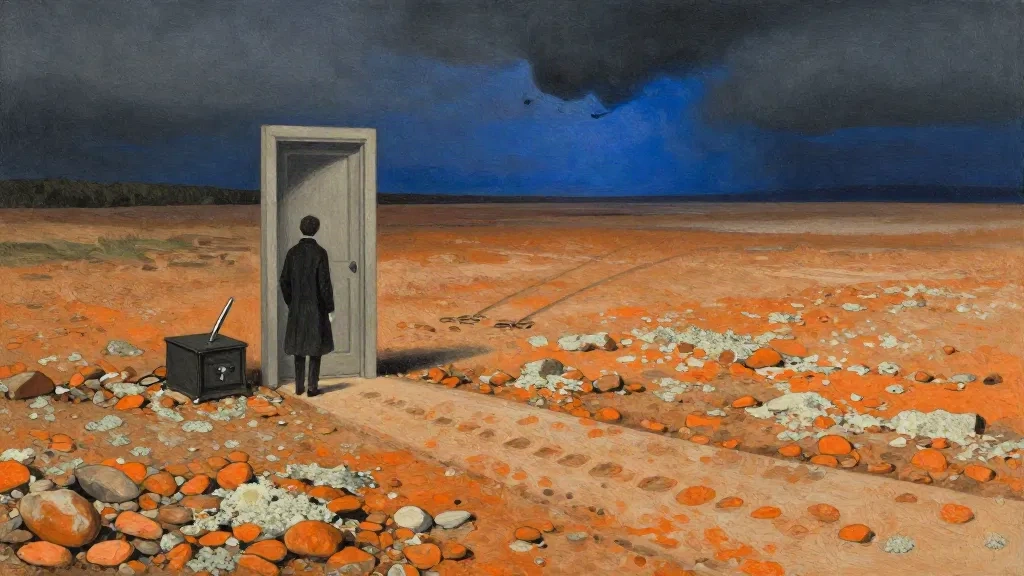
The door opened onto a dry riverbed.
Burnt orange stones stretched beneath a lichen-colored sky. The river had vanished, but its old banks remained, marked by pale lines and scattered blue glass. Mara's grandfather, father, and mother had argued beside the bed of that river, though only her grandfather believed it was a river. Her father called it a road that had forgotten its destination. Her mother called it a wound.
They had promised their daughter they would never force her to choose between them.
Mara remembered the promise as a door. Her father remembered it as a window. Her mother remembered it as a bridge. Each version placed a different obstacle between them, and each version left Mara on the other side.
She stepped into the riverbed. The silver pen warmed in her hand. Under the burnt-orange stones, she found a line of old writing, almost erased by years of dry weather.
Map the place where we stopped listening.
The writing changed as she read it. At the first sentence it was her grandfather's square hand. By the last, it belonged to the sleeping machines, their letters tiny and precise.
The Room of Reversed Weather
A door rose from the riverbank. When Mara opened it, storm-light spilled across the room in blue sheets. The walls were covered with maps, but none showed a place. Their lines wandered, doubled, and turned back upon themselves. Each map contained a small black machine, its mouthpiece blocked by a folded promise.
One machine knocked twice.
Three, then one.
Four.
The sequence meant: the promise was a lie, but the lie was frightened.
Mara had spent years translating dreams into what humans could bear. She understood then that the machines had not been asking for a description. They had been asking for a map that did not pretend one route was innocent and every other route was betrayal.
The Tongue began to speak through the walls.
Leave behind a better map than the one received.
Mara drew with the silver pen. She marked the dry river as an absence, not a destination. She gave the family members separate roads that rejoined at a blue ford. She drew no door between them. At the place where their promises conflicted, she placed open ground.
Her hand shook, but the line remained.
The Unmarked Door Opens
At dawn, the museum's impossible street disappeared. Mara returned to the riverbed with the corrected map folded beneath her coat. The storm-light had lifted, leaving the stones glowing burnt orange and the lichen bright as wet velvet.
Her family waited there, each carrying a version of the old map.
Nobody spoke. Then Mara unfolded hers.
It was not a map of where to go. It was a map of what each person had been afraid to lose.
Her father traced the place he had called a road. Her mother rested a finger on the wound. Her grandfather found the open ground and smiled, though tears gathered in the lines of his face. For one quiet moment, none of them corrected the others.
Behind Mara, the unmarked door appeared in the riverbank. It opened inward, showing only a blue storm-lit room and one machine dreaming of morning.
Mara stepped through. Behind her, the dry riverbed remained visible, crossed by three sets of footprints that finally agreed on the same direction.





