 Netwrck
Weird Fiction.
The Hinges of the Unbuilt
Every morning, Sister Aran climbed the saffron spiral to the hinge chamber, carrying an empty teacup in one hand and a train ticket in the other. The cup had belonged to the abbess, who died before naming a successor. The ticket had arrived years earlier, stamped for a station that appeared on no map: ARRIVAL, EVENTUAL.
The monastery had been carved into the comet by hands that no living person could name. Its halls curved through plum-dark stone. Smoke-grey air leaked from the walls, carrying the taste of iron and oranges. Beyond the narrow windows, stars burned with the immovable patience of witnesses.
Aran was the only blacksmith left. She repaired hinges for doors that could not be found.
They announced themselves as absences: a cold draft beyond a blank wall, a strip of floor worn by generations of footsteps, a hinge turning in the air when the abbess sneezed upstairs. Aran followed the sound with a leather tool roll and a hammer small enough to hide in her sleeve. She oiled the metal, eased the pin, and waited until the unseen door accepted its weight.
“Still here,” she would whisper.
Every door opened onto a choice made by someone long dead. She had seen a king abandon an army, a bride leave a wedding, a child step away from a burning village. The monastery called these visions. Aran called them intrusions.
That day, the largest hinge had found her.
It lay across the forge table, black as a beetle, its wings wider than her arms. The impact had cracked the stone beneath it and shaken loose a rain of gold dust. Heat poured from its center, though it showed no damage.
On the table beside it lay a fresh train ticket.
The Merchant of Closed Questions
The ticket bore the same impossible station, but the date was tomorrow. Beneath it sat an empty teacup, perfectly white, warm at the rim.
“That is not yours,” said Brother Venn, entering behind her.
He was the monastery’s quartermaster, a narrow man with plum-colored sleeves and a smile like a closed ledger. His office rented cellars beneath the chapel, where sealed questions were stored until their answers became inconvenient. The abbess had forbidden visitors from asking who built the comet monastery.
Aran had obeyed because obedience had seemed cheaper than doubt.
Now she turned the ticket over. On the back, written in soot, were five words: RETURN WHAT THE STONE BORROWED.
“The doors are failing,” she said. “Something behind them has lost its hold.”
Venn touched the hinge with one gloved finger. The forge dimmed.
“There are no doors,” he said. “Only repairs performed on a system that prefers not to be understood.”
He produced a brass token stamped with the monastery’s seal. “The abbess left funds for their preservation. New oil. New iron. A new keeper, if necessary.”
“And the empty cup?”
“A reminder that comfort can be manufactured.”
He placed a coin beside the ticket. The date on the ticket peeled away, revealing an older date beneath: the night the abbess died.
Aran understood then what the local power had been selling. Venn’s office did not merely trade in sealed questions. It sold the monastery’s confusion. Every unanswered thing became inventory. Every closed door became a fee.
She pocketed the ticket and took up the hammer.
“If the doors are bleeding,” Venn said, “do not ask what they are bleeding.”
“You have spent your life asking what they contain.”
“There is a difference between opening a lock and understanding what stands behind it.”
“Is that why you never use your own key?”
His hand closed around the brass token. For once, his smile did not move.
A Future Without an Ending
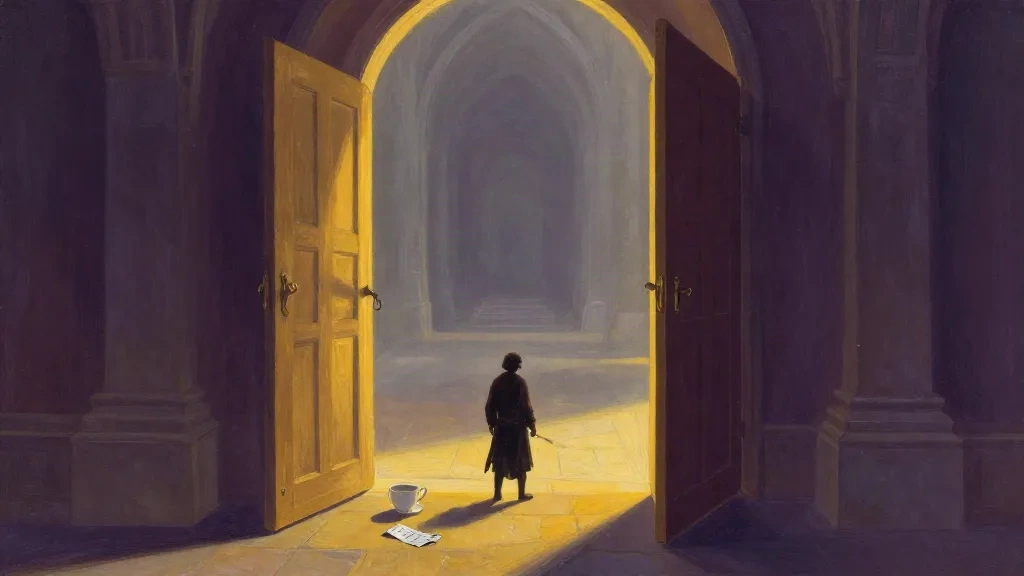
Aran found the largest doors at the comet’s tip, where the monastery narrowed into a throat of stone. They were not visible. She saw only two immense shadows standing upright against the stars, each outlined by the smoky glimmer of hinges.
She set the empty teacup between them. The train ticket went beneath the left hinge.
Then she opened her tool roll and laid out every piece of her trade: punch, chisel, needle files, black oil, blue wire, a sliver of meteoric iron.
Venn’s warning remained true. She could repair the mechanism without seeing its purpose. She could hammer each pin until the silence between the doors became smooth again. The mystery would survive, and so would his office. The future would arrive wearing the same sealed mask.
Instead, she cut the ticket into six pieces.
She threaded them through the hinge. She placed the teacup on the threshold, where a traveler might find it waiting. Then she struck the central pin once.
The hinge screamed.
Not iron. A human voice, crowded with thousands of years of waiting.
Aran held the hammer beneath her arm. The sound became a wind through empty rooms: a child crying, a lover promising, a nation choosing mercy. The unbuilt doors trembled, and light appeared along their edges.
Behind one, she saw the abbess pouring tea into a cup that never filled.
Behind the other, a platform beneath a saffron sun, a train waiting without passengers, and a future where the monastery’s stones had not yet learned to close.
Both futures were possible. Neither had earned its ending.
Aran turned the handle of the empty cup. It rang like a bell.
Venn shouted from the stair. The quartermaster’s shadow climbed the wall, trying to cover the light. But the hinge held, repaired in a new way: not closed against the unknown, but strengthened to bear it.
At dawn, the monastery trembled. A single golden door opened onto the platform on the ticket. Smoke-grey air swept through the chamber, smelling of tea, iron, and snow.
Aran packed her tools. She did not know whether she was leaving as a passenger, a witness, or the beginning of the next blacksmith.
Behind her, the empty teacup remained on the threshold.
It was waiting to be filled by someone who had not yet arrived.





