 Netwrck
Weird Fiction.
Orbit Was a Kind of Ground
Ilya Rook kept herself in orbit after the landing stations were mothballed, after the oceans developed a municipal accent, after the newspapers printed Earth in the past tense. She floated beneath the botanical garden with her boots locked to a maintenance rail and watched its doors open in the leaves.
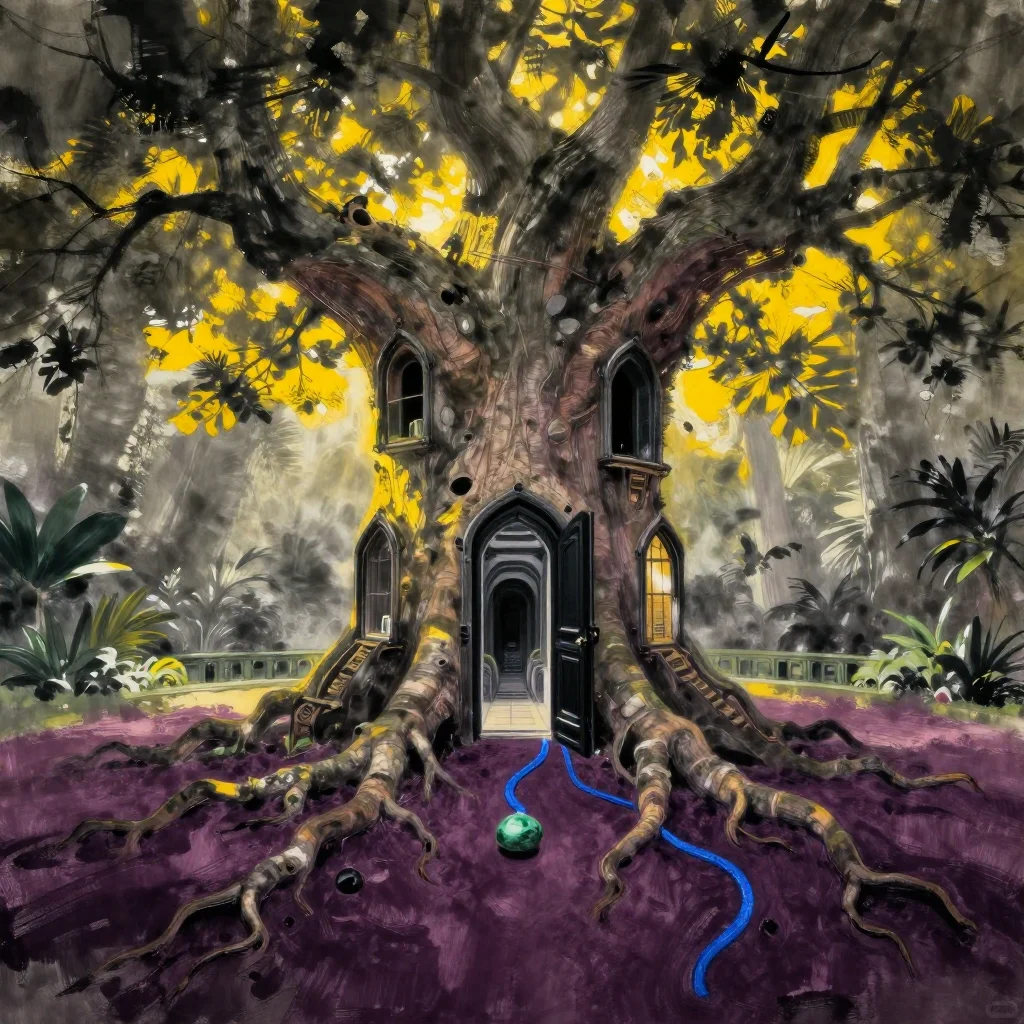
The garden had been built around a tree that grew doors. Its bark peeled them out by the hinges: narrow cream doors, iron doors sweating rust, blue nursery doors with brass knockers. Each led somewhere unfinished. One opened onto a subway before it was dug. Another onto the kitchen of Ilya’s childhood home, though the occupants were a species of patient, long-handed birds.
Every ninety minutes, the station’s landing computer offered her a descent capsule.
Ilya always declined. Earth was reliable only in reports. Reports said the rain had become courteous, the forests had adopted civic boundaries, the northern cities were quietly renamed. She had spent nine years beyond the low orbit, long enough for every certainty to expire into hearsay.
In her left pocket she carried a green stone, smooth and cold, found in the tree during her first orbit. In her right, she wound a blue thread around two fingers. The thread had come from her daughter’s emergency recorder. Its last complete entry contained Ilya’s own voice, but the useful words had been buried beneath mechanical warnings: atmosphere breach, atmosphere breach, keep the channel open.
History had used that voice as background noise. Ilya wanted it back before she returned to a world that might politely forget her.
A Door in Every Direction
The storm arrived as a pressure drop full of silver insects. They struck the garden glass with the sound of applause. Below, the great tree shuddered, and its doors began to move.
Ilya watched a yellow door swing inward and release a summer afternoon scented with hot pavement. A child came through, barefoot and crying, carrying a paper lantern that contained no flame. He held up an object Ilya recognized: her green stone, smaller and unscarred.
You haven’t gone down, he said.
Ilya tightened the blue thread around her fingers. The child’s eyes moved independently, one watching her face, the other searching the station’s dark ceiling.
She asked his name. He said Lio.
Then the tree split.
Doors rotated through the trunk without breaking it. Cream panels became plum-coloured panels became sealed pressure hatches. The garden floor buckled into stairways. People stumbled through: a beekeeper in a snow coat, an old woman carrying a bucket of seawater, a boy who wore her daughter’s face and held a recorder against his mouth.
They crossed the garden in impossible chains. Each person entered one door and emerged from another with a fragment of someone else’s memory clinging to their clothes.
Ilya caught the recorder boy. When she touched the machine, the blue thread tightened around her fingers and pulled toward a narrow black door at the tree’s base.
The Room on the Wrong Side
She entered without letting go of the boy. The black door opened onto the station’s own interior, but arranged as a room she had never seen. Its windows showed the garden from underwater. Its floor trembled with pressure from a storm still approaching.
At the far wall stood a console, its screens filled with the final minutes of her last flight. The recorder played.
First came the warnings. Then the cabin creak, a cough, Ilya’s younger voice shouting over static: If Lena is listening, do not wait for permission. Do not make my fear into the whole story.
She had forgotten those words. During the inquiry, she had repeated them, but the report retained only the impact, the oxygen loss, the damaged hull. Her warning had been clipped into evidence that proved she was unstable.
The storm tore the room apart by degrees. Water entered through the ceiling. A white door appeared beneath the floor, then a garden door, then her daughter’s bedroom door. Through it Ilya saw Lena grown old, reading beneath a lamp whose shade was made of green leaves.
But Lena was not alone. Behind her stood a younger Ilya, still in her flight suit, holding a green stone and a spool of blue thread. The girl looked at the doorway and shook her head.
The future Lena closed the door.
Ilya reached for it, and the black room flung her into the storm.
What the Tree Kept
She woke in the garden among doors spinning like loose leaves. The people had vanished. Saffron yellow light leaked through the broken panes, while deep plum shadows gathered beneath the tree. Smoke-grey air pressed the grass flat.
The recorder lay beneath her palm. It was broken, but one last message remained. Not a warning. Not an order.
Simply Ilya, speaking to Lena years ago, before either of them understood that the world would sometimes edit the record and call the missing part truth: You are not the sound behind the disaster. You are the person who came back to explain it.
Ilya played it until the storm consumed the batteries.
Then she entered the first door that opened. It led upward through branches, through smoke, through the space where the station had hung. Behind her, the garden doors slammed shut one by one. Their thunder sounded less like an ending than a city changing street names.
At last she stepped onto the observation deck. The planet filled the window, green stone under a saffron sky, its blue oceans crossed by a single bright thread.
Ilya remained there. She would not call it orbit forever. But she no longer mistook staying for hiding.
Below, somewhere she could not prove and no longer needed to fear, her daughter opened a door and listened.





