 Netwrck
Magical Realism.
The Museum of Borrowed Weather
On the third morning, the doors began changing their weather.
At nine, the brass door exhaled the salt smell of winter. Before noon, a narrow blue one had filled the gallery with the hush of deep water. By dusk, every brass hinge wept a different rain.
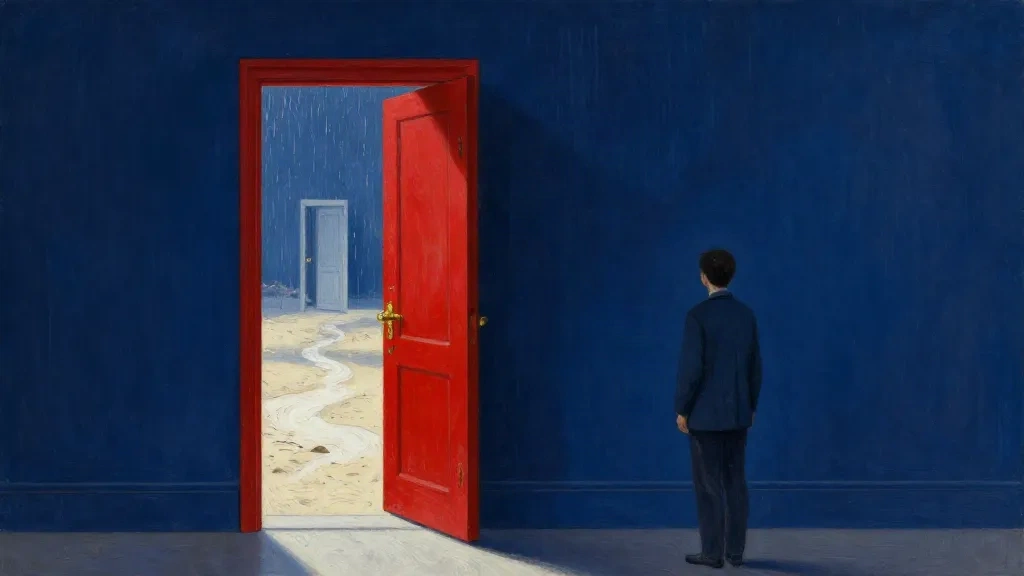
Elian Voss stood before the red door with her translation key resting against her palm. She was paid to decipher the dreams of sleeping machines: blue-black cabinets humming beneath museum floors, retired calculators dreaming in the language of loose wires. Her work was precise, patient, and solitary. She translated their longing into human sentences.
The red door had no plaque. That was unusual. Every other opening in the Museum of Doors carried a label—Courage to Return, Courage to Begin Again, Courage to Leave Without an Explanation.
Her commission was written on a brass card: Recover the buried promise. Do not open the dry riverbed.
Elian wanted the commission to be finished cleanly. She wanted to leave behind a better map than the one she had received from the museum: a map of streets, failures, silences, and all the places where her own courage had taken the wrong turning.
A Grammar of Missing Things
She set her ear to the red paint. Behind it, machines slept in rows.
One dreamed of a silver spoon tapping a child’s teeth. Another dreamed of a woman counting railway carriages until the number became a name. A third repeated the word after in seven different tones.
Elian wrote the translations in midnight-blue ink. Pearl light gathered around the letters as she worked.
Then the machines began speaking with human voices.
“I promised to come back before the river changed,” said one.
“I promised to stay until the harvest,” said another.
“I promised never to speak of the night we left,” said a third.
All the voices belonged to the same family: Mara, Elian’s former patient and the only person who had ever understood the machines’ dreams. Mara had disappeared years ago, leaving behind a dry riverbed, an unmarked map, and a promise nobody could repeat correctly.
Elian’s own mother had told the story differently. The river had flooded the house. Mara had gone north. The door had been locked from the inside.
Her brother said the door had been open. Her father said there had been no door at all.
Each memory contained a fact and a betrayal.
The Door That Would Not Open
The red door opened when Elian spoke the promise in her mother’s voice.
Beyond it lay a dry riverbed under a pearl sky. The machines stood along its banks, small and rust-colored, each one carrying a piece of the family’s history. At the river’s center, Mara sat beneath an unmarked door.
“I did not ask you to come,” Mara said.
“I was paid to find the buried promise.”
“Then you found it.”
“Whose version?”
Mara pointed to the door. On its surface, a family had carved three overlapping lines.
The father insisted he had promised to return with the dry river’s water.
The mother insisted he had promised to return before the water left.
The brother insisted the promise had never been made.
“The machines recorded all three,” Elian said.
“They recorded what each of us was afraid to lose.”
Then the riverbed cracked. Pearl light poured into the fissures, and the unmarked door began to open.
Behind it was not another room, but the museum’s first map: a blank blue field crossed by a single red line.
The Map Made Afterward
Elian understood then that the family had not lost its promise. It had lost the capacity to say it in the same voice.
She stepped toward the door. Mara caught her sleeve.
“If you map it now, one meaning survives.”
“If I don’t, none does.”
Elian took out her translation key. She did not choose the truest memory. She placed all three beside one another, then added the machine voices, the dust in the riverbed, and the silence after the flood.
The map bloomed across the blue field. A red line led from the unmarked door to the river, split into three paths, and became a road.
When Elian returned, the red door had vanished. In its place hung a small brass plate: Courage to Remember Differently.
She submitted her map with the final translation attached. Later, visitors complained that it led nowhere in particular.
That was how Elian knew it was good. A better map did not command a single destination. It gave each person a road, and trusted them to choose what courage waited at the end.





