 Netwrck
Historical Fantasy.
The Garden Above the Map
By the last century of the Union, Earth was no longer spoken of in the orbital settlements. It had become a rumour passed between navigators: green fields beneath a bruised sky, oceans full of remembered light, cities where people still touched one another without helmets. Captain Ilya Vale refused the rumour. He remained aboard the Asterion, a retired transport converted into a greenhouse, circling the vanished planet above its permanent cloud deck.
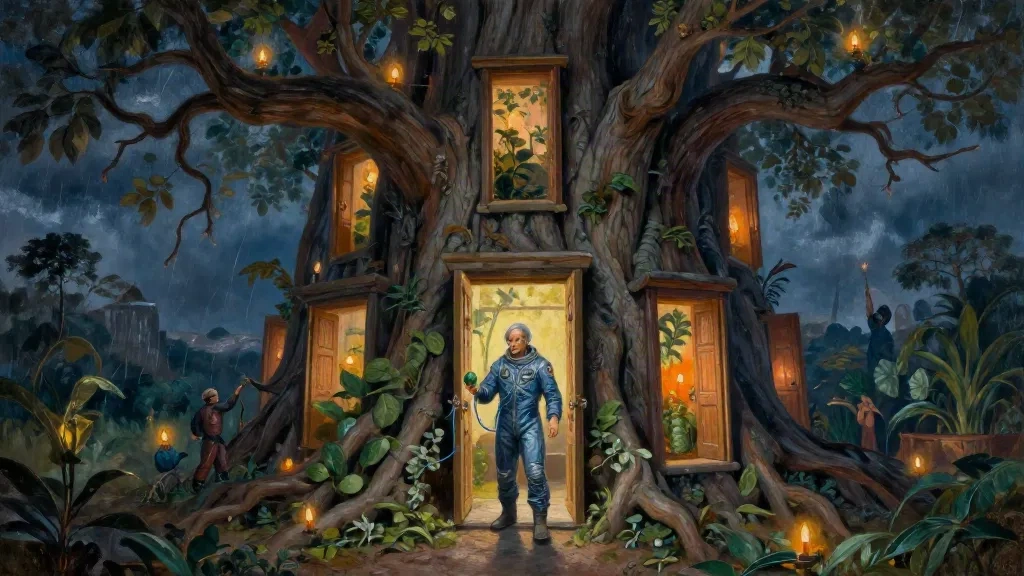
The botanical garden grew around one ancient tree. Its roots had been found beneath a frozen sea, where the bark was warm and smooth as a closed eyelid. The tree produced doors. Not doorways built by hands, but panels of living wood that opened onto places no chart admitted: a childhood kitchen, a battlefield before dawn, a city street under summer rain. Gardeners entered them with lanterns and returned carrying seeds, pollen, and scraps of voices.
Ilya kept his green stone in the pocket of his flight suit. It was a rough piece of orbital basalt, drilled once by a tool that no longer existed. Whenever he pressed it to the tree, he heard his daughterMira through the grain.
“You built the doors,” she had told him, seventeen years old and impatient with every instrument aboard the Asterion. “Build one that opens to me.”
He had answered that doors were not built toward people. They merely found them.
Now the tree was flowering with grey leaves, and the garden lights burned in the colour of tobacco. Ilya stood beneath the highest branch, listening to the pipes shiver with wind. He intended to recover Mira’s voice from the vault where history stored its background noise. He had waited nine years for the storm to make the doors move.
What the Storm Carried
At midnight, the warning bell sounded without a hand upon it. The doors began opening all at once. One led into a room filled with blue snow. Another opened on a forest where every tree spoke a dead astronaut’s name. A third exposed a field of empty chairs.
Ilya fastened the blue thread from his daughter’s old scarf around his wrist. He had kept one length in his locker, unwashed, though it had faded almost white. When the smallest door appeared at the base of the trunk, its hinges made no sound. A green stone rested on the threshold.
He recognised the stone. It was the exact shape of the one in his pocket, though the pocket was empty.
Across the garden, the horticulturist Sera called out. Three workers had vanished inside a door to the old observatory. Another door was opening around Ilya’s arm.
He could not reach the vault from the ground. The threshold had become a sheet of storm-lit rain, carrying faces that were almost familiar. In it he saw Mira at the age of eight, laughing beneath a paper sun. Behind her stood the recorded voice of every person who had vanished during the Transfer: announcements, arguments, lullabies, the last words of the world below.
“Father,” the child said, “I am not lost. I am being ignored.”
Ilya gripped the green stone. The door seized his shoulder.
The Room That Changed Its Walls
He entered.
The storm did not carry him away. It rearranged the garden around him. A corridor of black leaves became a kitchen, then a railway platform, then a hospital ward. Each change left one object behind: a green stone, a blue thread, a doorframe polished by many hands. He followed the thread through the shifting rooms. At every junction, Mira’s voice grew clearer.
“I recorded myself for you,” she said from a wall. “You were asleep.”
“I was in orbit,” he said.
“You were always in orbit. Even when I was in the room.”
He reached a chamber of steel-blue glass. Shelves rose into the dark, holding years of human speech. The vault had been built by archivists who believed the future would need fewer names. Each voice had been stripped of its context until it became a signal: affection, warning, apology, report.
Mira’s was there. He knew it by the slight breath before she spoke.
“Dad, if you hear this, do not come down. Stay where the sky is quiet.”
The storm struck the tree. The chamber tilted. Doors slammed open across the shelves, and workers from the garden stumbled through, carried in by impossible weather. Ilya caught the blue thread before it tore away, then wrapped it around the green stone.
The stone opened. Mira’s voice returned, whole and fierce.
The Door That Held
He took her into the smallest door, where a reflected candle burned despite the absence of flame. Behind him, the vault’s voices collided: every forgotten person speaking at once. He could not save them. He had not come to save them. He had come to recover one voice, and history had tried to reduce it to a report.
“I heard you,” Ilya said. “I am here.”
On the other side, the botanical garden had returned. The storm stood beyond the glass, bending the tree and its doors into new configurations. Workers clung to branches. Sera reached upward with a pruning hook. The small threshold was closing, its living wood warm against Ilya’s palm.
He stepped through before it sealed.
When the rain stopped, every door in the garden opened onto the same place: the Asterion’s observation deck, looking down at Earth’s blue curve. In the branches, hidden among the grey leaves, a single green stone glowed under reflected candlelight. A blue thread ran from it to the tree’s heart.
Ilya did not leave orbit. He climbed onto the branch beside the door and listened as Mira’s voice entered the living wood. Then, for the first time since the Transfer, she spoke to him without recording.
“You came,” she said.
“Not yet,” he replied. “But I heard you.”
The doors opened inward. The garden breathed. Below them, the world that had become a rumour turned slowly beneath the stars.





