 Netwrck
Weird Fiction.
The Hinges of Absence
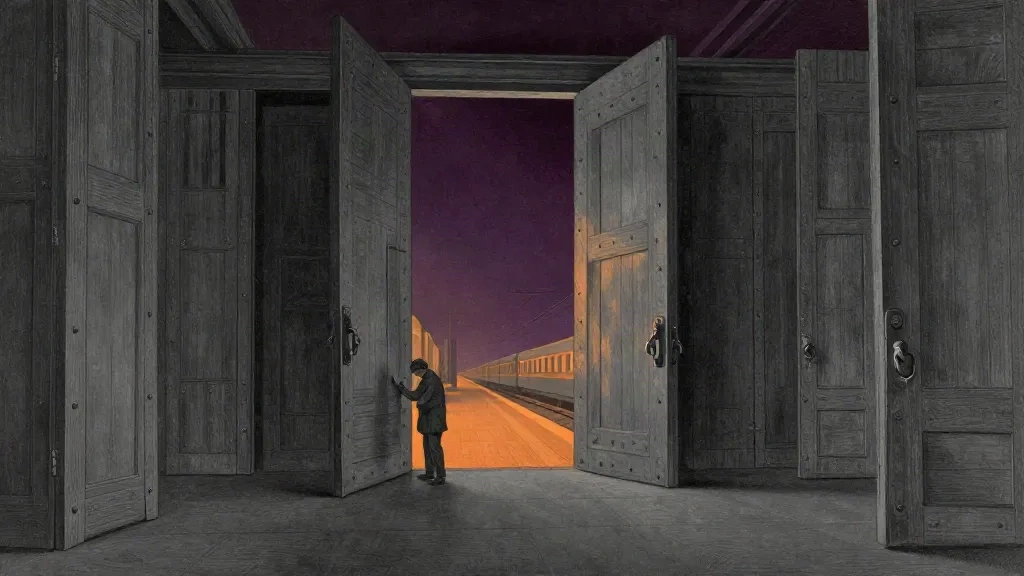
The museum had no walls, only doors.
They stood in saffron rows beneath a ceiling the colour of plum jam: narrow green doors, red doors swollen with rust, white doors breathing frost into the smoke-grey air. Each carried a brass plate naming a kind of courage. The Patience of Sinking Ships. The Mercy Required to Leave. The Refusal to Become Useful.
Orin worked at the blacksmith’s table between them. His hammer rang across hinges for doors whose frames had vanished. There remained only the doors, hanging upright over black floorboards, and the repairs that kept them from folding flat.
He knew every hinge by touch. The spring in the courage of small mercies. The seize in the courage of saying no. One door carried a stain shaped like a closed eye, and its hinge had been repaired so often that Orin could close it without looking.
On the morning the future arrived, its hinge lay unfinished on his bench.
It was a long iron tongue with a notch for the ninth and fourth teeth, worn at a place that might be palm, might be boot. A saffron ticket rested beneath it, printed not for a destination but for a moment: ARRIVAL: AFTER YOU CHOOSE. Orin’s old pocket watch was missing a hand, so he could not say what that moment was.
He cleaned the hinge. He oiled its bright shoulder. On the museum’s tea cart, beneath the chattering sparrows of the Courtyard Door, sat his empty teacup.
What the Museum Preferred
The door did not yet exist.
Orin could feel where it would be: three paces from the last row, where smoke-grey air thickened into the unfinished distance reserved for courage without a known destination.
“We don’t repair those,” said Vey, the keeper of the admission ledger.
She wore plum sleeves buttoned to the wrist. A line of pale numerals was embroidered inside one cuff: 954.
Orin tapped the ticket against the iron. “The work is sound.”
“That isn’t the question.” Vey placed the empty teacup on his bench. A thin grey rope climbed from its rim and vanished into the ceiling. “A hinge may be sound and still turn a door toward a choice it cannot survive.”
Beyond the doors, boots passed in corridors the museum did not admit to owning. Each footfall made a possibility go quiet.
Orin had repaired doors for courage that returned, courage that was never called, courage that took the wrong train and still saved someone. He understood that an opening could be a kindness or a catastrophe. What he did not understand was why a catastrophe required locking.
“What do you profit from the closed ending?” he asked.
Vey’s hand closed over the teacup. “Same as everyone who keeps a mystery: I am paid when the question cannot be finished.”
She was right. The museum’s trustees sold access by the layer. Visitors could admire the courage of falling. They could rent a whiff of the courage to begin. But beyond the final door lay the Chamber of Unchosen Endings, where every future the world had rejected gathered, nibbling the hinges from the other side.
The trustees called the damage atmospheric.
The Door That Owed Him Nothing
Orin waited until the visitors had gone. He kept his ticket beside the empty teacup and sharpened his tools until midnight, when the doors began whispering in their separate sleeps.
Then a woman came through the Courtyard Door wearing smoke-grey mourning clothes. She carried no lantern and feared no shadow, though the brass plate said she embodied that.
“If you hang the hinge,” she told him, “one future becomes available.”
“Only one?”
“Only one that has earned its ending. The rest are still becoming.”
She lifted the saffron ticket between two fingers. On its reverse, in soot, was the figure 954.
“The trustees know,” Orin said.
“They know the number. They don’t know the door.”
She set the ticket down and placed two fingers in the teacup. No tea appeared. The grey rope tightened.
Orin drove the hinge into place.
The empty frame rang like a bell struck underwater. Smoke-grey air folded outward, revealing a room lit by late saffron sun. Beyond it stood a railway platform beneath a plum-dark sky. His forge had been rebuilt there. Copper tools hung on a wall. A young apprentice waited beside the fire, alive with impatience.
On the platform rested a paper cup, warm and empty.
He could smell coal, iron rain, bread baking somewhere beyond the platform’s edge. Every muscle in him knew the life waiting there: a morning entered rather than survived.
The price came at once.
Elsewhere in the museum, hundreds of hinges slammed shut. The visitor doors began to tilt in their rows. Beyond the unchosen chamber, a vast and patient darkness pushed against the black floorboards.
“One door’s weight moves all doors,” the woman said.
Orin held the ticket over the flame.
The Courage of No Ending
He did not have to destroy the hinge. He could hammer it loose, keep the future closed, return to the safe labour of repairing what could never arrive.
Instead he turned the ticket over. The soot digits shone. A departure time had appeared beneath them.
Not for the platform beyond the door.
For the museum’s last corridor, where smoke-grey air led to a staircase descending beyond the sign for the Unchosen Endings. There was no brass plate on that stair, no name for the courage required to leave every future possible.
The trustees rushed between the leaning doors, shouting about premiums and permits. Vey reached Orin first. Her plum cuffs were torn; the grey rope was wound tightly around her wrist and vanished into the teacup.
“If we go down,” she said, “there is no guarantee we return.”
“No,” Orin said. “That’s how it earns one.”
He took the empty teacup in one hand and the saffron ticket in the other. The woman opened the future-facing door fully, holding the weight despite the darkness pouring through it.
Then they crossed the threshold together.
Behind them, Orin’s apprentice raised a hammer in the saffron room. Ahead, the unchosen endings cried out like freight trapped below the rails. The staircase did not promise courage.
It asked only that they keep choosing while the way remained unwritten.





