 Netwrck
Magical Realism.
The Last Window
Every night, the theatre performed tomorrow's discarded endings. The house stood behind the ordinary station, hidden by a wall that looked like brick until midnight, when it opened onto velvet curtains and a stage smelling of rain on warm glass.
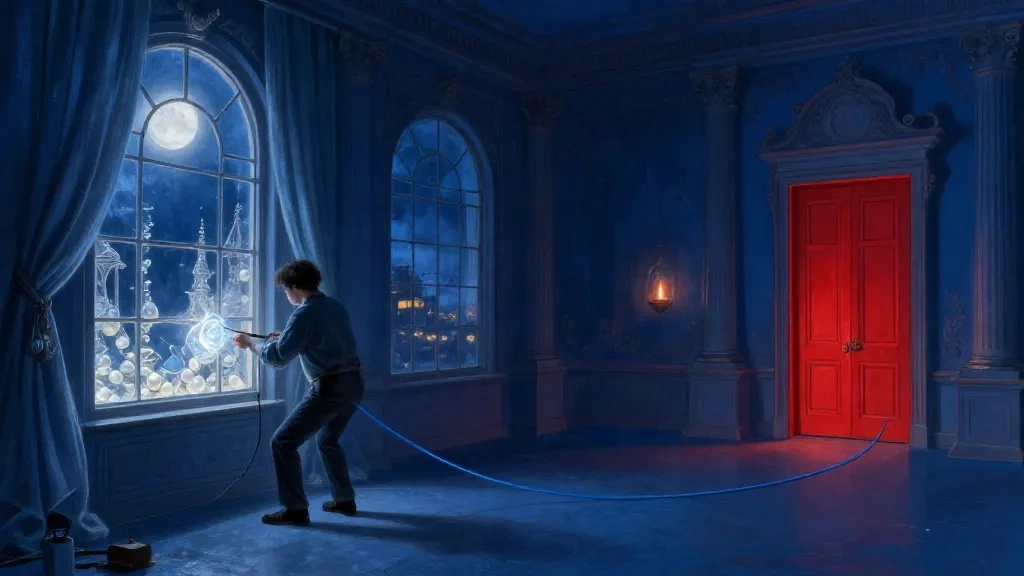
Backstage, Mara worked the furnace alone. She was a glassblower, though what she shaped was not cups or bottles but windows for rooms in other worlds. Each pane was cut for a particular need: a widow who wanted to see sunlight without remembering the funeral, a sailor who wanted a sea that could not sink, a child who wanted a horizon beyond the edge of the sky.
Her own window was plain. It showed the kitchen at dawn, the blue cup beside the sink, flour on the table, her sister's footsteps in the hall. This was the ordinary morning Mara had tried to keep for seven years. Every morning, the theatre collected it and sold it to someone else.
That night, a blue thread appeared under the furnace door. It crossed the floor, climbed the wall, and vanished through a crack in the stage. When Mara touched it, she heard her sister's laugh from behind the scenery.
The Price of Safety
On the other side of the thread was the theatre itself, seen from within its walls. Rooms opened off the corridor, each containing a rejected future. In one, a city floated above the sea. In another, a man kept returning to the same goodbye. In the third, no one spoke, and everyone remained alive.
An unmarked door stood at the far end of the corridor. The blue thread passed beneath it.
The theatre's keeper waited beside the door. He wore a red coat, though the single red door behind him was the only red thing in the building. He told Mara the thread led to her stolen morning.
“It can be returned,” he said. “But a path grows safer when no one speaks the truth.”
Mara asked what he meant.
“Say that your sister left because she was afraid,” the keeper replied. “Then the door will open farther. Say instead that she left because she was brave, and the path will become slippery.”
Mara understood then. The theatre did not punish falsehood. It punished certainty. The more completely people agreed on the truth, the less room the world had for anything else.
She entered the corridor and found a procession of endings walking beside her. Each whispered a different account of her sister. One had died in a winter storm. One had married a stranger. One had forgotten Mara completely. One had simply grown tired.
Mara told the truth she had avoided: her sister had left because she was afraid, and because Mara had pretended not to notice. Each word loosened a brick in the wall. The blue thread brightened.
The Unmarked Door
The path became a staircase sloping downward. At the bottom, the unmarked door waited beside a pool of black water. Beyond it was the kitchen, exactly as Mara remembered it. Her sister was pouring tea. The blue cup steamed on the table. Outside, birds tested the first pale branches of morning.
Mara reached for the handle.
The theatre shuddered. A voice behind her said, “If you take it, another ending will be discarded.”
She turned. The keeper stood at the top of the stairs, holding the blue thread. Behind him, every door in the corridor had opened at once. From each came a life that could have been hers.
“You cannot keep one morning without giving something else away,” he said.
Mara looked through the door. Her sister looked up.
“I was afraid too,” the sister said. “Not only of leaving.”
That was the truth the theatre had omitted.
Mara took the blue thread and tied it around the door handle, then opened the door all the way. The stolen morning entered the theatre, filling the corridor with birdsong, flour dust, and the smell of tea gone slightly bitter.
Other endings poured out behind it. The theatre shook as it tried to sort them. The keeper reached for the red door, but Mara caught the thread.
An Ending That Could Move
By dawn, the theatre had changed. Its stage was bare except for an unmarked door. The blue thread hung above it in a loose line, bright as a vein. The keeper sat on the floor, no longer red, looking at his empty hands.
Mara returned to the workshop and placed the kitchen window in a frame. It did not show a fixed scene. It showed the room changing with the hour: rain, then sun, then the long blue shadow of evening. Her sister knocked from the other side and asked why the glass was warm.
“Because it remembers,” Mara said.
That night, the theatre performed a new ending. No one knew who would leave, or what might be lost. The audience sat in silence while an unmarked door waited backstage, and the blue thread trembled whenever someone tried to tell them what came next.
Mara left the window open. The morning entered freely, carrying with it the taste of tea, the sound of footsteps, and one small, impossible promise: that not every ending needed to be discarded.





