 Netwrck
Weird Fiction.
The Hinges of Absence
At noon, the river ran east beneath a saffron sky, carrying leaves and bottle glass past the border town's customs house. At midnight, it turned west, carrying the same things back.
Everyone had learned to build for the change. Shopkeepers weighted their shutters north. Children memorized the two routes to school. The mayor posted notices instructing citizens not to follow the water after the twelve bells, though the notices changed their instructions every night.
Near the old quarry, Mira worked a hammer shaped like a crescent. Her forge stood where the road divided: one branch toward the plum-dark hills, the other toward the river. Customers brought her locks, latches, and hinges from houses that still stood. But some brought hinges from houses that did not.
They arrived in her basket with dust of impossible colors. A hinge from a door that opened onto winter. A hinge from a door sealed behind a drowned orchard. Once, a woman brought a bar of black iron and said, “The door is on the other side of the river. It has no house.”
“Then it does not need a hinge,” Mira said.
The woman had placed an empty teacup beside the iron. Its rim was chipped, and a brown crescent of tea remained in the bottom.
“It needs you,” she said. “Come at midnight.”
Mira did not go. The next evening, the woman returned, older, or perhaps merely more tired. The teacup was gone.
At the third midnight, Mira found the hinge waiting beside her anvil. It was enormous, taller than her shoulder, and cast in the shape of a bent key. Its surface smelled of smoke and saffron. She carried it to the river because curiosity is a forge of its own, and because she had never understood why the town paid her to mend what could not be opened.
What the River Carries
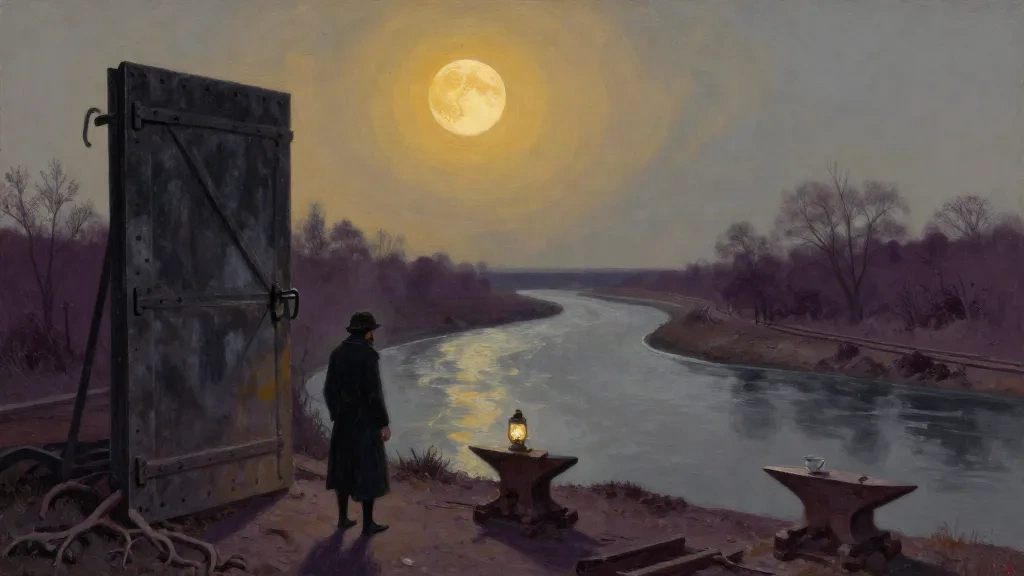
The river turned before she reached the bank. Its new current moved against the moon, black water folding around stones that shone like wet coal. On the opposite shore stood a door.
It was taller than the customs house and wider than the mill. No walls met its frame. It hung alone in the smoke-grey air, its hinges sinking into the earth like roots.
A ticket lay beneath it.
The ticket was warm. Its route ran from Border Town to a place called Vesper, with a departure time one day from now and an arrival time marked by a black star. Mira had seen that star on old maps, though the maps had been burned before she was born.
On the riverbank, a lantern moved. The woman from the forge stood beside it, holding an empty teacup in both hands.
“The river takes a door once each year,” she said. “The town pays to have it returned.”
“Who benefits?”
“Everyone who lives here.”
Mira looked at the dark water. In its surface, the town appeared twice. One version had chimneys, children, and smoke rising from cookfires. The other had only the customs house, its windows nailed shut.
“Why?”
The woman drank from the empty cup. “Because a closed mystery is a border. Open it, and the town loses its shape.”
Behind Mira, footsteps moved along the road. The mayor, the tax collector, and three men carrying lanterns had followed the light. Their faces were pale in the saffron glow. The mayor held a ledger made of blue leather.
“Turn back,” he said. “The door is inventory. It does not belong to you.”
Mira looked at the ticket. The departure time had changed. It was no longer tomorrow. It was tonight.
A Future Without Its Ending
The blacksmith understood then that the town did not fear the door. It feared what the door might choose.
She drove the great hinge into the riverbank. The metal sank deep enough to shake the water. The empty teacup in the woman's hands cracked clean in half, releasing the smell of bitter leaves.
“You cannot repair a future,” the mayor said.
“I can give it somewhere to begin.”
Mira struck the hinge once. The sound traveled through the earth, through the river, through the houses behind her. Windows brightened. Locked doors opened inward. In the second version of the town, a child began to cry.
She struck it again. The door cracked from top to bottom. Beyond it was not a room, but distance: fields under a saffron moon, a railway platform, a figure waiting with an empty teacup.
The ticket tore free from the ground. Its arrival time disappeared.
“Choose,” said the voice from the doorway. “A future earned, or a future chosen.”
Mira stepped through. The town fell silent behind her, the river changing direction beneath the last bell.
The Morning Afterward
She woke beside an unfinished railway line, holding a hammer in one hand and the ticket in the other. The arrival time was blank. Beyond the fields, a red house stood with one enormous door and no walls.
Behind her, the border town had vanished. Or perhaps it had merely become small enough to fit inside a teacup.
Mira set the ticket on the anvil she had carried without noticing. Hammered its blank surface until a new line appeared.
Then she began to build the hinges.
By then, the first hinge was already beginning to rust.





