 Netwrck
Weird Fiction.
The Hinges of Evening
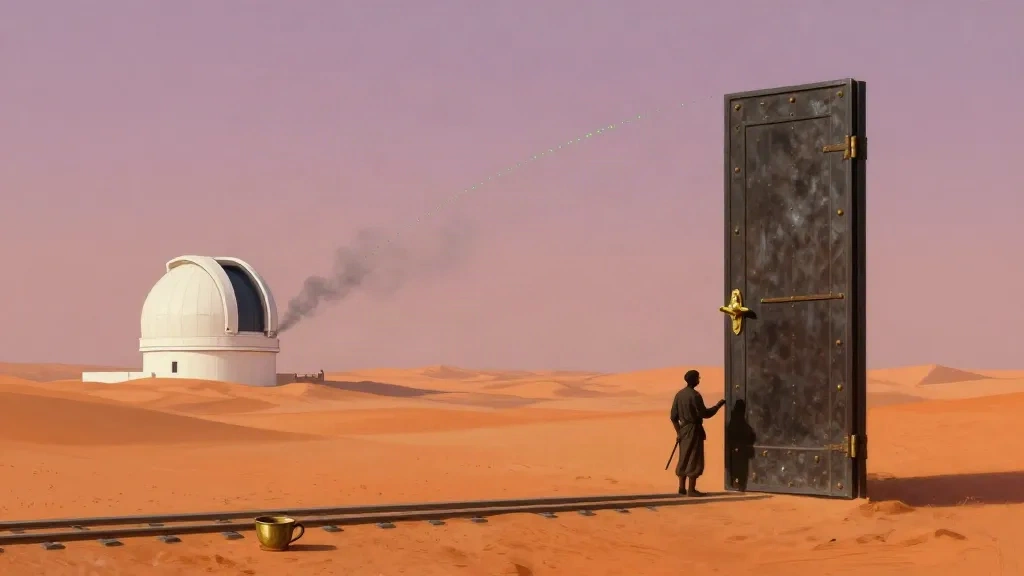
By noon, the saffron sun had bleached the desert until every dune seemed cut from old paper. Above it hung the Meridian Observatory, a white wheel of domes and brass antennae, tracking stars that sent messages in bundles of green light.
At its western gate, Nera repaired the hinges of enormous absent doors.
They stood nowhere: no jamb, no threshold, no wall. Each was a slab of iron suspended in smoke-grey air, broad as a house and taller than the telescope tower. Wind moved through them without opening them. At night their hinges warmed, and the stars wrote sentences in the dust.
For twelve years, Nera had oiled the brass knuckles, tightened the pins, beaten out every flaw. The doors were silent, but not abandoned. Each evening, the star-screens showed a room beyond: a child waiting beside a flooded river, a city burning backward, a man holding an empty teacup beneath a violet moon.
Then the messages stopped.
The Price of an Unfinished Sky
The observatory’s directors announced that the sky had entered a Closed Interval. No future observation would be permitted until the anomaly had been understood.
Master Vell came with guards and a brass seal. He controlled the water condensers, the desert tram, and the archives where the oldest star messages were stored. Since the Closed Interval began, he had sold tickets to the tram as if tomorrow were a distant city. His ledger showed journeys accepted, not journeys made.
“The doors remain closed,” Vell told Nera. “A mystery is a well when you own the bucket.”
That evening he placed a train ticket on her workbench. The destination was printed in smudged ink: LAST ARRIVAL.
Nera turned it over. The return date remained blank. She had carried it for six years, waiting for an ending that had not yet decided to arrive. The observatory’s sealed predictions offered her a cleaner fear: her own disappearance, a life with no witness, a final sentence cut before its verb.
“I want to see the last train,” she said.
Vell smiled without warmth. “Then repair Gate Seven. Its hinge is failing.”
Gate Seven
Gate Seven was unlike the others. Its iron face bore no dust, only a shallow handprint. When Nera tested it, the hinge complained in the voices of people waiting beyond.
She worked by day, while the smoke-grey air pressed close. At night, Vell’s guards watched the tower, and the empty teacup in the gatehouse cooled beside her lamp. It had belonged to an assistant astronomer who vanished after questioning the Closed Interval. Nera had kept the cup because emptiness was not the same as absence.
On the seventh evening, the hinge opened one finger-width.
Beyond it lay a room in the observatory. Nera saw herself entering through the western gate, young and carrying a red toolbox. The future-that-might-be flickered beyond the doorway.
In that version, the stars had been studied for six years, the river had broken its dam, and three hundred people had vanished from their records. Vell stood at the console, selling certainty to the desperate.
“The Closed Interval prevents disaster,” the future-Nera said. “It also prevents preparation.”
Nera’s hand tightened around the hinge. She could force the door wider. She could bring warning forward, and perhaps make herself the event that changed every ending. Or she could close it, preserve the only peace still guaranteed, and let the future remain a door she had never learned to use.
Behind her, Vell ordered the guards to unbolt the tram.
The Last Arrival
The desert train emerged from heat like a long-held breath. Its brass wheels clicked over the rails, and every window displayed a different sky.
Vell climbed aboard. “You can still choose,” he called. “A closed future is safe.”
“No,” Nera said. “It is merely unfinished.”
She placed the train ticket into the empty teacup. The paper darkened, softened, and became a small blue flame. It burned without consuming itself.
Nera struck the hinge with her hammer.
The absent door rang across the desert.
Gate Seven swung wide, and every unopened door in the observatory answered. The saffron sunset broke into panels. Smoke-grey air poured upward, carrying names, warnings, and the unintelligible laughter of possible stars.
Vell reached for the brake. The train stopped. The future did not.
It arrived in fragments: a hand on a different handle, a child beside a repaired river gate, an empty teacup filled at last. None of them guaranteed salvation. Together they made a choice possible.
By morning, the observatory belonged to no one. Its doors stood open on the desert, and people walked through them carrying questions instead of tickets.
Nera kept the last unopened door. Its hinge was sound, its surface warm, and its waiting no longer a prison.
She oiled it carefully, then stepped away. Some futures arrive only when no one owns them.





