 Netwrck
Fantasy.
The Lake Beneath the Garden
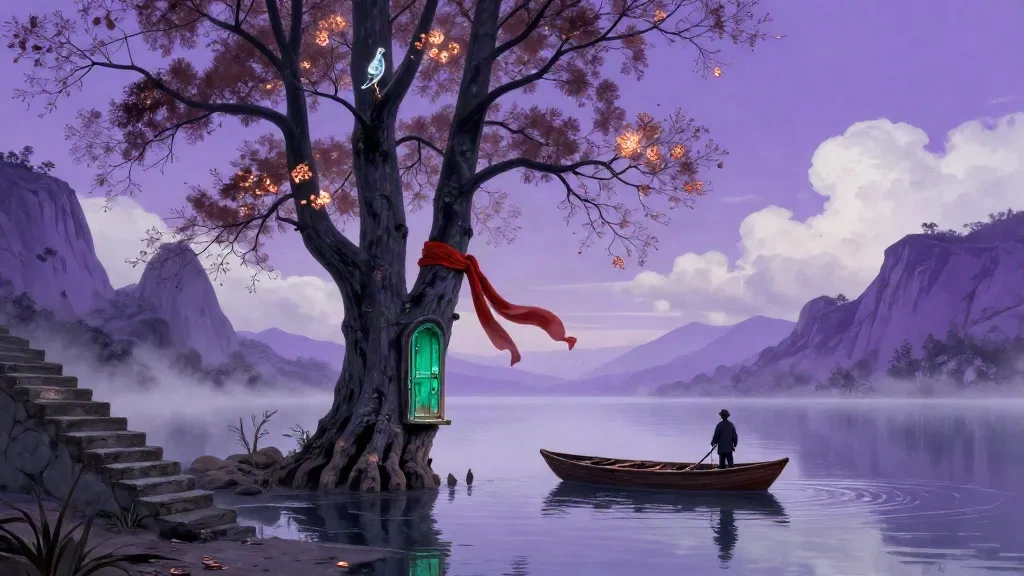
Twice each month, when the sea withdrew beyond the violet cliffs and left the smell of iron on the wind, Vesper Lake appeared beneath Orison Garden. It came up the way a held breath comes up: quietly, and all at once. Neral rowed across it before dawn, carrying botanists with their knees full of pinned moss, schoolchildren who never stopped naming things, and now and then a widow who wanted to stand once more above the place where her house had been.
The water was clear to the bottom. Under it lay the old town's drowned geometry: flagstones worn round in the middle, a flight of stairs descending to nothing, the white ribs of an observatory dome, and along the shore the black stumps of orchard trees that had borne fruit in a climate no longer warm enough to ripen it. The lake did not mourn any of this. Water is the most patient archivist there is; it holds what is put under it and does not comment.
At the center stood the Door Tree.
It was older than the garden around it and older than the lake, and its bark was the black of a well-mouth. From its limbs grew green copper doors, some ajar, some sealed, some with hinges of verdigris the size of a man's forearm. They opened onto narrow rooms that smelled of rain. They showed empty horizons under a sun the wrong colour. One, when Neral was nine years old and had not yet learned to be careful about doors, had opened onto the world as it had been before the sky acquired its second moon.
He had been standing in the doorway with his hand on the frame. Beyond it the light was green-gold and lay low in the west, and the trees in that version of the orchard spoke in the old names — arren, tovel, the small-bitter ash — and a woman with copper hair was holding an arch-stone on her shoulder, waiting for him to help her set it down.
He had helped her. He remembered the weight of it, the way the stone warmed in his palms.
Then he had told his mother, and his mother had told the Warden of Names, and the Warden of Names had come with brass instruments and a company of men who said they were protecting the district, and something had gone out of the world like a lamp being pinched between two fingers. Not all of it. The lake and the tree and the doors stayed. Orun stayed, which is to say she stopped changing. Everything she had been in — the arch, the second moon, the light on the western water — left her, and she kept the last version, and she has been waiting under a tree ever since, patient as a kept thing.
Thirty-one years. Neral had a daughter in that time, a daughter who was fourteen now and who thought the lake was a party trick of the tide.
A Map Against Honest Use
The map arrived in October, folded inside a glass bird that stood on the bow of his boat without flapping and without appearing to breathe. Its wings were clouded with something like breath on a winter window. Its beak was chipped violet, the exact violet of the cliffs above the lake. A red scarf trailed from its neck though the October air was warm enough to keep the rowers in shirts.
He had carried a glass bird once before. He did not say so aloud, and he put that not-saying down carefully in the place where he kept the things he was not ready to look at.
The first time he spread the map it showed an ordinary route from the eastern landing to the tree: a straight black line, an arrow, a neat little border in the cartographer's hand. He burned red leaves along that line, one at a time, the way you burn to mark a thing you intend to keep. The ink moved. The leaves slid west. And beneath them the map wrote, in a small unresisting script:
You still mistake endurance for a destination.
He laughed out loud on the empty water, which is how he knew he was afraid.
He went to the gardeners. Petho and the two brothers who keep the glasshouse, who know every tree in the district by the sound it makes in a hard frost. He laid the map on the potting bench and said, Tell me where to look. The names went first. Petho's name, scratched into the corner in his own hand, lifted off the paper like frost from a pane. Then the paths stopped being paths and became channels: the map was telling him how to cross a marsh that no longer existed. And the Door Tree moved, walked off the margins of the paper, and set itself down in a place it had never grown — north of the cliffs, on bare rock, in a wind that would have killed it in a year.
He showed it to a child. The district's children had swum the shallows all summer; this one was Ilme's youngest, and Ilme ran the ferry before Ilme had legs. The child looked down at the drawn figure of himself standing at the water's edge, and turned, without lifting his hand from the paper, and looked up at the glass bird on the bow.
That is the wrong bird, he whispered. There were two. Ask her for the other one.
And then he did not remember having said it, and asked Neral what a wrong bird was, and Neral said a bird out of season, which was the sort of thing adults say to close a subject, and the child accepted it the way children accept weather.
He lent it to Captain Senn, who ran the seaward boats and had once, in a matter of tariff, told a customs officer that his hold was empty. Senn brought it back blank. Not white — blank, the way paper is when the writing has been taken out of it by a careful knife. Salt stained it in a ring, the ring a glass leaves on a table when wet.
He followed the map exactly once, out of pure obedience to the notion that he was being tested. It brought him, at the fourth hour, to a locked door beneath the observatory ribs, and behind that door rainwater struck against the other side in a hard, impatient hand, over and over, the way water strikes a stone it wants to move.
He stood there long enough to understand that obedience had not failed. Obedience had simply never been the door. The map would not tell a true thing to a man asking for a true thing, and would not tell a false thing either, and would not be finished with him until he understood the difference.
The Lies That Held
What held it was deceit, and the price of that was written on the other side of the coin in a hand he recognised.
He went to Senn with the best lie he owned, which was a lie with a number in it, because numbers are the part of the world men reach for when they are frightened. He said the map had shown buried silver under the western scree, four hundred weight, stamped, the sort of thing that made a man rich and quiet.
Senn was quiet for a moment. Then he said, You have never in your life liked silver.
No, Neral said. But I have liked watching you look at something.
That was the worst of it, and he chose it on purpose: not to deceive a man but to give him a true pleasure with a false object inside it, which is a different sin and which he would have to think about for a long time. Senn went west with two men and a spade. The map held its shape for three days, black lines and neat borders and an X over a scree slope where the sea had never left a stone, and during those three days Neral sat on the bow with his hands flat on the paper and read one buried object out of it and then put the paper away and did not look at it again.
A copper door. Numbered seven. Beneath the smallest moon in the Door Tree.
There is an accounting in deceit, and it runs on this: you may not take what is given, only what is owed. He had not been given a door. He had been permitted, by a mechanism older than he was, to lie once, and so he took a door, and the world took the rest of the price at the counter and did not itemise it.
The Door Numbered Seven
He told the glass bird the red scarf was a gift. It was the second lie, and the second lie was not for a person; it was for the thing that had been waiting, and Neral understood as he said it that this was a rule and not a loophole, and did not much like the shape of the rule, and said it anyway.
The map brightened. A white line ran out across the drawing of the lake and stopped under a lilac, and the lilac on the real bank directly above him, eleven feet of trunk and two hundred years of slow growth, opened like a mouth.
Under it was a stairway, cut clean, its treads white with something that was not salt.
He wrapped the bird in the scarf because the birds on the tree had all been wrapped, and because his hands needed something to do that was not praying. The stair went down further than the lake was deep. Twice he counted steps aloud to keep his mind on the counting, and twice he lost the number, and the second time he let himself stop counting because he had understood that the stair was not a stair but an argument he was winning by agreeing to be argued with.
At the last step was a copper door, polished to a brightness that hurt, in the door a place where a thousand hands had been and were not now. Neral put his palm flat. It was warm, which no door on that tree had ever been. Cold, the gardeners said, meant a room that had been closed. Warm meant a room still being kept.
He opened it and found Orun.
She sat in a round room with no floor visible, filling the walls with shelves, and the shelves with paper birds, cloud-white, hundreds of them, each folded from a single sheet and each with a small weight in the hollow of its breast. Her face was the face from the arch-stone: copper-haired, brow like a hinge, the small scar at the jaw where a door had caught her once in a world with different hinges. She had not aged. His memory of her had aged by three decades and worn through in the middle, the way a coin wears.
She wore a red scarf knotted beneath her chin.
You came through a map that would not tell the truth, she said.
You sent a bird that would not tell the truth.
I sent the only bird that could get there. She said it without pleasure, the way a doctor states a fracture. There was another. It is the one your lake is for.
Ilme's boy said there were two.
There are always two. One that carries and one that cannot. The one that carries must arrive having lied, because the road only opens for a traveller who has already proven he is willing to be wrong on purpose. The one that cannot tells the truth, and the truth here is a door that closes when you look at it. She looked up. You were the last one.
Last at what?
Last witness. That is not the same as last. I kept the last version, Neral. A version is a thing you hold. A witness is a thing that happens to the world. I have been happening to nothing for thirty-one years. Everyone else may forget, and most of them did, and the ones who did not are on the far shore of this lake with their hands over their ears.
Then she raised a small silver key, and he saw before she told him — because he had carried her arches at nine years old and the world had taken his hands for this — that the metal had been cut from a piece of his own childhood tooth. A splinter, no bigger than a grain of rice, and the cut of it was exact.
What the World Forgot
The garden grew doors because the old world was failing, Orun said. Not violently. That is the part the stories get wrong. It did not break. It was simply finished, the way a day is finished, and the things in it went on being true right up until they weren't. Every time we remembered it correctly, something here was forced to change to make room for the remembering. The map tried to return you to it. So it punished every honest journey until you learned that truth could be carried without being displayed.
Neral thought of the child on the potting bench, the name lifting off the paper, Petho watching his own name leave.
You made it do that.
The map is not a person. It is a room with the furniture taken out. What happens in it happens to you. He did not look away. Every honest road ends in your taking something from us. Not a stone. A name. A season. The older this district gets, the smaller the pool of things it can prove.
And the door?
I kept the world that vanished. Your believing memory kept the world you lost. Those are two rooms in the same house with a wall between them, and the wall is not spite. It is load-bearing. If either one entered the other, both would stop being rooms and start being noise, and there would be nothing on this coast worth crossing to.
Beyond her, the paper birds beat their cloud-white wings, and each one carried a single fact in its breast: the name of a tree, the hour the tide first came wrong, the shape of a door that is no longer on any tree, the whole of a man's last sentence. He asked what the facts were for.
They are for carrying. Not for giving. To be known, a fact has to be told to someone who is owed it, and being owed is not the same as being present, and truth is the only door in this house that opens from the wrong side.
Then she lifted the glass bird into her cupped hands, and the clouded breast of it was not empty. Inside, on a nest of scorched paper, a small flame burned in the colour of dawn, low and green at its heart, exactly the colour of the light Neral had seen in the west when he was nine.
Can anyone remember both? he asked.
Not anyone, Orun said. But something can.
The Arithmetic After
He came up the stair with the bird against his chest and the lilac closing behind him, and the sky over Vesper Lake that evening had one moon.
The other had not been taken. It was there, below the first, low over the violet cliffs, green-gold, familiar as a lamp set on a windowsill in a room you have left. He stood on the eastern landing and looked at both and could not make his eyes hold them at once. When he looked directly at the green one, the ordinary moon above it thinned. When he looked at the ordinary one, the green one became the afterimage of something bright and did not come back. He would have this for the rest of his life, and he would not be able to describe it, and he understood that immediately, entirely, without hope, in the doorway of the lilac.
He could not tell his daughter. That was the price, and it was the only price that had not been named out loud.
Nell came down to the landing the next morning with the oars across her shoulder and asked him what the green light under the moon was called. He had taught her the old names of four trees, badly, out of a childhood nobody had corrected him in, and he opened his mouth to give her the name of that light too.
What came out was the ordinary word for a star. He heard it land in her and go flat there. He nodded and went to the bow and untied a knot that did not need untying.
Then he tried the way the house allows, which is not a lie: he said, There is a thing about that light I will tell you when you are older, and you will think I am being dramatic. I will not be. I have simply been asked not to hand it over, and the asking was not done by me. She accepted that with the enormous, unbearable patience of a fourteen-year-old, and went out to the water.
Petho would not meet his eye for a season. The gardeners had lost names — not many, a page of them, the winter catalogue, three trees that had existed only in the district's own records and now existed nowhere and would never be recorded again — and the winter catalogue was Petho's work and Petho's loss, and Neral knew that the loss and the lie were the same event seen from two ends. He could not say so. So he mended the glasshouse frames in the off-season, badly, and Petho let him, which was a kind of sentence.
Captain Senn came back from the western scree in the second week of January with a broken spade and a bad cough and no silver, and Neral met him at the landing and told him the truth: that there had never been anything west but scree, and that he had said otherwise on purpose, and that he would take any fine the district chose to lay.
Senn listened with the face he made when weather changed and the sea did not.
You did it to get a door, he said at last. You were not lying to me about money. You were lying with money. There is a difference and I am going to spend the rest of the winter deciding which one I can forgive.
They did not speak again until spring. When they did, it was about rope, and it was enough, and Neral noticed that being forgiven was not among the things that had happened to him. Something else had: he had been let back in at a price he had not negotiated and could not name, which was the price of the bird, and which he was still paying in instalments.
The birds go out in twelves. Once every low tide, once every season, Orun's cloud-white birds climb out of the Door Tree and take the air over the water in a slow wheel, and each carries one fact. A fact gets out when somebody is owed it, and the oldest of Orun's rules is that being owed is not the same as being present, and so the birds do not land in open hands. They land in the second-best place: on the sill, on the ledger, in the case of the man who has been the last to be told anything, in the mouth of a fourteen-year-old on a landing who opens a paper bird out of boredom and finds four words in a hand nobody living uses.
Arren, tovel, the small-bitter ash, the bird said, or its weight said, or the air said.
Nell looked up at the green light low over the violet cliffs, and then at him, and waited.
He had one honest act left in him and it was a door that shut when you looked at it, and he understood at last, standing there, that this was not a curse laid on him by a mechanism or a room with the furniture taken out. It was a craft. Thirty-one years he had thought of honesty as a lamp he could set down anywhere. It was a lamp you carried with your hand shut, in the dark, uphill, for the person behind you.
So he lied to his daughter, and told her the old name of a tree that was not in the bird, and invented a ninth word for the green light, and gave it to her, and watched her take it and hold it carefully up to the light the way you hold something you have been told is yours.
She will remember that word. She will remember it more clearly than he will ever remember anything, and it will be wrong, and it will hold.
On the next low tide the red scarf streamed behind him like a road across the water. Above the lake the Door Tree opened all its leaves at once, and out of each one came the sound of footsteps on a road that existed in two places at once — the drowned road of the old town, and the new one along the garden wall, walked at the same hour, by the same people, in two directions, never meeting.





