 Netwrck
Fantasy.
The Jar That Wept
At violet dusk, when the fishing boats became dark shapes against cloud-white water, the sea returned a salt jar.
Mara Venn found it outside her sewing room, balanced on the sea wall as carefully as an egg. It was squat and blue, sealed with salt crusted into the grooves of its lid. Her brother Tomas had packed it the summer he drowned.
She held it against her chest. The old distance between them felt thinner than cloth under her fingers: eleven years of silence, one goodbye, the long afterward. Everyone in Bellwether had forgotten something to the sea. Each tide brought back one object, but never the hand that had lost it. Tomas’s blue cap had returned once. It had belonged to a man who had forgotten his son. Nothing came back whole.
“You came back without it,” Mara whispered.
No answer came. Instead, the salt on the jar loosened into grains shaped like letters.
Words Under the Glass
The next evening brought a glass seed.
It lay in Mara’s palm, clear except for a dark seed trapped at its center. The fishermen said no such seed grew in the western sea. Mara knew better. Tomas had shown her one during their childhood, explaining that the sea kept small beginnings safe until the right shore asked for them.
When she placed the glass seed beside the salt jar, the salt letters rearranged. A script appeared across both objects: sharp black strokes that changed whenever Mara looked away. The village clerk could not read them. The priest could not read them. Only Bellwether’s drowned had ever possessed eyes able to.
Mara understood the words slowly. They were the village agreement, old as the harbor wall. Its living signatures had faded, but its dead witnesses remained.
What the sea returns may be received only when keeper and owner consent.
Owner and keeper. Not finder and claimant. Mara read the clause again and again. Tomas had returned his cap, but the man who had lost it had forgotten his son. Both had refused the return, though neither knew it.
The glass seed warmed. One new word rose in the salt: door.
A Seam Through the Water
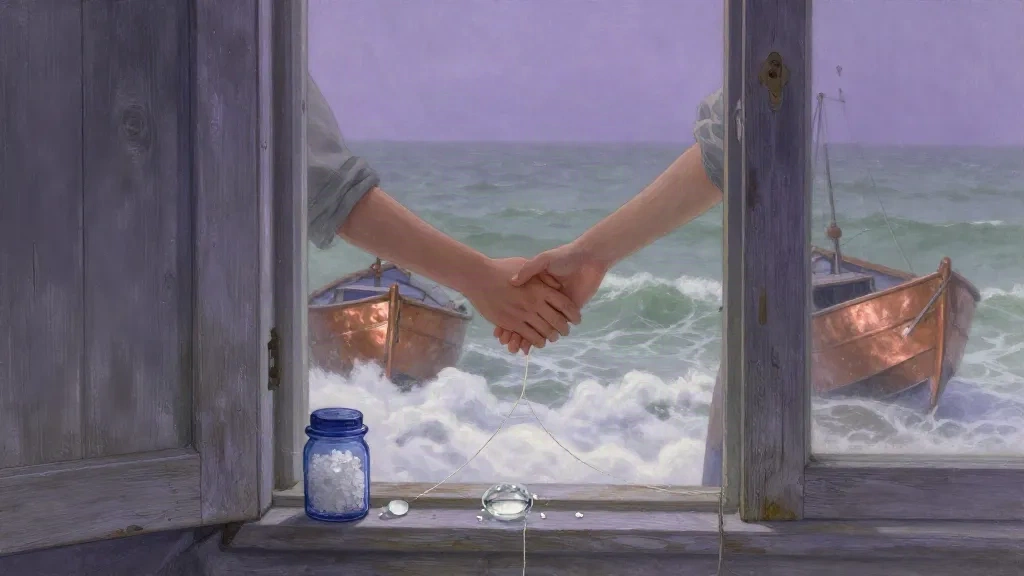
Mara took down the sign from her sewing room and leaned two cedar boards between the salt jar and the glass seed. With her finest needle she stitched wet thread from the jar’s rim to the seed’s point, asking the distance between herself and Tomas to close.
Needles were poor at answering questions. Her mother had told her so. A seam held what the wearer was willing to carry.
On the third stitch, a knock came from inside the door frame.
Mara did not open it. Consent was not curiosity. She pulled the thread tighter, listening.
“I kept the salt,” a boy’s voice said. “That is my consent.”
“And I kept the seed,” Mara answered. “That is mine.”
The thread drew taut. The boards filled with a gray transparency, neither wall nor water, showing only a boy of fourteen with salt in his hair. Behind him stood the drowned of Bellwether, blurred as storm clouds.
Then the village bell rang.
Old Ferrick slashed the hidden seam before Mara could knot it. He had signed the village agreement in his father’s blood. The living could not read its terms, he said, but the dead could, and dead consent was dangerous.
“Open no door to them,” he told her. “Not tonight.”
What Bellwether Owed
At dawn, Mara returned the needle to the sea wall.
Ferrick was right. The agreement bound the whole village, not one grieving household. She had stitched only her side of the distance. A door opening on one side was merely loneliness given hinges.
So she asked every keeper what they would surrender if the sea returned what they had forgotten. Some named old hatreds. Some named lovers. Some admitted they had stopped believing anything came home. As each answer entered the thread, a corresponding mark appeared on the glass seed.
At dusk, the dead replied.
One by one, the marks brightened: yes, yes, not yet, no. Ferrick’s remained dark. Beside it waited his drowned father, carrying the salt boat he had lost before his son was born.
“I cannot consent,” Ferrick said at last. “If I open that door, I must believe he forgives me.”
Mara drew the needle through the dark mark and left the loop unfinished.
Across the transparent door, Tomas took hold of the other end.
Neither pulled. The unfinished seam held them apart, but no longer divided. At high tide, the sea returned Ferrick’s father’s salt boat. The old man climbed out carrying nothing, because grief was not a possession that could be restored. He only held the boy’s wrist.
Ferrick’s mark turned gold.
Mara tied the thread. The hidden door opened inward, and cold air moved through her sewing room, smelling of rain, rope, and salt. Tomas remained on the other side, but he was no longer alone.
By morning, Mara hung a plain cedar door where no wall had been. It opened only when someone on each side put their palm to the wood and agreed, plainly and without enchantment, to meet.
On the first violet evening, Tomas knocked.
Mara opened it.





