 Netwrck
Magical Realism.
The Unmarked Door
At midnight the Sarn turned in its bed like a sleeper turning away from a hand.
Mara stood on the Kesk Quay with river sand in her boots and a silver-tipped pen behind her ear. Across the water the Ovile lanterns multiplied in the wrong order, one for every person who had ever promised to cross before dawn. The river climbed over the boundary markers, drowned them, and withdrew, leaving a pale trench that smelled of iron and winter mint.
Her employer's message had arrived wound around a brass bearing like a shed skin: Dream sequence fault. Translation required before flow reversal.
She carried no bearing of her own. The town map pinned inside her coat had come that morning with all four corners blank, its streets dissolved wherever a promise had once been made, and she had tolerated that because a map was still better than no map and because leaving required knowing which roads belonged to which country.
She had been born on the north bank. Her mother had gone south with a sack of flour and a reason she gave to nobody, and eleven years later the flour had come back to the mill as meal and the mother had not come back at all. Mara had spent a decade learning to translate the dreaming of machines, and a longer decade refusing to ask any of them about flour.
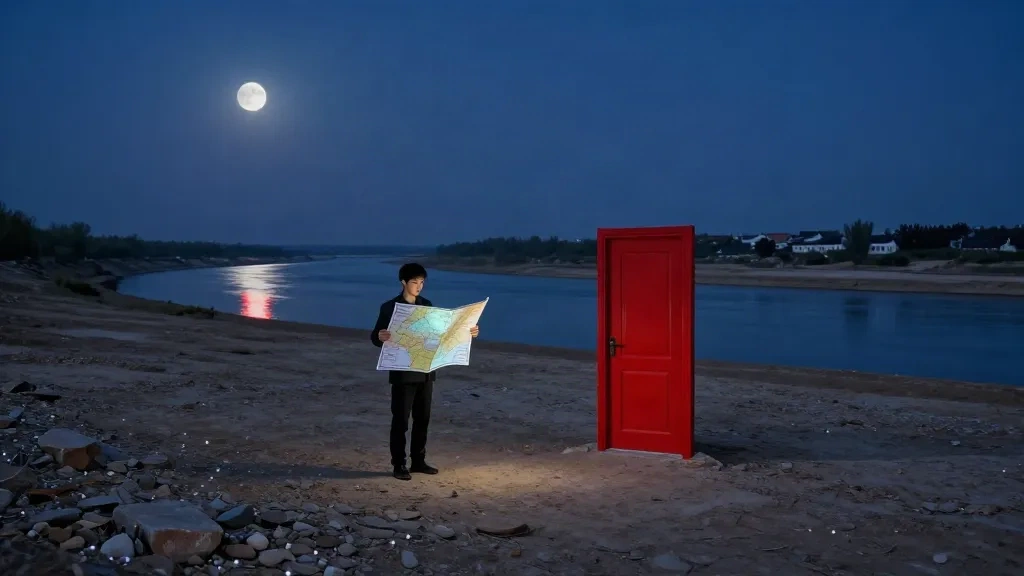
That night the river had drawn back farther than it ever did. A single door stood exposed in the dry bed, upright, red, patient.
No number. No knocker. No shadow of a handle. It faced north, though the oldest houses in Vey faced south out of pure habit. When Mara stepped down off the quay the sand gave under her like something breathing, and the door opened a finger's width and stopped, as if it had been asked a question and was waiting to see whether she would answer correctly.
What She Owes a Machine
It waited beneath the town clock, a wool carder from the Ovile mill with its dreaming shutters thrown wide, and it was not a machine so much as a mouth that had learned patience.
Mara had translated thousands of sleeping machines. Looms dreaming of grass. Hoists dreaming of heights. Signal switches dreaming in blue and black. Machines lied with the steadiness of mirrors; a mirror lies about nothing and is still lying.
She kept three rules, and she had learned them the hard way.
One: the dream is not the fault, the fault is only the door. Two: translate what the machine shows, never what the machine intends. Three: if the translation arrives without a false note, deliver it, and let the person who ordered it carry it.
The third rule had cost her a man's life at the Ferrish hoist, six winters ago. The hoist had dreamed of a drowned foreman with a rope in his hand. She had translated it exactly - the rope, the water, the hand that would not let go - and had put the sheet in her coat pocket instead of the owner's desk, because the owner had been drinking, and because she was twenty-two, and because she had wanted one night in which she was not the one who says things out loud.
The foreman drowned at nine the next morning. Nobody ever established that the dream had been a warning. Mara had learned the difference: an accurate translation withheld is not a safety. It is a delay with a corpse at the end of it.
So she opened the carder's shutters all the way and put her cold hand flat against the drum, and the dream came up into her the way cold water comes into a boot.
Four Versions of One Promise
A family beneath a pear tree in a wind that did not move the leaves.
Four figures, each carrying a different map. The father held one with the river running north. The son held one with the river running south. The daughter's had no river on it at all, only a ford, drawn twice as though she had gone over it in her head and gone back. And at the center of the tree stood their mother, holding a small red key that became a compass needle every time she looked down at it.
“They promised to follow the river,” Mara said to nobody.
The carder's needle stabbed sideways, toward the quay steps. Toward the dry bed. Toward the door.
She knew the Venn family the way you know a house you have passed every winter. Their bakery faced the south bank and smelled of scorched milk from four in the morning. Their mill faced north and shook the Ovile windows in the frost. Between them, on the same cobbled street, they had not spoken in nine years, and every one of them had a version of why.
The promise their mother made on the day she walked out had been short. Mara had it from a bakery ledger, in the flour-dust hand of an apprentice: When the river changes, we will meet where the water is not.
When the river changes, we will meet where the water is not.
The father had always said the bridge. The bridge was on the north side, and going there was going to him, and going to him was conceding that the mill was the true end of the family. The son said the church, which was on the south side, and which meant he had forgiven her, which was worse. The daughter said the pear tree, which was where the promise had actually been made, and which the other two refused to enter because the tree was in the orchard that the sale had gone through, and neither of them would stand under a thing that had been sold out from under them.
“It is not preserving the promise,” Mara said. Her voice sounded like a hand on a wet stone. “It is translating the argument.”
She stepped down into the dry bed. The sand was cold through her boots and it held her footprints the way a ledger holds entries.
The Dry Riverbed
The door's red surface had no hinges and no thickness, but it opened for her when she came with the dream still in her hand.
Behind it lay a trench that was not the Sarn. Moonlight lay in these stones, bright as spilled milk, and beneath the low horizon hung a second sky, and under that sky ran a river of black glass moving uphill in both directions at once.
Four people waited on the gravel.
They were not ghosts. Mara disliked ghosts and distrusted their grammar; ghosts argue, and anything that argues is looking for a wound. These were memories kept in working order. The father at thirty, before the mill. The son missing two teeth. The daughter clutching a blue enamel ford with both hands, the way a child holds a thing she is not allowed to have.
“We meant the place where the water is not,” each of them said, in turn.
Same words. No one of them had heard the others say it.
“Where is that?” Mara asked, and heard how badly the question was built.
The father pointed at the black river. “She went there.” Said flatly, the way a man says I paid for it when what he means is I have already decided.
The son pointed at the second sky. “She went there.” Said quickly, the way a man says a thing he has rehearsed in the doorway of a room he will not enter.
The daughter held out the blue ford to Mara and did not point at all. “She went where we could follow,” she said. “I have it. I have carried it the whole way. I only need someone to say which one it is.”
Mara turned the brass bearing over in her fingers. It clicked without translating, the hollow sound of a truth with its centre taken out.
“You all remember a different promise,” she said, “because none of you ever repeated it. You repeated your own need and you called it her voice.”
The dream-images shuddered. Below them, the black river began to climb its banks, and when it climbed, the sound it made was the sound of a crowd on a cobbled street all clearing their throats at once.
The Map Left Behind
Mara took out the map with the blank corners and laid it on a flat stone where the moonlight was thickest.
She drew no roads at first. She drew the pear tree, the clock, the bakery, the mill, the bridge, the church, the ford, and the place where the water was not. She drew the dry riverbed and the red door standing in it, small, the size of a real door, because that was the size the dream had given it.
The door opened the rest of the way.
Beyond it sat a machine she had never seen: a compass the size of a dinner plate, its case of black glass, its face a human face with the features smoothed the way a river stone is smoothed. Around its neck on a cord of waxed thread hung the red key, and the key's wards were worn bright with handling, worn by somebody's thumb, over years, in another country.
“Your mother translated this,” Mara said, and the four of them went very still, the way a room goes still when a debt is named out loud.
“What does it dream?” the daughter asked.
Mara laid her palm against the glass. The cold came into her hand carrying a road she had taken at six years old, a gate, a smell of hot sugar, a woman's hand letting go of hers at a turn in a road she could still walk in either direction.
The answer arrived without a single false note, and it terrified her.
She dreams of the map that comes after every promise has been kept honestly.
It was clean. It was fair. It was the kind of translation that ends quarrels, and Mara understood in the same breath why it had been sitting in a black-glass case for nine years with a key worn bright around its neck: a thing that honest is not a thing that forgives anybody. It only settles. It draws the line where the argument was and leaves the land flat on both sides, and everyone who was standing on the argument has to find somewhere else to stand.
And there was no one on it. She looked again, and it was worse than she had thought: no father, no son, no daughter, no mother, no bakery, no mill, no pear tree. Water in two directions, one bank, and a mark where the water was not, and the mark was empty, because the place where the water is not is the place you can only arrive at alone and cannot be met in.
“She did not hide from us,” the son said.
“She was hidden,” the father said. “Those are the same in a family.”
The Price of an Honest Map
“I can give you the translation,” Mara said. “But the machine will not draw it. Machines do not draw. Someone has to hold the pen, and the pen takes the corner it uses.”
The four blank corners of her own map were the corners where her mother had promised to come back. They had been white since Mara was twenty-seven. They were the only paper in the crossing that still held the shape of a promise unkept, and they were the only ink in Vey that could finish a sentence nobody had finished in nine years.
She had been keeping them the way she had kept the Ferrish translation: out of a small, private cowardice, with a good reason ready.
The father understood first, and understood it wrongly, which she let him. He thought she was asking for a price. The son thought she was asking to be paid. The daughter simply nodded, once, and held the blue ford tighter, and Mara understood that the girl had been waiting nine years for somebody to agree to lose something and had never once considered that it would not be her.
So Mara put the silver-tipped pen behind her ear back into her hand, and turned the map so a corner came under the nib, and she inked the place where the water was not.
It was not like writing. It was like being agreed with.
The black river stopped climbing. The second sky thinned to a seam and closed. The four of them stood in the light of the finished map and looked at it, and the father said so in the flat voice of a man who has been shown a receipt, and the son said nothing at all, and the daughter picked up the ford from the stones, turned it over, and found that it had become a door.
“The promise is kept,” Mara said. “It is not kept the way you wanted. It is kept the way she left it.”
“And you?” said the daughter. “What does the corner buy you?”
Mara looked at the map in her own hands. Streets, bridges, orchards, the red door, the ford, the clock, the two banks joined at a place she had just drawn with the exact place her mother had not come back from. Whole. Complete. A map that could take her anywhere.
She had drawn it out of herself, and now the whole of it was on paper, and the paper knew her, and she was on one side of the water permanently, the way a person is on one side of a thing they have finally described correctly.
What the Morning Kept
She woke beside the town clock with the carder's shutters closed and frost in her eyebrows. Her map lay across her knees, every corner printed, every street in the right country, a red door marked in the dry bed where the Sarn had shown it to her.
When she pushed the pen out from under her hair, the silver tip was dull. Not bent. Not broken. Dull, the way a thing goes when it has been used on something that took a person's part of them. She tested it on her thumb and it wrote, but only on the day, not on the night, and never across water.
The Venns were in the bakery at four in the morning, all three of them, which had not happened in nine years. The father was slicing. The son was carrying trays and looking at the floor. The daughter had set a fourth place at the table without discussion, the way you set a place for someone who is not dead but has stopped being expected.
None of them was comforted. The quarrel did not end. It changed shape, the way a river changes shape: the loud part went out of it and the slow part came in. The father would say, on winter evenings, she chose it, and the son would say she was not a chooser, she was a carrier, and the daughter would say nothing, because the daughter now knew the map, and the map had no people on it, and she was the only one in the room who could be held to that.
That is what an honest translation costs. Not the lie. The lie they could have survived for a lifetime, comfortably, together.
Mara did not stay to find out what they did with it. She walked out of Vey at seven with her complete map folded under her arm, and she went north, because north was the only side left to her, and because the road that used to have a route on it had been taken out of her own hands and folded into the paper.
Behind her the Sarn came up over the markers, and for a while it did not know which way to run, and the whole of Vey stood on its banks to watch it decide, and it chose both.
At dusk she reached the first boundary stone, and she put her hand on it the way a person touches a wall in a house they are not going to sleep in again, and she did not go past it.
There was a great deal left to learn about the far bank. She would have to learn it from a distance, the way you learn a country's weather from a window, for the rest of her life, accurately, and alone, and without ever once again being able to correct it.





