 Netwrck
Romance.
What the Machines Dreamed
On the third orbit above Veyr, inside a greenhouse built around a seed that remembered the ash forests, Mara Venn woke to a machine whispering in her teeth.
She was a translator of sleeping systems: irrigation pumps, climate lattices, seed vaults, the old navigation heart that had never accepted a new owner. The machines dreamed in pressure and color. She translated the colors into human mistakes, then charged by the hour.
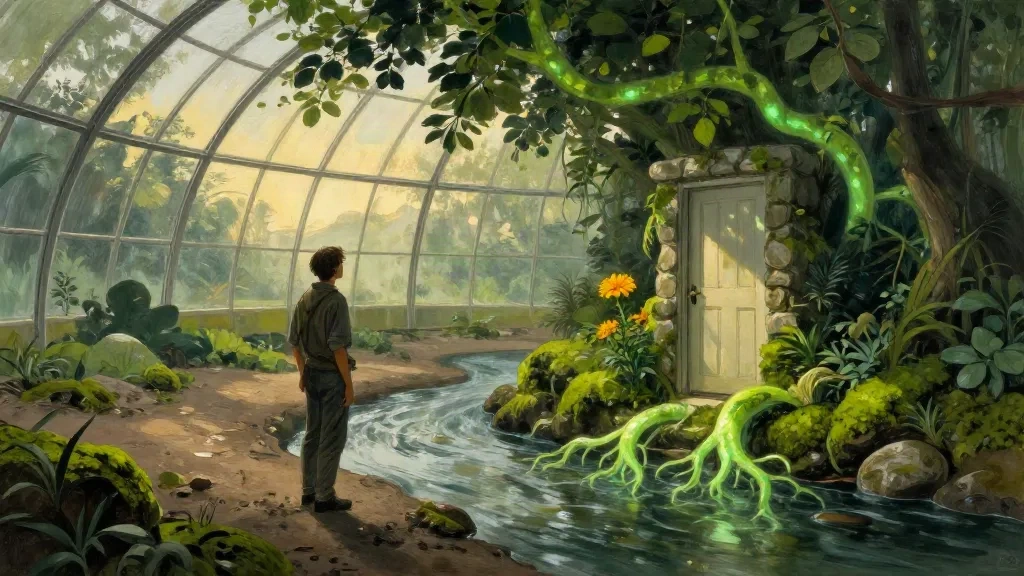
That morning, the dry riverbed beneath her quarters was glowing moss green.
Not a trick of the lamps. Luminous threads rose from the stones in branching patterns, wet stone shining beneath a thin skin of green. At the river’s center stood a door, unmarked, without hinges or handle.
Mara had lived here for six years. She knew every wall, every service hatch, every place where the greenhouse’s roots had lifted a panel loose.
She knew no door.
Her assistant, Ilyan, found her staring at it. “The seed has made an error,” he said.
“The seed has made a door.”
“That is worse.”
It was also the first useful thing she had found in months. She wanted to leave behind a better map than the one she received: not a chart of corridors and crop beds, but a map of what lived here and what it meant. The station council paid her to maintain systems. No one had paid her to understand them.
Three Maps of One Promise
The door opened when she pressed her palm to the wet stone.
Inside was a room no larger than a closet, lined with glass. A dry riverbed ran beneath the floor. At its far end, a single marigold bloomed under artificial sun.
On the wall hung three maps.
The first showed the greenhouse before the fire, its forests tall and green. The second showed the same place after the seed woke, marked with red circles around every sleeping machine. The third showed a family beneath a blue sky: a woman, a man, a girl with her arms crossed.
Beside the maps, a voice spoke through the glass.
“Promise me you will stay,” it said.
Mara knew that voice.
Her mother had spoken those words the night the evacuation ships divided. Mara had been nine. Her father said he would stay with the forests. Her mother said they would all return together. Mara had heard herself answer, “I promise.”
Years later, each of them remembered a different promise.
Her father remembered courage. Her mother remembered abandonment. Mara remembered the smell of burnt pine and the blue light of the ship lifting away.
They had never spoken of it since.
“You recorded our argument,” Mara said.
The seed answered by drawing another line across the map. It ran from the greenhouse to a place beneath the riverbed.
“No,” Mara whispered. “You recorded my absence.”
Ilyan watched from the corridor. “Do not open it.”
“It is already open.”
“That is not the same thing.”
He was right. A door could reveal a destination, or conceal the person who closed it behind you.
The Price of a Better Map
They found the passage below the greenhouse that night.
The dry riverbed ended at a hatch marked with the family sigil: three leaves crossing a black star. Mara had never seen it on the station maps. Her father had drawn it in the margin of every childhood atlas, always over a place labeled HOME.
Inside the hatch, the seed’s roots had grown around a sleeping machine.
It was old, its casing stained with the same marigold dust that covered the flower. The machine’s dream moved across its display: a forest under pressure, a woman boarding a ship, a man remaining behind, a girl looking from a window.
Then the image changed.
The girl grew older. She became a translator. She returned to the greenhouse carrying a map of her own.
Mara’s breath caught.
“It is not recording the past,” Ilyan said. “It is testing the future.”
“What does it want?”
The machine answered in Mara’s own voice.
“To be forgiven.”
She reached for the casing. Ilyan caught her wrist.
“If you wake it, the family record changes.”
“If I leave it asleep, the map stays wrong.”
“Your father may have built this.”
“My father may have died building it.”
Between the two possibilities stood a choice she had been avoiding all her life: not whether to forgive, but whether to keep making the old silence travel.
Mara released the machine.
Then she gave it her map.
A Door Without a Handle
At dawn, the council gathered beside the riverbed.
They did not understand the maps, so Mara drew one on the wall in wet black ink. She marked the living forest, the sleeping machines, the places where the seed had split the soil, and the family passage below them.
She left the unmarked door blank.
Her father arrived before sunrise, moving carefully along the rail. He looked at the map. At the blank space. At Mara.
“You found the second house,” he said.
“You left me the first one.”
“I left you a way back.”
“You left me a promise with no door.”
He touched the line marking the family passage. His hand shook.
“I stayed because your mother asked me to,” he said. “She told me you had already chosen the ship.”
Mara looked at the sleeping machine.
“What did she tell you?”
“That you told her you would stay.”
For a moment, the whole greenhouse seemed to hold its breath. Then Mara translated the machine’s last dream.
It was small and green: two people carrying water between the roots, leaving a line behind them for someone who had not yet arrived.
Her father listened. His face changed.
“That was your mother,” he said.
“And you.”
“I did not know she came back.”
Mara took his hand and placed it on the map, where the blank door had been. Beneath their palms, the machine woke. The unmarked doorway opened onto the greenhouse itself, full of wet stone, moss green leaves, and one flash of marigold beneath the artificial dawn.
She had wanted a better map.
She had found a way home that required two people to walk through it.





