 Netwrck
Science Fiction.
The Museum of Refusals
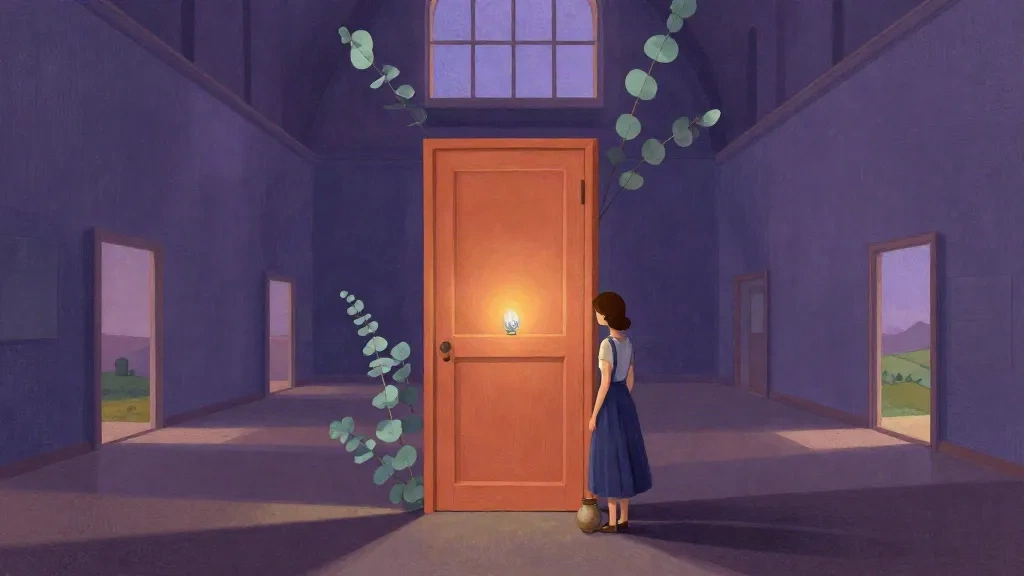
At the end of the Museum of Doors, Mara found the room with no exhibit. Terracotta dust covered the floor, eucalyptus leaves pressed blue-green against the windows, and beyond the glass the sky hung like a split plum, bruised violet at its edges.
She carried a salt jar in one hand and a glass seed in the other. The seed had appeared in her workshop that morning, warm as a cheek, with no mark on its surface. Mara had spent years mending what distance made between people: sleeves torn by quarrels, wedding shirts returned unbuttoned, letters softened by too many hands. Distance was a kind of torn cloth. It could be joined, if the seam did not lie.
Her desired door stood in an empty rectangular frame beside the room. She had designed it during the museum’s long winter: a narrow eucalyptus door, painted terracotta, opening only when the person on either side said yes without urgency, without debt, without the hope of receiving something.
She placed the glass seed in the frame. It vanished. The salt jar followed.
A Treaty for the Vanished
Beyond the door waited a village under a sky the color of an old wound. No houses stood there. Only a circle of foundations, a dry well, and rows of stone markers carved with names no living villager recognized.
At the center stood a woman in a rust-colored coat. Her shadow pointed toward the buried well.
“You have brought the salt,” the woman said.
Mara looked at the jar in her hand. It was back. “The dead keep their promises,” the woman continued. “Your village stopped speaking to ours after the flood. The agreement that ended the war was written in the language of the dead. They sealed it in the well, and the living were told never to read it.”
“Why only the dead?”
“Because the living hear disagreement too loudly.”
At the well’s mouth lay a copper tablet, green with age. Its lines had been cut into it in pale, branching script. When Mara bent close, the marks separated into shadows. The dead did not write with words. They wrote with absences: the missing path, the withheld hand, the door left unopened.
What the Living Owed
The woman named herself Sefu, though she had been dead for ninety years. She and the other dead had signed the treaty after their village surrendered the right to harvest the common forest. In exchange, the living promised never to raise a wall, fence, or locked door between any two houses.
But Mara, looking across the empty village, saw walls everywhere. Low walls had become foundations. Foundations had become stores. A granary stood where a meeting ground should have been.
“The treaty was broken?” Sefu asked.
“The words were forgotten.”
“Words do not break a promise. People do.”
At the far edge of the village, three living figures emerged from the eucalyptus trees. Each carried a tool: a mason's hammer, a surveyor's chain, a farmer's sickle. They came to demolish the granary and claim the forest.
Sefu pointed to the copper tablet. “Read it aloud.”
Mara had never spoken the dead language. When she touched the tablet, though, her needle moved beneath her fingers, stitching invisible thread through the marks. The sentence rose inside her, not as sound but as pressure behind her eyes.
No person shall close the way to another without consent.
She translated it to the villagers. The mason lowered his hammer.
Two Hands on the Hinge
Back in the museum, Mara rebuilt the door from her own measurements. She set the salt jar on one side and the glass seed on the other, then withdrew her hands.
The mason's daughter approached first. “I consent to your passage,” she said.
Mara answered, “I consent to your passage.”
The door opened.
Beyond it stood the buried village, no longer empty. The well shone with water. Sefu raised one translucent hand, and the other dead answered from the foundations. One by one, the living villagers came forward. Each had to speak before crossing. Each had to hear consent returned.
By dawn, the treaty had been carried into the museum. The dead language remained on the copper tablet, but the forest was marked in living ink, every boundary redrawn as a path wide enough for both neighbors.
At closing time, Mara tested her door once more. She knocked from the terracotta side.
“Do you consent?” she asked.
From the other side, Sefu replied, “Only if you will leave the salt.”
Mara smiled and placed the jar down. The glass seed split open in her palm, revealing a thin green shoot. A door, she had learned, was not a promise to keep people apart. It was a promise to let them choose.





