 Netwrck
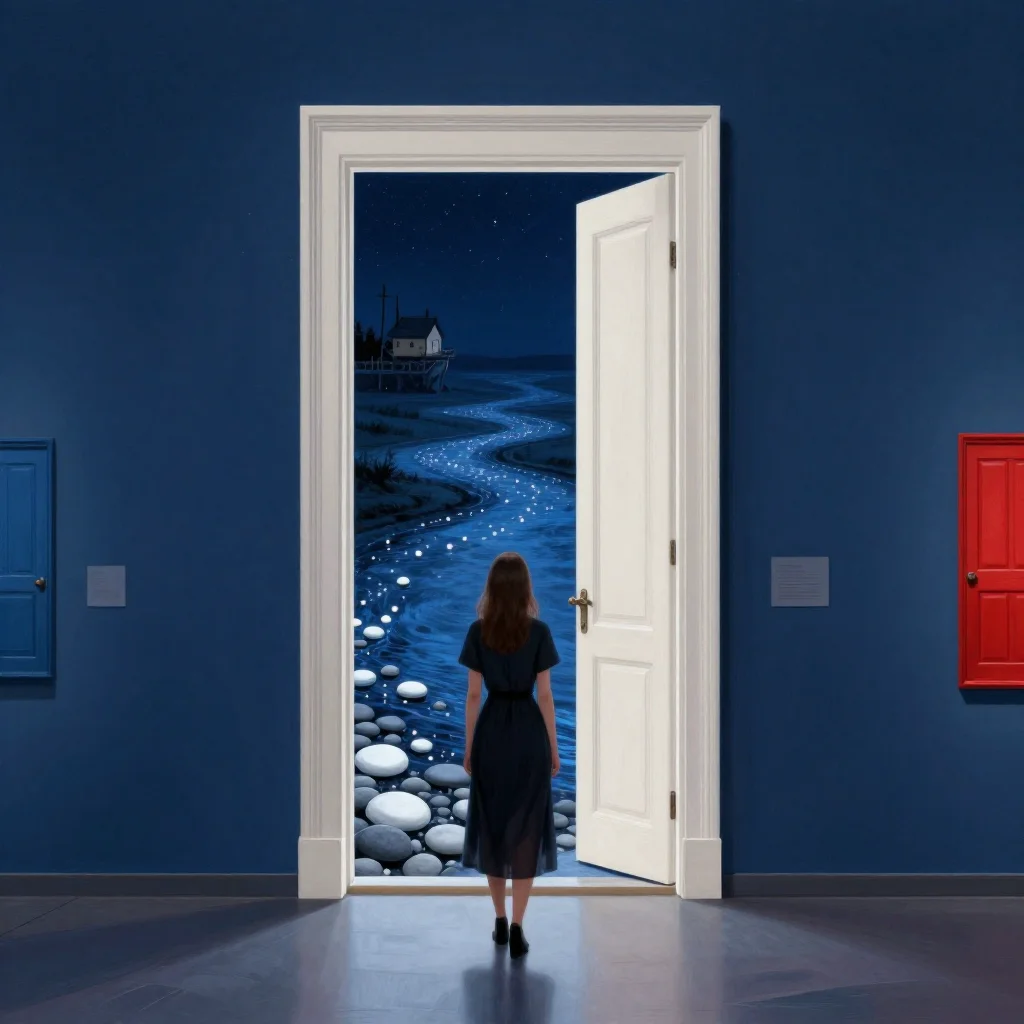
Magical Realism.
The Translator of Sleeping Machines
Mara Venn had spent eleven years listening to machines breathe.
They did not wheeze or sigh. They clicked, hummed, and sometimes produced a low blue light beneath their panels, as if dreaming of voltage. She translated those dreams for the Museum of Doors, where every opening led to a different kind of courage. One corridor required forgiveness. Another required the ability to walk toward a stranger. A third opened only for people who had abandoned a plan.
Mara wanted to leave behind a better map than the one she had received.
Her own map was a folded transit diagram with no stations left on it. At seventeen, she had left her family in Bellwether and promised to return when the river rose again. The river had never risen. Her mother believed Mara had forgotten. Her brother believed she had been abandoned. Mara believed the promise had been misunderstood by everyone, including herself.
On the museum’s lowest floor, she found a machine older than the collection records. It had no label, only a single red indicator blinking in the dark. When Mara placed her palm against its sleeping face, the machine whispered a sequence of metal clicks.
She translated it as: Someone is waiting where the water used to be.
The Unmarked Door
The machine opened a door behind the gallery.
It was unmarked, unfinished, its paint the color of a pearl held underwater. Beyond it lay a dry riverbed beneath a midnight-blue sky. White stones crossed the sand in careful lines. In the distance, a house floated above the ground, every window lit.
Mara stepped through.
The riverbed was not empty. The promise had taken root there.
Her mother appeared first, carrying the blue bowl they had once shared during winter. Her brother followed with a shovel. Her father came last, holding the transit map Mara had sent home years ago, though its edges were now brown with age.
“You said you would return when the river rose,” her mother said.
“You said you would wait,” her brother said.
Her father tapped the map. “You said we should go together.”
The words did not match. The memory did not match. Mara felt the promise changing beneath her feet, becoming a bridge, a wall, a road that bent toward the floating house.
She took out her brass notebook and began to translate the silence between them. Each remembered version contained one true sentence and one deliberate lie.
The Dry Riverbed
She wrote the true sentences in pearl ink.
Do not leave until I understand.
I was afraid you would not come back.
Wait for me at the crossing.
I wanted a reason to follow.
The river was never the promise.
We were.
Her mother lowered the bowl. Her brother planted the shovel in the sand. Her father folded the map along its oldest crease. The lie beneath the promise was not betrayal. It was the belief that love required a single meaning.
“Then what was the promise?” her brother asked.
Mara looked at the door behind her. Its red warning light had turned gold.
“That we would keep finding one another,” she said.
She erased the incorrect versions from the notebook. The dry riverbed began to sing beneath the stones, a low mechanical hymn. Water rose around her ankles, cold and impossible. The floating house lowered itself onto the earth, and the family walked toward it together.
A Better Map
At dawn, Mara returned to the museum with a new map.
It was not a map of roads. It showed doors, crossings, silences, and the places where people had mistaken their fear for another person’s intention. The unmarked door stood at its center, no longer hidden.
The curator asked whether the machine had revealed anything useful.
“It revealed that maps are made by remembering,” Mara said.
She placed the old map beside the new one, then fed both into the machine. It clicked once, twice, three times.
From somewhere beyond the walls came the sound of a dry river learning to run again.
Mara smiled and began to translate the dream.





