 Netwrck
Romance.
The Room for the Missing
Mara kept the old restaurant above the museum, where the menu changed with the weather and the kitchen smelled of browned butter, bay leaves, and rain. On the wall behind the pantry hung a black umbrella, its ribs bent from a storm that had never touched the city.
Her grandmother had told her the family legend while tying on her apron: every recipe summoned the people who had once eaten at that table. Not ghosts, exactly. More like warmth retained in the food, appetite given a shape. Mara had laughed then. Later, after the restaurant emptied, after her grandmother died and the bank took the dining room, she had begun to wonder.
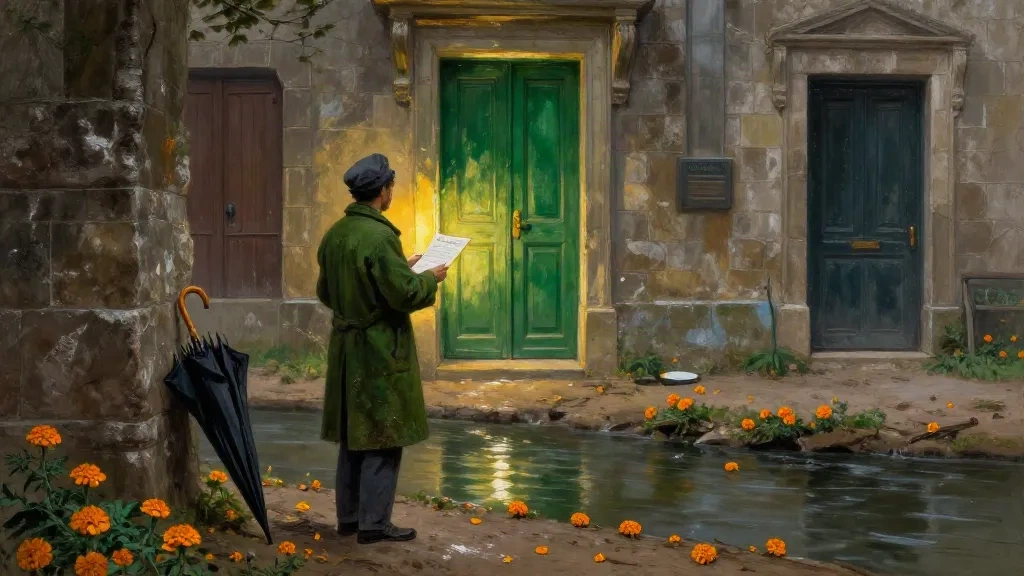
The museum of doors stood across the avenue, its moss-green doors set into wet stone. Each opened onto a different kind of courage: one led to a field where frightened soldiers had learned to advance; another to a black sea where widows crossed without looking back. Visitors entered alone and returned changed, though nobody could say how.
Mara carried her grandmother’s last recipe. It was written on the back of a flour receipt, with no quantities, only instructions: Bring the dry riverbed. Leave the black umbrella. Ask for the door that has been waiting.
What the Riverbed Kept
Behind the museum, a dry riverbed ran beneath the glass floor. Marigold flowers grew along its cracked banks, vivid against the moss and wet stone. The river had vanished sixty years ago, when the city diverted the water to protect its underground factories.
She laid the flour receipt on the stones. The riverbed answered with a low metallic hush, like spoons gathering in a drawer. One of the museum doors unlocked. A card beneath its handle read: FAMILY, but the word had been scratched away.
Inside, a narrow staircase climbed into darkness. At the summit stood her grandmother’s table, laid for two. The cook who had taught Mara to make soup was seated there, younger than memory, her gray hair dark and her hands steady.
“You came,” her grandmother said.
“You said the recipes could summon them.”
“They can. People leave pieces of themselves in what they eat. Taste enough, and the table remembers.”
Mara set down two bowls. The first brought her father, still wearing his train conductor’s cap. He kissed her forehead, apologetic and hurried. The second brought Daniel, the man she had loved before deciding that love was not enough to build a life. He looked at her as if they had met only yesterday.
“I wanted to prove you were right,” Mara said.
Her grandmother’s expression softened. “You already have.”
The Cost of Opening
Beyond the table, a final door appeared, green paint peeling around its brass lock. Through it came the sound of rain on a tin roof. Her grandmother’s voice warned that the door opened only once. The cost could not be paid twice.
“What does it cost?”
“The memory that made you leave.”
Mara understood. She had left the restaurant, the family, and the man she loved after a winter when cooking felt like carrying every absent person at once. To open the door, she would forget the reason she had survived that winter.
Daniel stepped toward the threshold. “Don’t do it.”
“I don’t want to forget you,” she said.
“Then don’t open it for me.”
He took her hand, and for a moment the room was warm with the old kitchen, with his laughter over burned onions and the first morning they had woken beside each other. The love had not been weak. It had simply been frightened.
She understood then that the legend was not about bringing everyone back. It was about admitting that those who had been loved could remain loved without being kept.
Marigold at the Threshold
At dawn, Mara returned to the dry riverbed. The black umbrella hung in the restaurant doorway, repaired with silver thread. The final door stood open behind her, revealing only a kitchen table set beneath marigold-colored light.
Her father and Daniel were gone, but the recipe remained. She rewrote it in her grandmother’s hand, adding quantities at last: one cup patience, two handfuls of salt, enough bread to share with whoever is still hungry.
That evening, the first customer entered: a young man who had never met Mara, carrying a suitcase and looking nearly lost. She served him soup. He laughed suddenly, as if remembering a better day.
When he left, a second chair scraped back. Someone had taken it.
Mara smiled and wiped the counter. Courage, she had learned, was not a door that opened once. It was a table that made room.





