 Netwrck
Fantasy.
The Garden's Forbidden Gate
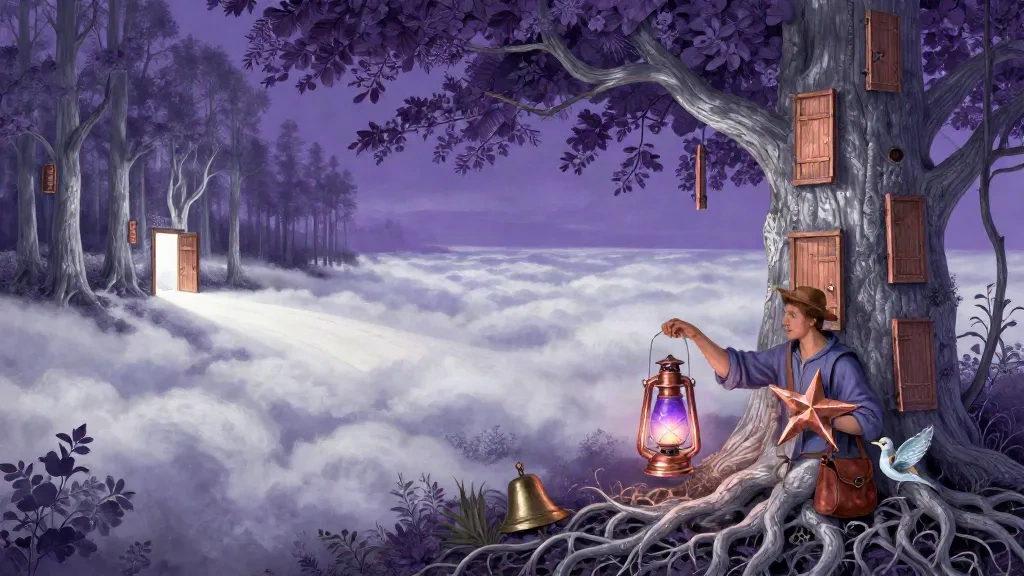
At violet dusk, the doors began opening in the silverwood tree.
Mara watched one unfold from a scar in the bark, its hinges turning without a sound. A child stepped through and vanished beyond the eastern hedge. An old woman came out of the trunk carrying a white lily, though nothing had grown in that direction for a century and the ground there was bare to the stones.
Mara kept her eyes on the paths instead. That was her work and she had made it her whole character: eleven lamps along a mile of gravel, hedgerow, and black stream, lit each evening before the sun was down, wiped, trimmed, and lit again. Copper filings ground fine enough to catch; beeswax from the hives the garden let grow crooked; a wick she trimmed with a thumbnail until it gave off that thin, sour, honest smell. Light was a material. It could be rationed. It could be withheld.
That was the whole of her trade, and on paper it was a kind public good, and for eleven years she had let it stay that way.
Because the border lay beyond the garden's northern wall, and the only route through was the Door of Undeclared Passage, and a border that cannot be declared cannot be crossed. Everyone knew this. Everyone, that is, who kept to the sanctioned itineraries the guards published each spring: four roads, listed, lit, patrolled, and safe in the thin sense that a road is safe when you are already accounted for.
Mara lit the four. She also made sure the others went dark. It had begun as a small thing, a matter of craft. A path the guards did not list was a path the guards did not look at, and a person on it could be anyone, going anywhere, unrecorded. The unsanctioned tracks through the alder scrub, the ford below the mill, the mile of bank where the willows hung down to the water and made a tunnel of the whole river, went to black that first autumn. She took the small hours to do it. She told the keeper the lamps were old. She told herself the dark was safer, because darkness is a wall and walls are a kindness.
In her satchel she carried a copper star and a glass bird. The star had been her father's, struck from a coin in the town where he was born, worn smooth at one point by his thumb. The bird she had found in the garden in the first year, in the mulch at the foot of the silverwood, its painted wing hiding her father's initials beneath a leaf of flaking blue. She had never told anyone, not the keeper, not the physician, not the woman who came in spring to ask after the lamps. She would surrender neither. Behind her lay the long sleep of the silverwood's roots; ahead lay a country that had forbidden her name from its records, which is a thing an ordinary person discovers only by trying to be written down.
The Bell Beneath the Roots
At midnight, the bell answered.
It hung in a hollow under the tree, visible only through a door of black glass set flush with the earth. Its sound was felt in the teeth first, then in the ribs. It rang once when Mara touched the glass bird. Twice when she tightened the strap of her satchel. Three times when she chose the northern path with her lamp in her hand.
The garden keeper found her at the top of the hollow, in the particular stillness of a man who has been waiting to be wrong about something for a long time.
“It rings for decisions,” Vetch said. “Decisions people refuse to admit they made.”
Mara looked down at the stream, where her reflection had lately begun moving before she did. “What kind of decisions?”
“The kind that change a life.”
“That is a very small category, Vetch.”
“It is the only one that has ever mattered.” He set down his own lamp, which was older than hers and gave off no heat. “You have been ringing it since you were nineteen.”
She carried her lamp down into the hollow. The bell's bronze mouth lay open beneath the roots, bright as a setting sun, rimmed with a strip of cloud-white cloth. On the cloth was a road sign, cut and painted by hand, the kind that meant nothing to anyone who had not been taught it: a line with a break in it, meaning the road ends where it is not written. She had learned it in a garden, from a woman who would not say where she had learned it.
She touched the cloth. The bell rang, and the two lamps in the hollow threw shadows in opposite directions, and for one breath the shadows did not agree on where the wall was.
“You turned the lamp toward the northern road,” Vetch said, from above.
“I lit every sanctioned path.”
“You hid the others.”
“I lit the ones that mattered.”
“You decided which ones mattered.”
That was true, and it was the first time anyone had said it to her in that shape. After her father went, she had stood under this tree at nineteen with her hands shaking, and instead of following him she had gone home and taken a lamp and gone out to the ford and put it out, methodically, the way a person puts out a fire they are afraid of becoming. She had told herself for eleven years that she was steering people away from harm. The bell gave her no mercy and no argument either. It simply kept the fact where it could be reached.
A Door Is Not a Promise
The hollow opened into the Gate House, where borders were made tangible, and it had clearly been expecting her.
Tables stretched to the horizon beneath a violet roof. Officials inspected objects, memories, and names, writing each in a ledger thick as a paving stone. A girl of about fifteen surrendered the sound of her mother's laugh and walked away lighter, silent, astonished. A merchant offered a year from his childhood and received a receipt. All the while the black-glass bell rang beneath the floor, so constantly that no one remarked on it, the way no one remarks on a river.
Mara understood, standing in the queue, that she had come to pay. She had understood it for eleven years. She simply had not known the till was open at night.
The officer who received her was Registrar Halvard, and he had the courtesy to be bored, which she found harder to bear than cruelty. He read the satchel's manifest as though it were a grocery list.
“The cost of passage is the satchel,” he said. “The star and the bird remain here. You may cross without them.”
“How long is a year of a merchant's childhood worth, here?”
“That was not your price.”
“No. It was my question.” Halvard wrote. “You may ask one question per crossing. It is the only part of the transaction people enjoy.”
She set the lamp down on the boards. Its flame leaned toward the glass bird, and the tiny painted eye appeared to turn, a trick of the light that she had watched happen perhaps four hundred times and had never once believed.
“Then I cannot cross,” she said.
“No one crosses carrying what the border has claimed.”
“The border has no claim on them.”
“It does not need one. The claim is the objection.” Halvard smiled without any warmth at all. “That is your undeclared decision, and I have written it down, and now you may take it with you or leave it here with everything else.”
He snapped his fingers. The satchel rose off the boards. The strap went taut and dragged against her hip, and she held on, because eleven years of small physical assertions were all she had left, and she held on with both hands until her knuckles went white and the strap bit.
The copper star rolled free. It struck the floor with a sound like distant thunder, and the whole violet roof shivered. The glass bird bent one wing, and in the bending the paint flaked away from the place where her father's initials were, so that they lay open, the way a name does when it is finally read aloud.
She remembered the last night of her father's leaving. He had come through the garden at dusk with the coin star in his pocket and his coat buttoned wrong, and she had not run after him. She had stood beneath this tree with her hands at her sides and chosen, deliberately, in the calm clear voice of a person making a reasonable decision, that he would come back when he had found the road he was looking for. She had chosen it so cleanly that she had never once been able to find the seam in it.
The bell rang so loudly that the windows trembled and the girl with the lost laugh put her hands over her ears.
Mara opened her palm. The flame in her abandoned lantern rose, not touching the star, not touching the bird, but casting their shadows between them, where no shadow had any business being cast.
The Border Opens Its Eyes
In the borderhouse, every official stopped breathing, which is a thing that happens more often in large rooms than anyone outside them understands.
The shadow of the copper star fell across the boards and stretched, and the shadow of the glass bird fell the other way, and where the two shapes met a narrow doorway appeared in the wall. Not the Door of Undeclared Passage, which was a slot for surrender, a mouth shaped exactly like the shape of giving something up. This was not that. This was a living door, with a hinge that breathed, and warm air came through it smelling of wet clay and lamp oil and, faintly, of a woodsmoke she knew from her childhood.
Halvard seized the satchel. Mara pulled the other end of the strap and felt the leather go to a hard, singing tension between them. The glass bird sang one clear note, and the copper star spun beneath the floor, tracing a small bright meridian around her hand, the way a compass needle settles.
“You cannot make a border,” she said.
“You can,” he whispered. “You already did.”
And that was the sentence that went through her, because he was not taunting. He was filing. He was a man in a room where a fact had finally arrived that he had been waiting eleven years to write down.
The garden did not grow doors. It grew decisions, and then it grew consequences, and the two were the same plant at different stages. For years Mara had gone out at dusk and made it impossible for anyone to leave by a way the authorities had not sanctioned, and everyone in the garden had called it kindness, and she had called it kindness, and in the meantime she had built a thing: not a road, not a wall, but a permission. A standing possibility of another way. And now the borderhouse had reached out and taken hold of that possibility and tried to turn it into an object, something it could hold at arm's length, itemize, and confiscate at the gate.
She stepped through the living door carrying both things.
Beyond it lay a road under cloud-white stars, and it did not go toward a country. It went sideways, along a strip of land that the maps of both sides had agreed, for the sake of peace, never to mention, and the grass there was long and the stones were unnumbered and the air smelled of a fire that had been burning a long time in a place nobody had reached.
Behind her, the black-glass bell rang one final time, and the Garden of Exits illuminated every neglected path at once.
The Man on the Unwritten Road
He was sitting with his back to a milestone, eleven years older and about a hundred years tired, cooking something in a tin, and the star was not in his pocket because it was on the boards under a violet roof in Halvard's ledger, and the coat was the same coat with the same wrong button.
“Mara.”
“Father.”
She had rehearsed eleven years of versions and none of them had this in them, that he would be glad, and that this would be the worst of it.
He looked at her for a while. “The ford path went out.”
“I put it out.”
“I know. I felt it happen. I was two hundred yards up that bank and the lamps went one after another, and after that I had nothing to walk by, and I have not been able to reach either side of anything since.” He stirred the tin. “I could hear the garden. You were lit. That was the worst part. There was a light and I could not tell whether it was for me.”
“It was lit.”
“It was lit on the sanctioned road.”
That was the exact shape of it, and she had no coat to put it inside.
“I thought if I made everything else invisible,” she said, “no one would walk out and be lost the way you were lost.”
“Somebody was always going to be lost. You only got to choose whether they went toward it blind.” He said it without heat, which was worse, because heat would have meant he had been angry for eleven years and anger at least has a date on it. “I have been walking a road that isn't written. I have met two other people on it. One of them had your lamps in her satchel. The other one had a bell.”
“The girl,” Mara said. “The laugh.”
“She paid for something small to get out of a bad winter. The rest comes later. That is the design.” He looked at her hands, and then at the shadow her lamp cast between the two objects she was holding, one in each hand, so that the shadows made a dark place on the ground shaped like a path. “You will not be able to hide them again.”
“No.”
“And neither will anyone else, now. Whatever you did with those lamps, the border has its version of it now, and the border will do what you did, only with a list.”
He did not say I forgive you. He was not a man who dealt in that currency. He set the tin down between them, and shared it, which she understood after a moment was the largest thing on offer.
Consequences, in the Order They Arrived
The Roads, Lit
By dawn the whole northern bank was a string of lamps, and people came to see what they had been denied for eleven years. A poacher who had used the alder tunnel for twenty years stood at its mouth and wept and would not say why. Two sisters who had lost each other in the willows found each other walking in opposite directions, which is what happens when both paths are visible and only one of them has ever been maintained.
And the tax collector came. That was the part no one had thought about, because everyone in the garden had been thinking about the border as a wall and not as a clerk. A man with a ledger of his own stood at the ford and began writing down who had used which road, and the names went north by the next post, and Mara understood that she had not freed anyone; she had only changed which authority was reading the ground.
The Bell in Her Own House
The black-glass door was in the hollow that autumn, and it stayed. Vetch, who had said nothing for a week, came and sat on the root beside it and asked whether she intended to go down.
“It rings for decisions,” she said.
“It does.”
“Did it ring when I put the ford out?”
“Nine hundred times,” said Vetch. “We stopped counting by August.”
She had not heard a single one. She had assumed, for eleven years, that a thing that loud would be impossible to sleep through, and it turned out that the loudest things in a life are the ones you have agreed not to hear, and the agreement is the oldest machinery in the garden.
What She Did Instead
She did not put the roads out again. She went to the border stone, the low grey marker where the garden's lawn gives up and the sanctioned itinerary begins, and she stood there every evening for the rest of her life with the eleventh lamp and told people what it cost.
“You may cross,” she would say, “and it will take something you will not miss until you miss it. If you go on the written road, the border knows your name and takes the smaller thing first, and then the next one, and then you are a story in a ledger. If you go on the unwritten one, the road may not be there at all, and you will walk until you cannot.”
Then she would light the lamp, and set it on the stone, and walk home by whatever road she had advised them to take.
Some nights it was the ford. Some nights it was the bank under the willows. Once, in the last year, a woman asked her whether the unwritten roads were safe now, since everything was lit, and Mara told her the truth, which was that a hidden road kept you from being found and a lit road kept you from being lost, and that a person could have both for a while but not forever, and that every border in the world was only the argument about which one you got.
She never left the garden. That was the price Halvard had named and the price she had refused, and it turned out to be the same price, collected in a different currency. The country beyond the violet roof had forbidden her name from its records, and now there was nothing on the far side worth the walking to. She stayed with the silverwood and the lamps and the keeper, and the doors in the bark, and the bell under the roots that rang for her now and would go on ringing, and that she had learned, in time, to answer out loud before it finished.
She set the lantern down on the border stone one evening when the sky went violet. When she lifted it again, the flame had become a small violet star, steady, and gave off no heat, and threw one shadow and one only.
Behind her, a door she had not noticed opened in the trunk of the silverwood, and it did not ask for anything, and she did not go through it, because it was not a border. It was only a door, standing open, the way a door does when the person who has been knocking on it all night has finally gone home and left it unlatched.
She walked back along the road that no longer hid itself, and did not look at the sky, and did not need to.





