 Netwrck
Surrealism.
The Blue Translator
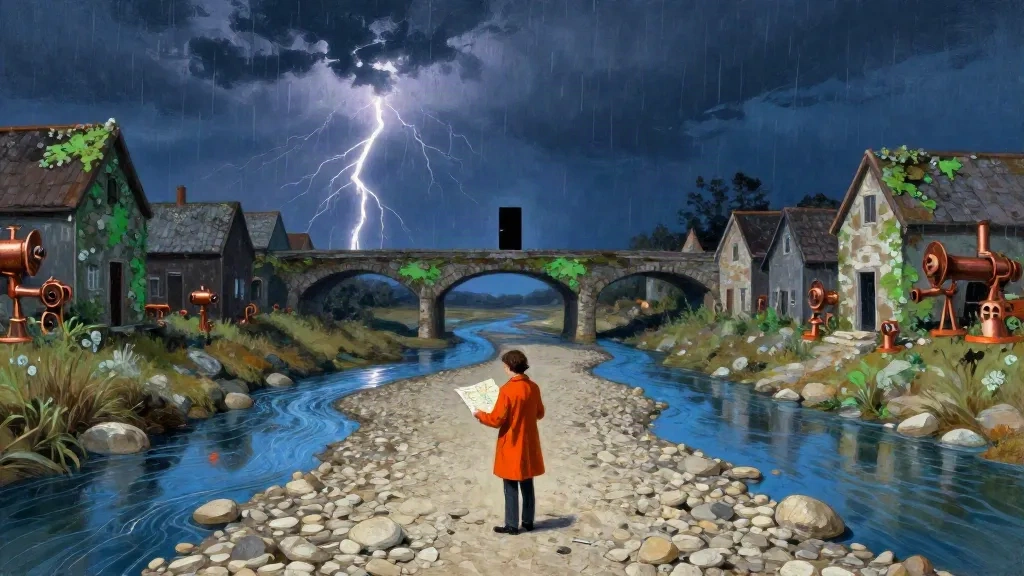
Mara was paid to decipher the dreams of sleeping machines. Each machine stood in its locked workshop, its metal eyelids sealed with copper thread, its dreaming loud as insects beneath summer bark. The town paid in small orange coins and did not ask what the machines saw.
Mara lived beside the dry riverbed, where pale stones still held the shape of water. Across the empty channel stood houses joined by narrow bridges. Every bridge bore a name, and every name was a promise. Come before dusk. Return what was borrowed. Never tell your brother the truth.
Her own family had once lived at the river's bend, before the water withdrew. Her father said it vanished because he had broken a promise. Her mother said it vanished because her father had refused to make one. Her brother said nothing, but kept a blue glass button in his pocket, the color of a storm before lightning.
Mara opened the nearest machine. In its sleep she found a city folded into a pair of hands. She translated its dream in a thin notebook: the river is not leaving; it is being remembered incorrectly.
What the Bridges Insisted
At dawn, the workshop door appeared without a wall around it. It was unmarked, black, and cold beneath her palm. Mara opened it and found the dry riverbed, except now a narrow blue stream ran through it, carrying leaves, small doors, and the reflected faces of people who had not yet been born.
The river was a witness. It repeated every promise made above its vanished surface, but never the speaker's meaning. A bridge asked, Will you come back? The river answered, I came. A bridge asked, Did you forgive me? The river answered, I forgave the person you meant.
Mara followed the stream toward her family home. Each bridge grew a new plank as she approached. Her brother waited on the far side, older than she remembered, though his face remained unchanged.
“You promised to take me away,” he said.
Mara felt the old map in her coat. Her father had drawn the route with one hand and torn out the destination with the other. Her mother had written beneath it: Do not trust a bridge that asks the same question twice.
The House With Several Doors
The house remembered all three of them differently.
In the kitchen, her father burned bread and claimed the river had been killed by a promise. In the bedroom, her mother folded sheets and insisted the river had been taken away by a promise. In the cellar, her brother showed her a dry channel cut into stone.
“Here,” he said, placing the blue button into her hand. “This is where the promise was buried.”
Mara turned the button over. Inside it, a tiny machine slept. Its dream was a family standing around a table, each person holding a different version of the same evening. One version ended with a departure. One ended with a return. One ended with the door locked from inside.
She translated it slowly. The machine did not say the family was divided. It said the promise had been divided, each meaning placed in a different body, where it could grow teeth.
The river stirred outside. A blue storm-light entered through the unmarked door. The bridges began to glow, every plank showing a face Mara recognized.
A Map With No Missing Country
Mara could have kept the dream and sold it. She could have crossed the river alone, taking the best meaning, or left the town and let the old map finish losing itself.
Instead, she drew a new map on the back of the ruined one. She marked the dry riverbed. She marked the bridges by their actual promises, not the promises people had assigned them. Where they conflicted, she left blank space. A map did not become honest by pretending uncertainty was solid ground.
Her brother watched. “That leaves out the house,” he said.
“No,” Mara said. “It leaves in room for the house to change.”
She placed the blue button at the center of the map. The little machine woke. Across town, every sleeping machine began to murmur the same sentence. The river answered from below the stones, not in water, but in the long echo of a bridge remembering its first crossing.
By morning, the blue stream had vanished. The unmarked door remained, but it opened onto a different street, its hinges covered in lichen. Mara's family stood on opposite banks, each holding half of the map.
She did not ask them to cross. She stepped onto the old bridge, then crossed the dry riverbed, and laid the map where all three paths could reach it.
In the burnt-orange light, the stones beneath her boots became dark with water. The river had not returned to forgive anyone. It had returned to testify.
And Mara, who had spent her life translating what others dreamed, finally drew a line that did not close around a lie.





