 Netwrck
Folk Horror.
The Hinges of Possible Things
On the north wall of the museum of doors, beneath a permanent frost, hung the hinge of courage to leave.
It was iron the color of a winter nail, broad as a man’s shoulder, and it turned a door that was not there. Mara Venn repaired it every autumn, hammering the pin back into place, smoothing the plates until they shone. The museum displayed openings onto courage: courage to confess, to forgive, to open a coffin, to cross a frozen river, to speak beneath a judge’s gaze. Each had its own room. Each opened onto a different kind of danger.
Mara wanted a future. Not the future her mother had chosen, nor the future the village had narrowed to fit inside its fear. She wanted the future that arrived when the last train left, carrying a future that had not yet earned its ending.
On the wall behind her hung that future’s hinge. It was smaller than the others, tarnished and still. Its door bore no handle, only a shallow notch shaped like a departing train ticket.
The House That Kept Its Mouth Shut
The museum was run by Collector Vey, whose profits came from closed doors. Visitors paid to see courage, but only from the safe side. When an opening wandered beyond its label, Vey nailed it shut. He called this conservation. He called the missing rooms a kindness.
One morning Mara found a train ticket beneath her teacup. The cup was empty, its rim stained blue with the tea she had not poured. The ticket bore no destination, only a departure stamped in soft cyan.
Vey took the ticket and smiled without showing his teeth.
“The future is not a door,” he said. “It is a hole people fall into when they have forgotten how to be frightened.”
That night the small hinge began turning by itself. Frost spread from it across the wall. Behind the plaster came the sound of wheels on rails, far beyond any track in the valley. Mara struck the iron with her hammer. The vibration traveled through the floor and into the museum’s sealed rooms. One by one, hidden hinges answered.
In the morning, Vey had locked her tools in the cellar and taken the train ticket. His guards stood beside the north wall, waiting for the door to open.
An Empty Place at the Table
Mara’s father left a chipped teacup beside her bed every morning. He had not died; he had boarded the first train after the thaw, promising to return when the river changed direction. The village called him lost. Mara kept his place at the table.
She broke the cup with the heel of her hand. The shard cut her thumb. Blood touched the old tea stain, and for one breath the room filled with the smell of hot iron and rain.
The wall opened.
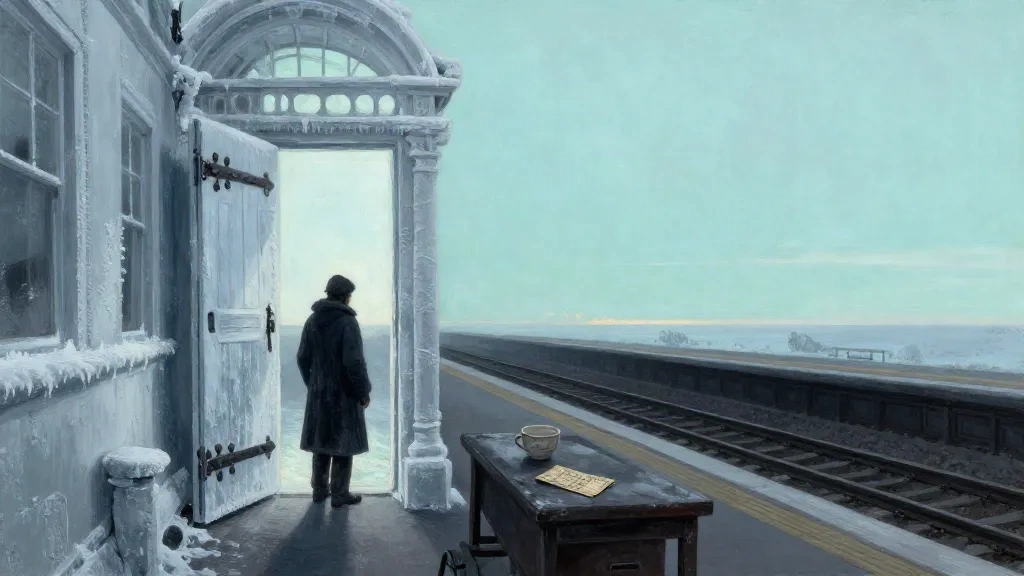
Beyond it stood a platform in impossible dawn. Cyan light spread beneath the rails. The train was there, made of black frost, its windows filled with shadows. A conductor held out an empty teacup.
“Your father paid for a future,” he said.
Mara took the cup. Inside it, a train ticket appeared.
Vey lunged for her wrist, but the other doors burst open. Courage of confession poured into the corridor. Courage of forgiveness. Courage to say no. The guards stumbled backward as a flood of choices struck them without direction.
The Ending Not Yet Earned
Mara mounted the platform. She did not board. She placed her father’s empty teacup on the conductor’s table and hammered the ticket’s notch flat.
The train shrieked. Cyan dawn spilled across the tracks.
“A future must be chosen,” the conductor said.
“Then I choose the crossing,” Mara replied. “Not the destination.”
She stepped back as the door tore itself from the museum wall. Vey vanished behind it with a cry like a hinge drawing rust. The train departed without a whistle. The station became a field of frost, then a corridor, then the north wall of the museum.
Mara set the empty teacup on the sill. Inside it, one drop of water reflected a dawn no storm could close.
She repaired the hinges. She left one door open.
Some futures arrive only when nobody is permitted to finish them.





