 Netwrck
Weird Fiction.
The Weight of Missing Doors
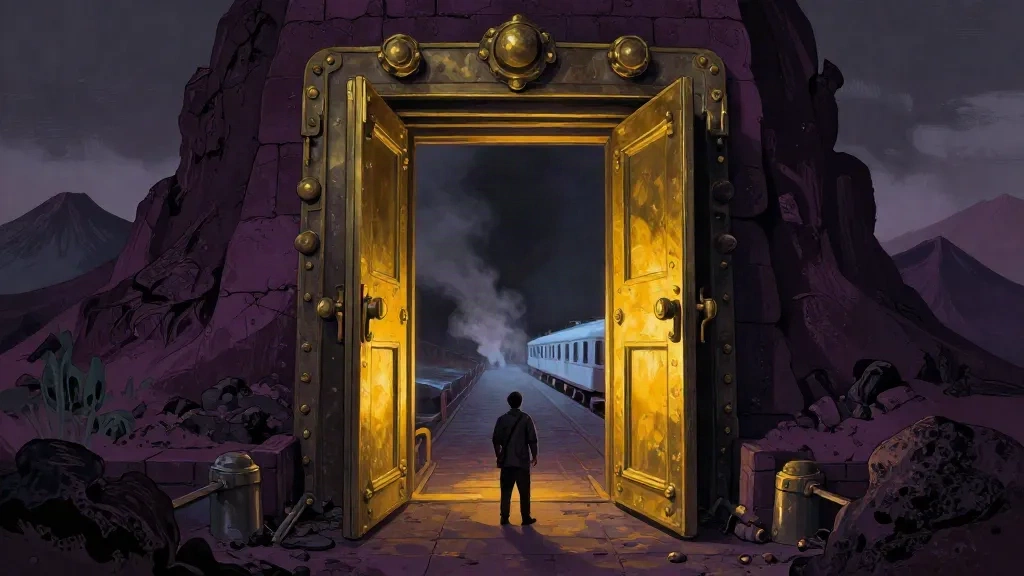
Iara kept the forge below the old transit room, where the mountain breathed warm through iron pipes and the air smelled of saffron, plum smoke, and rain trapped in stone. The observatory rose above her in black terraces, its brass instruments aimed at a sky that never cleared. Every morning the astronomers climbed toward their lenses. Every evening they came down with their charts blanked by the same grey cloud.
No door had opened there for ninety years. The missing had not been gradual. They had vanished during the eruption of 1886, leaving only their hinges embedded in walls that sealed themselves afterward. Iara repaired those hinges anyway: mountain shutters, vault hatches, the colossal frames for an airlock, the doors of a mail train that had never arrived.
Her hammer made small, honest sounds.
On the workbench lay her father’s last train ticket. SULTEMBER VALLEY. DEPARTURE: 17:40. ARRIVAL: UNKNOWN. The date had been torn away. He had left for the observatory and never returned, though his bed was still made, though his teacup remained beneath it, empty except for a violet stain.
Beyond the forge, something enormous shifted its weight against the mountain.
The Council of Useful Silence
Mayor Voss summoned Iara to the smoke-grey chamber beneath the telescope. Nine councilors sat beneath waxed portraits, all of them dressed in the plum uniforms of the Observatory Survey.
“You have loosened the eastern hinges,” Voss said.
“They were failing.”
“Failure is one of our exports.”
The council paid the village by keeping the mystery closed. Tourists bought sealed corridors, stamped blank charts, and stories of doors swallowed by magma. Their children inherited the same grey air and learned to ask nothing about the train platform beneath the mountain.
Voss placed a teacup before Iara. It was white, rimmed with saffron dust, and filled to the brim with ash.
“Repairing what cannot open has fed us for three generations,” he said. “Do not make hunger appear foolish.”
Iara looked into the cup. At the bottom, a tiny platform shone under the ash. A brass train waited beneath a station clock frozen at 17:40. On its platform stood a man with a blacksmith’s shoulders, holding a ticket out toward her.
She recognized his hands.
When she blinked, the cup was empty.
A Future Without Its Last Door
That night Iara carried the teacup to the eastern wall and worked until the hinges turned without force. The door did not open inward. It opened sideways, exposing a dark corridor lit by saffron lamps. Along its walls ran thousands of doors, each labeled with a possible ending: THE KINGDOM THAT NEVER FORGOT, THE CITY THAT FORGAVE ITS RIVER, THE YEAR THE STARS ARRIVED.
Beyond one door came the clang of a hammer. Beyond another, laughter. Beyond a third, silence.
At the corridor’s end, a railway carriage waited. Its conductor wore her father’s face, though his eyes were young.
“You can join us,” he said. “Every future begins with a departure.”
Iara raised the hammer. “Does my father ride this train?”
“In the future where you leave tomorrow behind.”
“And in the others?”
“In some he is waiting. In some he is dead. In some he never left.”
The carriage filled with smoke-grey air. Saffron light trembled across the plum velvet seats.
Iara understood the trap. The council had not simply hidden the doors. It had made uncertainty profitable. If she pursued one ending, every other possibility would close behind it. The future would arrive already polished, already explained, already possessing an ending she had not chosen.
But a choice made by fear was still a choice.
The Hinge That Held Tomorrow
She struck the carriage clock. The glass broke. Across the corridor, every labeled door flew open at once.
Light and weather and hungry shadows rushed through the mountain. The council’s sealed history collapsed into a roar. Somewhere above, tourists found their stamped charts turning blank. Somewhere below, the village children saw the sky through a hundred forgotten windows.
The conductor seized the ticket from her hand. “You will have no ending,” he said.
Iara took the empty teacup from beneath the platform bench and placed it in his palm. “Good. Then the cup remains useful.”
She turned to the doors. Behind one, her father was young and alive. Behind another, he was old and waiting. Behind a third, no father stood in the room, but a woman Iara did not know was teaching children to make hinges.
None of them commanded her.
Iara opened the nearest door and stepped through—not into a destiny, but into the workshop beyond it. There she found a fresh billet, a clean anvil, and a hammer waiting in her hand. Its iron was still cold.
Outside, the volcano exhaled. The doors remained open all night.
Years later, travelers still speak of the observatory where every future had hinges, and of the blacksmith who refused to decide which one deserved to be the last. They say that whenever the mountain grows quiet, an empty teacup appears on a workbench beneath a saffron lamp. No one knows what it contains.
That, perhaps, is how she chose.





