 Netwrck
Folk Horror.
The Hinges of Absence
Mara Venn worked in the Museum of Doors, a narrow building wedged between the frozen river and the hill where the old signal tower had once watched for invaders. The museum contained no rooms, only thresholds. Each doorway opened onto a different kind of courage: courage to confess, to leave, to return, to forgive, to walk beneath a sky that had forgotten the earth.
The doors themselves were absent. Their frames stood in shallow alcoves, and their hinges waited in a tin box beside the furnace. Mara repaired them with iron filings, narrow files, and a hammer whose head had been forged before the museum existed. An absent door demanded a hinge that could hold an invisible weight.
Every morning the caretaker brought her a list of hinges that had failed overnight. On the list she wrote the names of those who had visited: Elian Rook, who could not enter the courage to leave. The schoolteacher, who had spent eleven years apologizing. The boy who wanted courage to be seen. The names were never accompanied by requests. People came to the museum when their courage had grown too heavy to carry.
The Door That Was Not There
On the coldest day of the year, Mara found a hinge she did not recognize. It was smooth as a frozen puddle, pale blue at its center, and warm beneath her thumb. In its hollow lay a train ticket with a departure date three days in the future.
The destination was written in a language she knew by sound but not by sight. On the museum wall, a placard named the exhibit: Tomorrow, Before It Has Earned Its Ending.
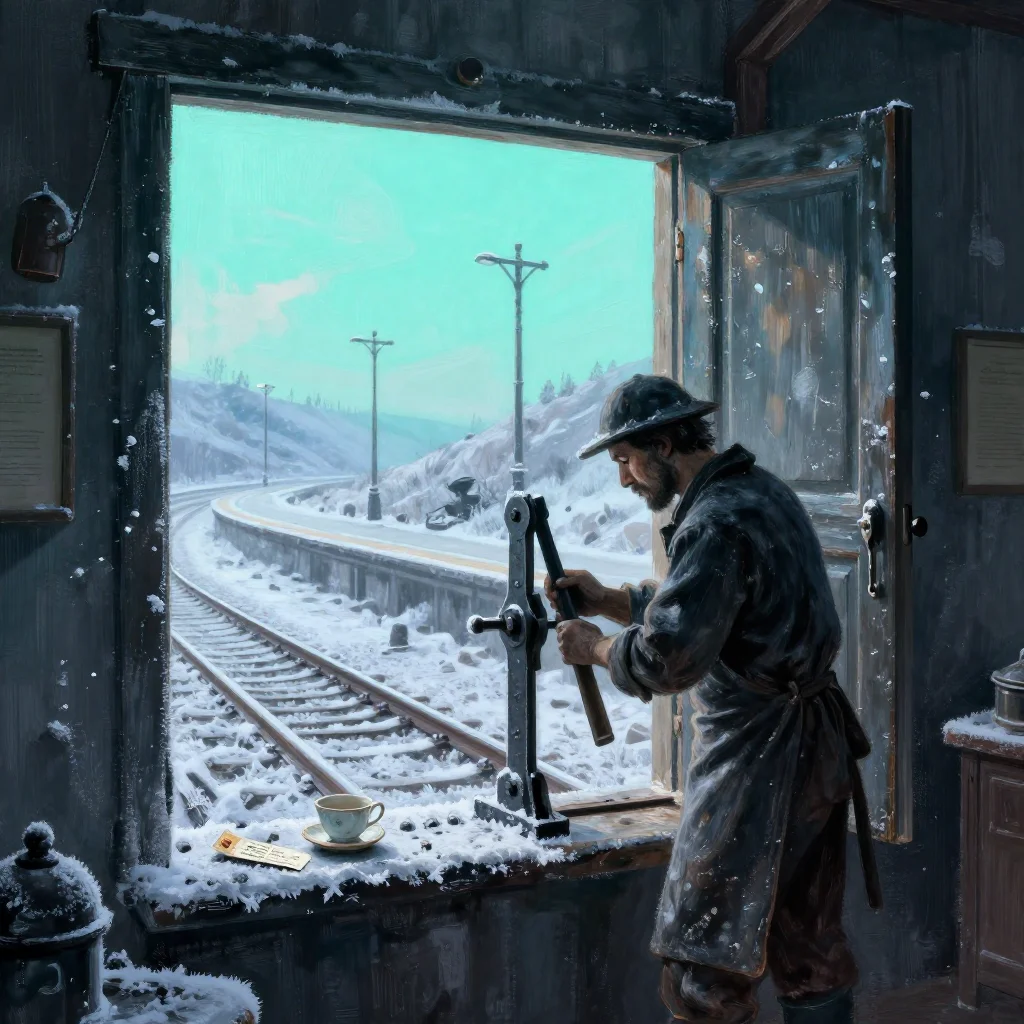
Behind it stood no frame. Mara placed the hinge against the wall, and a narrow outline appeared, frosted at the corners. Beyond it she saw a railway platform under an impossible dawn. The sky was cyan without clouds. Iron lampposts cast long shadows across the tracks. An empty teacup sat on a bench, its surface holding a small white moon.
Then she saw the conductor waiting beside the carriage.
“You have come to ask for a future,” he said.
“I have come to repair a hinge.”
“Then repair it.”
Mara knelt and drew the hinge from the wall. The outline vanished. The cyan light remained in her hands.
The Collector of Closed Questions
The museum’s power was not the town mayor, nor the river company, nor the priest who kept the old bell. It was Mr. Vale, a quiet man who sold nothing and owned the questions people were forbidden to ask. He collected unanswered cries, sealed them in glass jars, and charged visitors one memory for each mystery he explained.
Vale had made the museum famous. He had also made it safe. Visitors entered a threshold, felt a little courage, and returned to their ordinary lives. If a door opened too wide, if someone saw what waited beyond courage, Vale sealed the exhibit and sent the question home.
“You understand,” he said, finding her beneath the blue glow. “A future is merely a door without customers. Close it, and the town remains sensible.”
Mara held up the ticket. “This one has already been sold.”
Vale’s face changed. He reached for the teacup she had brought from the exhibit. “That is not yours to return.”
The cup was empty, but when Vale touched it, the tiny moon rose above the rim. Somewhere in the museum, every sealed question rang like glass.
The Last Hinge
Mara carried the hinge to the furnace. She made it red-hot, then black, then blue. Vale followed her, speaking of fees, preservation, the danger of letting strangers see the shape of their deaths. She did not answer. When the metal had cooled enough to handle, she set it into the empty frame at the end of the museum.
The door opened onto the platform.
No train arrived. The conductor lowered his lantern. Beyond the tracks, a village slept beneath frost, its chimneys white, its future undecided. Mara understood then that a future was not a destination. It was a hinge someone had to maintain.
She placed the train ticket on the empty teacup’s saucer and stepped through.
Behind her, Vale shouted that the museum would have no mysteries left. The doors in the walls began to close, one after another, but the blue dawn widened across the floor.
At dawn, Mara returned carrying a second hinge in her coat. The train ticket was gone. Vale’s glass jars lay empty in the snow.
She set the hinge beside the furnace and listened as the museum opened onto a morning no one had yet deserved.
Not every courage opens a door. Some courage is the hand that keeps it from being locked.





