 Netwrck
Science Fiction.
The Unlit Road
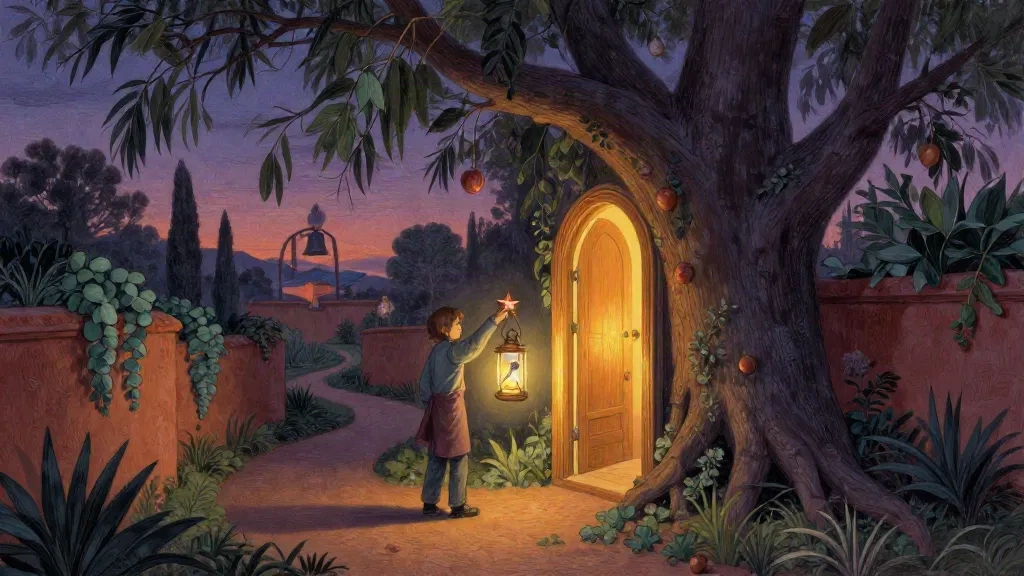
At dusk, Orra carried an unlit lantern along the path nobody used.
The Crowned Arboretum rose around her in terracotta tiers, its walls warm as kiln-fired brick. Eucalyptus leaves clicked overhead, exposing a bruised-plum sky. Ahead, the old border tree lifted a pale door from its trunk without a branch to support it.
Every evening, people approached the border carrying what they had earned on the wrong side of the law: a name, a deed, a dead relative’s ashes. They surrendered one thing, and the tree opened another world.
Orra carried neither document nor urn. Inside her coat, a copper star pressed a hard point against her ribs. In her other pocket, a glass bird weighed almost nothing.
She had crossed once before, seventeen years earlier, as a child permitted through for one hour. Beyond the door waited her mother’s house. Orra had been told to return before the bell in the eastern court finished ringing. She had obeyed.
Now she meant to cross again and keep what she carried.
Decisions in the Bark
The border tree refused her.
Its door remained shut, its narrow windows dark.
Across the road, an immigration clerk named Senn watched from his glass booth. He was a narrow man made mostly of cuffs and careful questions.
“Declare the burden,” he called.
“Lantern tools.”
“That is not a burden.”
“Then I am traveling light.”
The tree made a dry leaf-rustle. Orra looked back down the avoided path. At its beginning stood the Lantern Makers’ Court, where she had spent years polishing other people’s choices into brightness.
“You are carrying a star and a bird,” Senn said.
“Small objects travel poorly.”
“Everything crosses at its declared value.”
He slid a brass declaration beneath the door. The form asked for origin, owner, purpose, and the decision by which the traveler had come to possess each object.
Orra’s pen stopped.
Inside her pocket, the glass bird struck once against the copper star.
The Bell for Unspoken Things
A bell sounded in the eastern court.
It was not the evening bell. That one had a bright, measured voice. This was a single muted note, felt in the fillings of Orra’s teeth.
Every mason knew the forbidden bell. It rang for decisions no one admitted making: the choice to abandon a street, the instant a forgivable act became unforgivable, the moment kindness became a possession.
Doors in the arboretum shuddered.
“Listen,” Senn whispered. His declaration slipped beneath the booth’s counter.
Orra understood.
Seventeen years ago, she had found the glass bird beneath her mother’s bed, its painted wing cracked and its belly filled with recorded voices. Among them spoke her mother, alive only in the branching silver memory left by a clinic’s failing machines.
Instead of taking the bird, Orra had sealed it in the court’s lost-property vault. She had told herself that keeping it would make her mother’s death irreversible.
Then she had accepted a place among the lantern makers, where light was made to clarify other people’s journeys and never questioned.
The bell rang again.
She had not saved the bird. She had imprisoned it.
“Origin,” Senn said gently.
Orra tore the brass declaration in half. “Mine.”
The border tree opened.
What a Traveler Keeps
On the other side, her mother’s house had become a nursery. Weeds divided its rooms. A copper star hung crooked in one window, and on the sill sat a glass bird with an unbroken wing.
Orra touched the bird in her pocket. It was the older one, colder, crowded with voices.
Behind her, the tree began shrinking the doorway.
“You may take one,” Senn said from somewhere beyond the bark, “and leave one.”
Orra lifted her lantern. For years its empty chamber had seemed like proof of restraint. Now she understood: emptiness was not innocence. It was a darkness carefully maintained.
She placed the lantern on the sill, opened its glass door, and set the old bird inside beside the new one. The painted wings met. Silver voices trembled through the chamber, and one said her name.
Then Orra took the copper star.
It had belonged to her mother before either bird. Some crossings required carrying evidence that the person you had been existed at all.
The border narrowed. Orra stepped through as the bell began its third note.
This time, she did not wait for anyone to admit what it meant.





