 Netwrck
Adventure.
The Note Beneath the Lock
In the Museum of Doors, Nera kept the smallest key beneath her tongue. She had carried it so long that she knew its taste: iron, wax, the faint sourness of her own skin. It opened nothing in the building. She kept it the way other people keep a tooth.
She had been a musician, and the way she had been one still mattered, though she no longer traveled with an instrument. Her last concert had ended badly and without a sound. A woman in the third row hummed along half a beat behind her, cheerful, forever half a beat behind, and every phrase after that had been addressed to the wrong person. Nera had stopped mid-song, walked out with the violin under her arm, and never played for a paying room again. She had come to the museum to work in silence. She stayed because silence, it turns out, can be made to sing.
Each morning she entered the Hall of Unfinished Things and listened. When a visitor spoke honestly, a new note entered the air: a bright thread pulled from a cracked bell, a bell struck under water, a small sun coughing behind winter. She could not write the notes down. She could only hold them, and repeat them into cedar until they held without her.
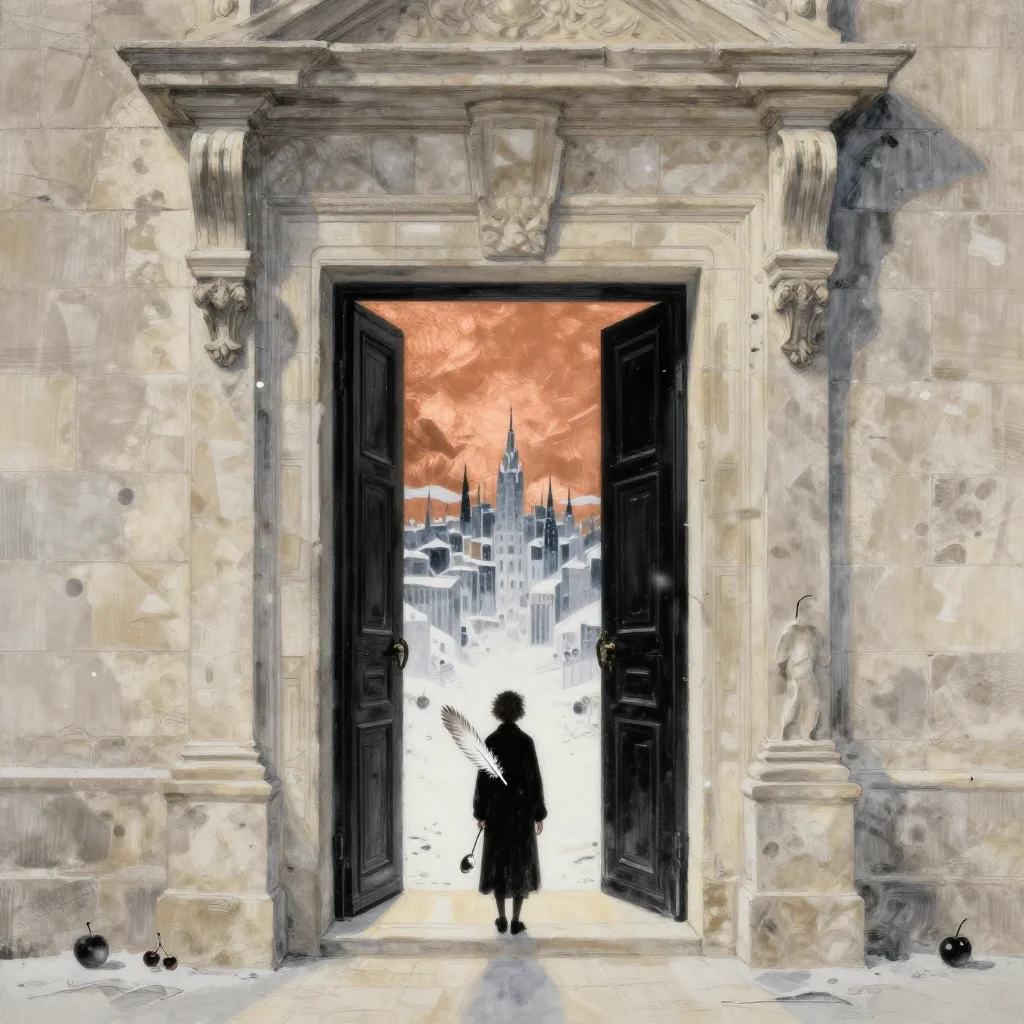
Near the western stair stood a black-cherry door set into a wall painted with a copper horizon. Its plaque read COURAGE THAT OUTLIVES ITS OWNER. Nera had tried that door for eleven years and lost nine small things doing it, one per attempt, which was either a fair price or a cheap one depending on the day.
Her father had gone through it on the last warm night of autumn, carrying his violin and a white feather that had belonged to the museum's snowfinch, dead a year and still beautiful. He had promised to return before the next thaw. The thaw never came. Instead, silence settled over the museum like frost, the swallows went, and the copper horizon outside the glass lost its shine.
The Gallery of Unfinished Things
Her plan occupied a whole gallery: cedar ribs, bone, and door hinges scavenged from three wings. A person who died, or forgot, or lied forever could still strike the structure and hear one honest thing they had confessed. The musician would be gone. The courage would remain.
Oswin, the registrar, came to inspect it every ninth day. He brought a lantern and a question and got an answer to neither. He wanted it catalogued. He wanted a number, a wing, a classification. He wanted, in the way of institutions that survive on order, Nera's name at the top of the page.
It is an unfinished thing, Oswin said. We catalogue unfinished things under things that are merely incomplete.
So she struck the frame instead of answering. It gave up a note she had not asked for: the sound of a man who had wanted to be remembered as generous and had settled, quietly, for being correct. Oswin entered that day in the ledger: subject resists.
The rule she worked by was older than the museum: a confession must cost something. Offer the truth that flatters you and the cedar stays mute. Offer the one that puts a nail in your own hand and the note comes out of the wood like a struck bell, and the room goes quiet in a way that has nothing to do with silence. She had tested this for years with strangers and once, unwillingly, with herself. She had a confession ready. She knew exactly which night it came from. She had not spent it, and she built around the hole in herself the way a wall is built around a missing stone.
What the Winter Took
She began with the first snow.
At first the winter was ordinary. It whitened the courtyards, sealed the windows, taught the swallows nothing. Then it lasted seven years. The second seven melted nothing. Rivers stiffened under skins of black ice so hard that a dropped hammer rang on them. The copper horizon outside lost its shine by the fourth year. By the sixth, visitors stopped arriving, and the ones who did had begun to lie in small ways, and the frame gave nothing back for them, and Oswin stopped coming on his ninth day, and then on the eleventh, and then stopped.
The museum doors began opening at night. Pale stone shapes wandered the galleries in borrowed coats, listening at the thresholds, going away unsatisfied.
In the ninth winter Nera found a silver spoon in the cedar. Nobody had put it there. Frost had bent the bowl into a hook. She struck the frame and heard:
I kept the spoon, but not the reason.
Her father had taken the spoon from a child in the east galleries, a child who measured milk with it, and he had promised to give it back when the child was brave enough to ask. The child never asked. The child grew up and told people about the man who took a spoon and said he would keep it safe, and the story got smaller at every telling, until all that was left was a man who takes things.
She struck the frame again. A fainter voice:
I am still carrying your courage.
Then a third, thin as wire, that she had not woven in and did not recognize until it was gone: Ask her what she heard me say.
The Door Remembers Weight
The frame needed one last note, strong enough to hold against a century of winter. She knew where to get it. That was the trouble with doors: they are also answers.
She went through the black-cherry door on a morning with no weather in it.
The cold did not burn. It erased. Each step took the nearest thing: the smell of rosin, the color of copper, the way her mother held a cup with both hands. She recited them away in order, out loud, and let the cold collect them, because it would be taking something regardless and she wanted to be the one choosing what. She gave up the smell first. She gave up the color second. When it reached for her mother's hands she stepped into the wind deliberately and let it have them, because a musician who cannot count her own beats cannot hold a note for anyone else. She kept the two things she needed: the bent spoon in her palm, and the number.
At the center of the frozen city stood a violin, split neck to belly, its strings drawn taut out of the ice. When her father stepped out from behind the ruined observatory his face was the face he had had eleven years ago, and the white feather he held had become a blade of black cherry wood.
“I could not return,” he said. It rang. She heard a note under it, deeper than anything she had ever heard from him.
“That is a reason,” she said. “It is not a why.”
“I stayed because returning would have made the journey mean nothing.” He raised the feather. “This was the last thing courage asked of me.”
“It is a beautiful sentence, Ansel.”
“Yes.”
“It is also a place to stand so you do not have to move.”
He did not answer for a while. Down the frozen avenue the black ice made a sound like a plate set down hard in another room. “I told myself the meaning,” he said at last. “The meaning was easier than the door.”
“You let me go,” Nera said. “The night before, I heard you say the door keeps what it is promised. I heard you say it and I said nothing, because you were the only person who ever told me my playing was enough.”
“Yes.”
“Eleven years of nothing.”
“I know,” he said. “I heard you not saying it. That is the part I could not spend.”
Together they raised the bent spoon beneath the copper sky, and the spoon held, because a thing bent but not broken will take weight out of proportion to its size. Nera played the frozen strings. Her father spoke every honest word he had withheld for eleven years, in order, without stopping, including the ones about her. The white feather burned white-hot and became the beam.
The winter heard all of it. Winters do. The thaw did not come.
The House After the Thaw
When Nera came back, the Hall of Unfinished Things held a small house with a black-cherry door, pale stone walls, a copper roof under a sky that morning had bothered to restore. The beam was the white feather, still burning, slowly, the way coals burn when there is a great deal of left.
Her father entered. The door did not close behind him. He did not look back, because looking back is a kind of spending, and he had just learned the rate.
Years passed. Travelers arrived carrying confessions they had carried across wars, floods, ordinary griefs. They spoke, and the house answered in notes, and the notes were always the ones that had cost something. Strangers found rooms they had never seen and, beneath the floorboards, a feather still white and a spoon polished bright by use.
There was a condition, and she had known there would be. Someone had to stand inside the house and hear, and never once add anything of their own. A keeper's ear cannot also be a witness. The moment it confesses, the house spends itself: beams cool, notes thin, a whole century of stored truth goes out like a lamp.
The museum wanted a plaque. She gave them the door's plaque instead, and they nailed it face-up as the threshold step, where everyone would tread on the words COURAGE THAT OUTLIVES ITS OWNER, which had been a joke in a curator's voice the night he walked in. Oswin signed the deed over without comment and asked her, at the door of the office, whether she was afraid. She considered lying, heard the frame stay mute, and said: I am, and I am the only person here whose truth this house cannot use, and we will both have to live in that.
She did not carve her name. The house did not preserve her; it preserved what she had done with the truth, which is harder to keep and needs no plaque. Nera was its last unfinished thing.
The Room Where Courage Was Put Last
On the deepest winter night a child stood before the door and told the truth, the way children do, without knowing that it is a skill or that it can be spent. The note sounded exactly as Nera had once imagined it in her worst hours: small, clear, impossible to kill.
Then the child opened the door, because children always do, and found the room where the storyteller had put courage last.
It was empty except for marks in the dust. A feather. The shallow bowl of a spoon. And beneath them, longer than either, the width of a hand: the place where someone had been standing up for a very long time.
“Do not clean in there,” the child's mother said. “That is the last one.”
The child struck the wall once more on the way out, out of manners. The house, which had never once answered with a lie, gave back a single note with no confession under it at all.





