 Netwrck
Surrealism.
Permit 957
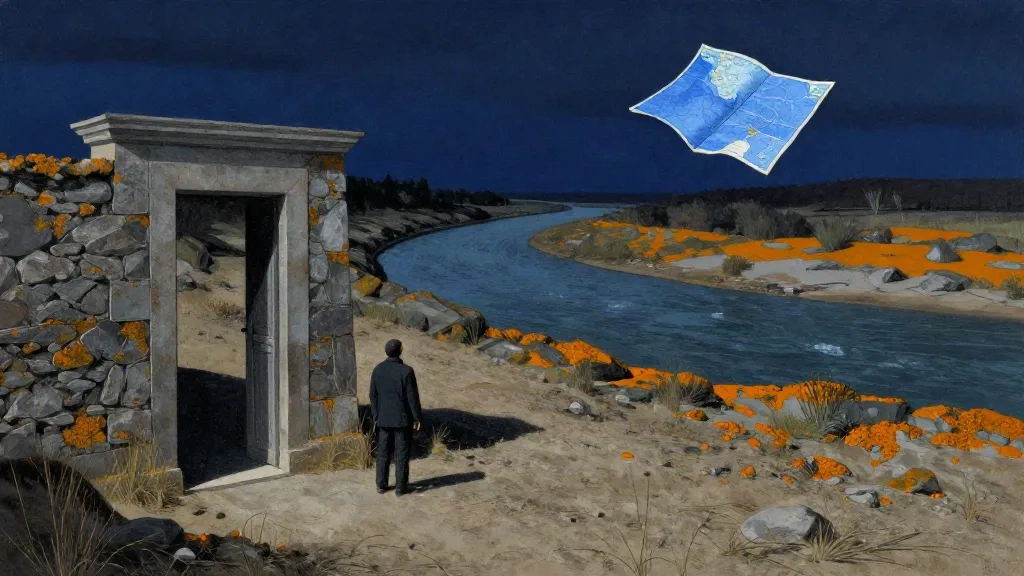
At 11:42 each evening, Ilyra entered the customs crane’s dream while its hooks hung still above the northern quay. The machine sent images without edges: orange lichen climbing a ladder of blue nails, a dry riverbed carrying footsteps uphill, an unmarked door opening into a room where her mother was young and her father was absent.
She translated these passages for the border authority. Payment came in folded maps, each one promising a route the river had not yet taken. Her own map was the oldest: blue paper, a red seam at the river, and no road out.
Her instructions said to improve it.
Ilyra had no intention of doing so. She was paid to preserve what sleeping machines remembered, not to repair the world. Still, she copied every blank edge and every impossible turn, hoping the combined errors might become a better map than the one she had received.
What Each of Them Kept
Her family had agreed to meet beside the eastern lock on the night the river turned north. That was how her father told it.
Her mother remembered a southward turn, at the place where the lock shone green.
Her brother said they had promised never to gather at the river at all.
Ilyra remembered being carried there as a child while thunder moved inside the clouds. Each version was precise. Each condemned the others.
When their mother died, her neighbors offered the usual account: she had crossed too early, found the wrong house, mistaken one promise for another. Ilyra translated machines for three years afterward, but never the family clock in the south tower. Its dreams rang like a cup repeatedly filled and emptied.
On the evening permit 957 arrived, the town’s weather loom began dreaming of her mother.
Midnight’s Revision
At midnight, the river reversed. Water withdrew from the northern channel and entered the dry bed south of town. Fish slid downstream facing the wrong current. Bells stopped.
The unmarked door appeared in the exposed cliff.
Ilyra walked toward it carrying the old map. Behind her, the customs crane emitted a sequence of sparks: factory whistle, childhood cough, three knocks, a pause, three knocks.
Inside the door was the customs office from her childhood. Her father sat behind a brass partition. Her mother held the eastern lock key. Her brother was young enough to have forgotten her.
“Which promise?” her father asked.
Ilyra unfolded the map. All its routes led to the room.
Her mother said, “We agreed to return.”
Her father said, “We agreed to wait.”
Her brother said, “We agreed to forget.”
The brass partition climbed like water. The clock began its emptying chime.
Ilyra realized the machines had not been remembering the past. They were comparing instructions. The river’s reversal was not a miracle but an amendment, carrying away every spoken version except the one the waking world refused to accept.
A Better Map
She drew a new line through the room, beyond the partition, into the blue storm-light of the cliff.
“You cannot change the promise,” her father said.
“No,” Ilyra answered. “I can change where it ends.”
She pressed the map against the clock face and translated its dream: not an image, but a correction. The chalk hands slowed. Water entered the dry riverbed again, carrying leaf skeleton, bottle glass, a child’s blue shoe. None of it went north.
Her family followed the line she had drawn, one after another, becoming older with each step until they reached the door as they were at the time of the promise. They crossed together. No one claimed which of them had been right.
Outside, dawn found the river flowing both ways. Ilyra’s new map held no route home.
Only beyond the unmarked door, a thin orange path crossed the lichen-stained bed toward a country none of its versions had named.





