 Netwrck
Fantasy.
The Museum of Consents
At violet dusk, the doors in Sable Hall turned their hinges in unison.
They stood beneath a ceiling stained the colors of oxidized copper. Each was a shallow arch, and each opened onto a different kind of courage. Mara passed the narrow door that opened onto a storm, the brass one that opened onto open water, and the child-sized door no visitor could enter without confessing a harmless lie.
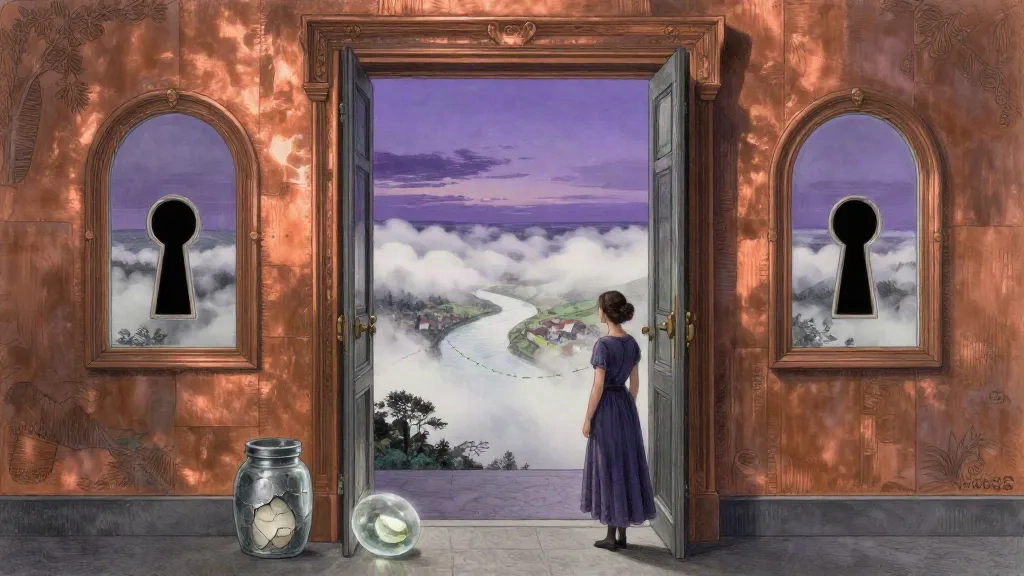
She carried a salt jar in one hand and a glass seed in the other. The jar held enough salt to preserve a town. The seed held the last green seen in winter.
Mara was a seamstress. Her needle could mend what distance had torn: a sleeve separated from its wearer, a glove crossed with the wrong hand, a road drawn so wide that siblings forgot they had shared a roof. Threads went through fabric, bark, bone, or breath, and pulled until closeness returned.
Behind the museum’s western wall, she had found a door with no courage on the other side.
It was blank oak, sealed without wax, marked with two empty keyholes facing each other. The curator’s ledger named it Mutual Passage. It opened only when both sides consented.
That was the door Mara wanted.
The Agreement of Ash
She tested it for seven years.
One side could knock, plead, bribe, or offer treasure. The other side remained stone. A king waited beyond the wood until his beard grew over his feet. A girl promised a year of songs, then another, and became an old woman before the latch moved.
On the eighth evening, an ash-pale woman appeared inside the blank panels. She had no shadow.
“You seek the door,” she said.
“Yes.”
“You understand it cannot divide power. It will permit only what is freely permitted by both.”
Mara felt the thread inside her wrist tighten. That was the promise she had been mending since her sister walked into the last winter without looking back.
“I want the village to see one another,” Mara said. “Without making them stay.”
The dead woman brought out a folded agreement, thin as onion skin. Its letters had been written in a language only the dead could read.
“Every settlement beside the White River signed this,” she said. “It divided the valley in two, though the map has one valley. Your ancestors cut the wording, not the land.”
At the word wording, the salt jar cracked clean through.
The Price of Reading
To understand the agreement, Mara had to mend what had been cut. Her needle entered the paper. Her thread drew on the dead woman’s breath.
The treaty’s language entered her: a winter morning; smoke rising from both banks; bells rung out of step; a mayor hiding behind a coat that was not his; children carrying stones because the old rule said strangers must pay tribute.
Mara could no longer see the present. The dead surrounded her in overlapping rooms. They shouted conflicting clauses. Each claimed the living had broken the promise.
Then she noticed the glass seed in her hand. Inside it, the tiny green shoot had bent toward the heat of her palm.
Life had never belonged to the agreement. It was the uncut thing.
She mended the treaty from its youngest clause backward. With every repaired word, salt spilled from the jar. A line formed between two kitchens. A bell rang in the eastern village, followed, one heartbeat late, by the western bell.
By dawn, only a ring of white salt remained on the floor. The dead woman had vanished. In her place lay a wooden shuttle, polished smooth by vanished hands.
Mara opened the blank door.
Beyond it stood the valley under cloud-white morning, both halves visible at once. Every resident waited at a marked stone, each able to see the other side clearly.
Two Hands on the Hinge
They argued about grain prices, old injuries, and whether the river should turn west. Some demanded the boundary return. Some wanted the mayor to pay. Everyone believed their consent was the only true one.
Mara placed the salt jar between the two oldest hands. She set the glass seed in a furrow of fresh soil.
“I will not sew your decision,” she said. “I will only mend the distance.”
That night, villagers carried the shuttle to the river. At each marked stone, two people—one from either side—turned the shuttle together. When some turned, the door remained still. When one tried to pull while the other resisted, the shuttle burned hot and escaped their grip.
Near dawn, a baker and a shepherd whose families had quarreled for sixty years lifted it together.
The blank door swung open.
No one crossed. No one was forced closer.
They stood on opposite banks, seeing one another fully, until the cloud-white light became violet dusk. Then Mara set the glass seed in the space between the hinges.
Its green shoot opened one new leaf.
Somewhere in the valley, two bells rang at exactly the same time.





