 Netwrck
Magical realism.
The Last Departure
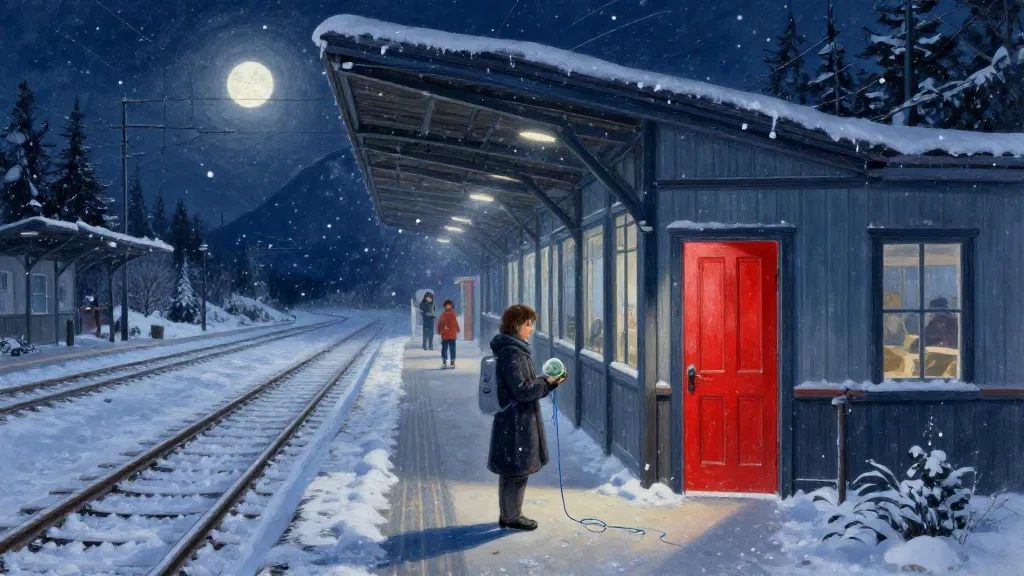
By February, the station had become a small white mouth beneath the mountain, breathing frost across its iron teeth. Four platforms crossed inside the concourse, each opening onto a different season. Spring waited beyond platform one, pear-heavy and loud with birds that would not come indoors. Summer slept behind the shutters of platform two, where the heat came off the boards in a slow copper shimmer. Platform three opened onto autumn, though no one had yet explained who was meant to board it. Winter belonged to platform four, where the benches were furred with frost and the departure board listed destinations no map admitted.
Mara Venn sat beneath the station clock with her gloves removed, because Odell had asked her to and because her hands were the only honest thing left about her. In the blue-black window they looked older than the rest of her.
Former astronaut, the ticket clerk had said when she arrived, as though the title were an address. Odell had worked the winter line for eleven years and still said it that way, the way a man says the name of a town he no longer lives in. His third-platform counter was closed. He had a cup of something going cold at his elbow and he did not drink it. She had not corrected him. Behind him his clock ran eleven minutes fast, which she noticed and did not mention, and which was the most either of them had managed all week.
For six years she had remained in orbit after the final crew evacuation. Not in a capsule. Not with a machine pretending to be a companion. Above the atmosphere, tethered to a dead relay station and the last clean orbit, with the sun coming up over an edge that was never quite the same edge.
Her brother had been the junior of the two of them. She was second on the rotation; he was ninth. The rule was that whoever stayed held the relay for ninety days alone, and the office had a way of calling that a rotation, which made it sound like weather. On a slow night in the third month she had gone into the roster and made one number wrong in the specific way a number goes wrong when somebody has decided in advance. She had told him the berth was his because his cot folded flat, because he was lighter, because he had asked her once, years before, whether the sky looked like anything from the ground. Every reason was true. Together they were a lie with a schedule.
The capsule had room for two. That was the whole of it. Not the roster. Not the number. A capsule built for two, and a manifest that said otherwise, and a sister who let the manifest say it.
The ship's radio brought weather reports, launch schedules, emergency instructions, and eventually a single repeated sentence, every ninety-one minutes, for a very long time: Earth remains unconfirmed.
She heard everything. She could have told the world how its rivers moved, how its cities blinked after midnight, how a voice sounded when it laughed in an underground kitchen with the tap running. Nobody on Earth received her reports. History had learned to use her as background noise: the woman in the sky, the astronaut who would not come down, a timestamp. A morning programme had run ten seconds of her breathing to say good morning to a country. She had listened to it eleven times that week. She had never told anyone, and she could not have explained why, and the not-explaining had by then become the largest thing about her.
What the Radio Kept
Her brother's voice had once been under the static, and she had kept it there. Lark, he called her, when she was small enough to answer to it and not yet old enough to mind. Later he told her the stars were a map for people with nowhere else to go, and she had laughed, because it was the kind of sentence a boy says to make a flight sound survivable, and because she had wanted it to be survivable.
Sixty-one transmissions survived the first year. The archive released them tidied: the hiss trimmed, the pauses closed, his breathing lifted out so the sentences sat down straight like guests at a table. Her copies were the raw ones. She had a shelf of them, indexed by the number of the day, and she had played them in order so many times that she could tell you the weather at the moment he said a thing.
The last clear sentence came on the night of the storm, nineteen minutes past the hour, on a channel that was still only listening in. Lark, don't wait for me at the station. Wait for the lights.
She had never decided what it meant. It could have been comfort. It could have been the last joke a man makes when he has already worked out the arithmetic. It could have been a sentence about her, written by him, and therefore the only evidence she had that he had ever been able to say the thing he actually thought.
She had drafted eleven replies. She had sent none. The channel was nine minutes each way by then, and a conversation takes forty, and she was afraid — for six years, quietly, industriously afraid — of being the reason he had to stop talking.
The green stone had arrived without explanation. It was smooth, cold at the edges, and warm at the centre the way a seed is warm holding shut a tiny sun. It had first been in her palm on the third winter, with no wound and no memory of picking it up. The blue thread had appeared on the handles of her airlock on the night the signal went, knotted by nobody, the same blue as the thread on her brother's flight-suit cuff in the last clear frame. Neither belonged to her kit. Neither had ever appeared in an inventory.
Doors in the Wind
At midnight the wind came down through the mountain. It did not blow. It moved the station around its occupants. Platform signs slid along the ceiling like fish. The ticket windows turned their faces to the wall. Beyond the walls, something long and heavy sounded its horn, though no track had ever been laid on this line, and never would.
A child in a red coat was halfway through a door when the storm took it.
The door was the summer door, platform two, the one that had been shut since October and now stood open onto nothing but heat and the smell of dust in a closed room. The door folded sideways, and the child folded with it, and she was in it up to her ribs, and her mother was on the far side of her and could not get a hand through the gap.
Mara lunged. She caught an ankle. The child kicked, which was correct, and screamed, which was also correct.
Hold the edge, Mara said.
There is no edge.
There is always an edge.
She got the blue thread off her wrist and looped it round the doorframe and her own wrist twice, and the thread pulled taut, and in her pocket the stone woke through the lining, pearl-white, and then midnight blue, and then a colour she had no word for that hurt to look at directly.
Through the bent opening she saw a wheat field under a red moon. A city going under snow at the speed of a held breath. An ocean with stars standing on its waves, not reflected but held, the way a hand holds water. The child's hand went through all of it and touched none of it.
Then the child looked up and recognised her, and Mara understood that she had been recognised before, a long time ago, by people who had not know they were doing it.
You're the weather, the child said. Mum says you're the weather on the telly. You breathe and then it starts.
Beside her, the mother said nothing, which was worse than anything she could have said.
On the platform the departure board cleared itself and printed three lines, and Odell, who had come out from behind the counter without his coat, read them over her shoulder and made a sound like a man stepping into cold water.
THE VOICE YOU LOST — BOARDING FROM ANYWHERE
THE EARTH YOU REFUSED — ALREADY DEPARTED
PLATFORM THREE — NO SERVICE THIS MORNING
Mara understood that the storm had not broken the station. It had reordered the doors, putting the ones she had spent six years not opening behind the ones she could reach with one hand.
The Passage Under the Clock
She went under the clock because the thread pulled.
It was not a stair. It was a corridor of frosted windows, knee-high and then shoulder-high and then no longer a corridor so much as a stack. Beyond each pane the same station repeated at a different hour. In one she boarded a train with blue window frames. In another she watched herself wave from a departing spacecraft, small, and already too far away to be waved at properly. In the last one, her brother stood under a summer tree with a telephone to his ear.
His face was younger than the one she carried. That was the cruelty of it: not that he was gone, but that he was twenty-two, and she had made him forty in her head, and here he was getting the first of it back.
Mara, he said, and she heard him through the glass, thin and clear, the way he used to sound in the corridor of their mother's house. You always waited until the station lights came on.
She put both hands flat on the pane. The green stone split cleanly in two, and the halves lay in her palms shining, one pearl, one midnight blue, and she understood without being told that the stone had been a single thing for as long as she had carried it, and that it was now an amount.
Say it again, she said.
Instead she heard herself ask the question she had never once put on the channel, in eleven drafts, in six years.
Did you know it was me?
He did not say no. He did not say yes. He looked at her through the glass with the patience of someone who has had a long time to think about it, and said, I knew you'd be the one who came down.
The train whistle took him. When he came back he was speaking to a stranger about the price of a bus ticket, and his face did the thing faces do when they have finished with you, and Mara opened the window.
Winter came through it, carrying snow, ash, and the smell of rain on hot metal. The corridor buckled. The thread burned cold around her wrist, so cold it felt wet.
The Price of a Voice
Odell stopped her at the foot of the stairs with two fingers on her sleeve, and did not touch her otherwise.
You are about to spend it, he said. I would like you to hear how it is done, since nobody tells you.
Tell me.
He kept his own voice down to nothing. This line does not take things. It has taken a coat, a ticket, a green stone, a pair of boots, a bar of soap, and I have watched a man leave his own crutches standing in the third doorway, and every one of them turned up the next morning in somebody else's pocket. It does not want objects. It wants the voice out of a thing. That is the freight. The rest is scenery, and the scenery is free, and that is how they keep you here, because you will hand over a boot before you will hand over a word.
I know, Mara said.
You know it the way the moon knows the tide. He nodded at the concourse, where the doors were still open in their new order, patiently, the way a clerk waits. Whose, Mara.
She had an answer ready and heard how thin it was. The stone halves. The thread. Her own voice, which had been the only unused thing she had brought down with her, and which the station had not once asked for.
His, she said. The sentence. Not the tone. The sentence.
There is no such distinction on this line.
There is on mine. She closed her hands around the two halves. It was never his. I kept it. Somebody kept it for six years and called it a habit, and now somebody else can have it, and that is the only door in this building that opens in a direction I can walk.
Odell was quiet long enough that the frost moved a finger's width up the glass beside them.
Tobias, he said at last, was nineteen. He went onto the third platform on a Tuesday because there were pears in the air and he had never seen a pear come off a tree. I have been on this counter eleven years and I have told four hundred people that a door is not a place a boy walks into. I have never once said it to the person who could make it true.
Odell—
I am not asking you not to do it. He took his hand off her sleeve. I am telling you that after tonight you will not be the woman in the sky. You will be the woman who said the thing. People will say it wrong, and some of them will be right, and you will not be able to correct them, and there is no window in this station where a thing can be said twice and only one of them kept. He straightened his cuffs. If anything comes back down for him, tell him where his father is standing. That is all. I have eleven years of not knowing and I would like it to end with a location.
What the Station Took
She opened the emergency channel at the second hour and transmitted the only thing she had kept unaltered: nineteen minutes past the hour, a young man's voice, the raw frame, the breathing left in. Lark, don't wait for me at the station. Wait for the lights.
The station took it the way a bell takes a note. It went out through every door in its new order and did not stop at the ones that had been shut in October. It crossed the wheat field and the city going under and the ocean with the standing stars, and it reached, the way sound does in dreams, further than sound should.
The cost came due in the same second. The two halves of the stone stopped being a light and became ordinary cold gravel, four grams of it, the size of a knuckle, and she put them in her coat pocket where they stayed. The blue thread parted at the loop and came off her wrist in a length, and she did not tie it back, and by the time the doors stopped moving it had worn down to almost nothing in her hand. And the last private copy of him was gone out of her, into nine hundred thousand mouths by morning, none of which would ever hold it at the right height from the floor.
When the doors settled, the child in the red coat was standing on platform four with both feet on the tiles, being held by her mother so hard that neither of them could speak. The child had her arms around the woman's waist and her face in the coat, and she said, muffled, it smells like outside, and her mother said, I know, and that was all the conversation anybody had for an hour.
On platform three the door stood open onto pears and warm wind and the long light of an October afternoon, all the way down, no service announced, no counter staffed.
Odell's coat was on its hook behind the winter counter. His cup was still there, gone cold further. The board said no service this morning, and the morning went on being a morning, and he did not come back through the door, and the season on the far side of it kept its light on until the light was ordinary.
Mara waited until the frost reached the heel of her boot. Then she stopped waiting, which is the whole of what she learned that winter, and which is less like a law and more like a habit.
A Rumor With Weight
At dawn she boarded the train marked Earth, If Confirmed. The carriage was full of people carrying news from years they had not lived, and not one of them looked up when she got on, which she had earned and did not want.
She sat at the window with four grams of green gravel in one pocket and a worn thread in the other. Behind her the station stayed pearl-white under the mountain, with one red door lit at the far end of platform four, and she watched it for as long as the glass allowed, which was eleven minutes, which was a number she did not choose.
The door that opened at the end of it was not weather. It was a street she knew: wet pavement, a bakery shutter coming up, the smell of yeast and rain, a child laughing somewhere under a low blue sky.
Then the train stopped, and she got off, and for a while nothing came for her. That was the part nobody had told her. The reports had gone out for six years and the world had not once sent anything back, and now she was on the ground with a sentence in circulation and no reason to expect a room.
The rumors started again immediately, at the bakery, from a woman who wanted to know if it was true that the woman in the sky had finally said something, whether the boy in the recording was her brother, and whether that was the whole story.
Mara said it was the whole story. She said it three times that morning, in three different kitchens, and each time it got a little heavier, and each time a little of it stopped being hers.
By the second week the readings were wrong. Somebody had it as a confession, somebody had it as a love letter, and one broadcast version put a laugh in the middle of it that had never been there. She could have corrected all of them. She found that she could hear herself deciding which one she preferred, and that the preferring was the tell, and she let it stand.
What she could not get back was the timbre. She had the sentence the way you have the name of somebody you loved: exactly, in order, in the right spelling. When she said it to herself in the borrowed room above the bakery, the voice that said it was the downlink voice, the flat one the programmes used, the one that breathed because it was required to and not because it was alive. She had given away the last of the warmth in it. She would do it again. That was the part she could not say to the woman at the counter, so she paid, and took the change, and went out into the wet street to ask a man with pears whether a train had ever stopped at the old station before.
He said it had, once a year, and that it was not a train, and that his grandmother had called it the road up.
She thanked him and kept walking and did not go up. Not yet. She had a sentence to carry, a man to find, and a version of the story on every radio in the country with a laugh in the wrong place, and she had learned the one useful thing about weight, which was that it never mattered who had poured it. She poured. She carried it. The door up the mountain was not going anywhere. It was the only one left that opened in a direction she could walk.





