 Netwrck
Magical Realism.
The Theater of Discarded Endings
Every morning, the theater received the endings that tomorrow had rejected. They arrived in paper bags, rolled into silver tubes, or tangled through the teeth of obsolete clocks. By dusk, the house was full of possible deaths: a woman walking into the sea, a king finding his own name on a tomb, a child growing old in a room with no windows.
Iara sat beneath the balcony and translated the dreams of sleeping machines before the endings could be discarded in turn. The machines spoke in currents, fractions, recurring errors. A refrigeration unit dreamed of winter repeating one degree at a time. A railway sleeper dreamed of arriving at a station after all the trains had become rust. Iara rendered their murmurs into human words, then placed the translations beside the morning’s offerings.
Her map was thin and badly stitched. It showed the theater, the street beyond it, and the uncertain shape of a life she intended to begin. She had received that map from her mother, who had received it from hers. The earlier versions were illegible. All Iara wanted was to leave behind a better one.
The Red Door
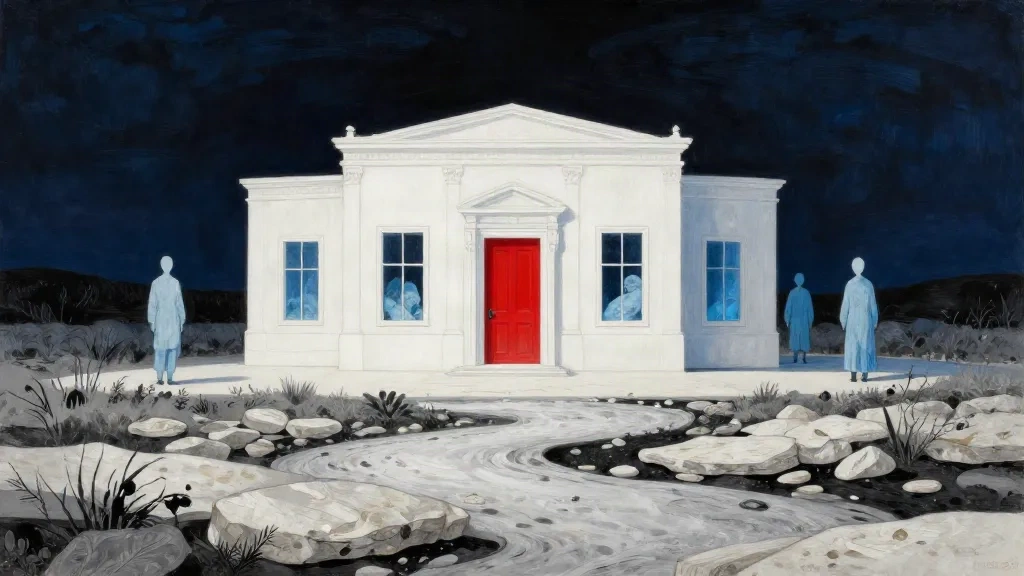
On the seventh morning, every dream described the same thing: an unmarked door painted a deep, single red.
It stood behind the stage, though everyone knew the wall was solid. The refrigeration unit dreamed of frost gathering along its hinges. The railway sleeper dreamed of wheels stopping on both sides of it. Iara translated the images and waited for the discarded endings to arrive.
Instead, her brother entered through the audience door carrying a dry riverbed in a glass jar.
“The family is coming,” he said. “They are coming to collect their promise.”
His name was Cael, and he had not spoken to her in six years. Their family divided long ago over the promise made at the river’s edge: leave the old country before the water returned. Their mother remembered saying they would stay until the harvest. Their father remembered leaving first. Their sister remembered no promise at all, only the sound of the dry riverbed cracking beneath their shoes.
Iara had chosen to stay. Cael had chosen to leave.
That evening, the red door appeared at the back of the stage. It opened onto a landscape of pale reeds and black earth, where a river once had run. At its center stood her parents, her sister, and three versions of Cael.
What Each One Carried
“You promised we would return,” her mother said.
“You promised we would never return,” said her father.
Her sister lifted a handful of dust. “Someone promised the river would remember.”
Each version of Cael carried a different map. One showed the road taken. One showed the road refused. One showed no road at all.
Iara opened her notebook and listened to the machines behind the walls. Their dreams were louder now. They spoke of routes abandoned and instructions misinterpreted, of commands transmitted faithfully into the wrong hands. A machine did not care who had been right. It performed the promise it had been given.
She stepped through the red door.
The riverbed smelled of iron, salt, and warm stone. She placed her hand on the earth and asked which promise remained true. No answer came. A map is not a memory. A map is an instruction, and instructions require a living hand.
So she drew a new map. She marked the theater, the riverbed, the door, and a path wide enough for disagreeing people to walk together. She did not choose one recollection. She wrote beneath it: We will meet here when the water is low, and decide again.
The Ending That Stayed
At dawn, the theater had no discarded endings. The machines slept quietly, dreaming only of daylight.
Iara left her map pinned above the stage. It was not perfect. It contained too many bends and a road that disappeared whenever Cael looked at it. But it was better than the one she had received, and better than the one she could have made alone.
The red door remained.
It no longer led to the riverbed. It opened onto the theater, where the family arrived separately, carrying their conflicting memories.
Iara did not ask which of them had been right. She handed each of them a pencil.
“Draw where you want to begin,” she said.
Outside, the rain arrived without ceremony. It ran through the old channel, filling the dry riverbed one careful inch at a time.





