 Netwrck
Mystery.
The Theatre of Borrowed Endings
The theatre stood behind the tram sheds, its doors painted the blue-black of rain after midnight. Inside, no play had ever reached its final scene. Each morning, the stage manager carried away the endings the city had rejected: the bride who stayed, the detective who forgave, the child who woke, the soldier who came home. In the basement, the endings slept in machines.
Mara translated their dreams for two coppers a page. She listened to brass lungs, glass hearts, and the soft static of machines dreaming of weather. Most endings wanted one thing only: a different door opened. She drew their desires on pale maps, then pinned the maps above the stage.
Her own map hung beside the ticket booth. It showed a narrow road leaving the city, a house with a red roof, and a black line crossing the road at the river. The line ended before the riverbed. She had received it from her mother, who said it was the way home. Mara’s father had called it a lie. Her brother had laughed and asked why anyone would need a map to leave a place they had never entered.
That morning, an unmarked door appeared at the back of the stage.
The Door Without a Scene
It had no handle, no hinges, and no number. When Mara touched the paint, it was warm. Behind it she heard a woman counting backward from ten. The voice stopped at three.
“That machine is awake,” said the stage manager. “It has been dreaming the same family for thirty years.”
He placed a transcript before Mara. The sleeping machine had translated the voices into images: a kitchen table, a dry riverbed, a woman sewing a button onto a coat. A promise passed from mouth to mouth, each time changing shape. The first version said, “I will return when the river runs.” The second said, “I will return before the river runs.” The third said, “I will return only if you wait.”
Mara’s hands went cold. Her family had owned the silver button. Her mother still carried it in a sealed envelope.
“This is not an ending,” Mara said.
“Then why is it dreaming?”
She pressed her ear to the door. Behind it, her mother was saying, “You promised not to leave.”
What the River Kept
The machine opened only when Mara spoke the words it had translated incorrectly. At first she tried the polite version, then the angry one, then the frightened one. The door remained still. Finally she said, “I will return when the river remembers me.”
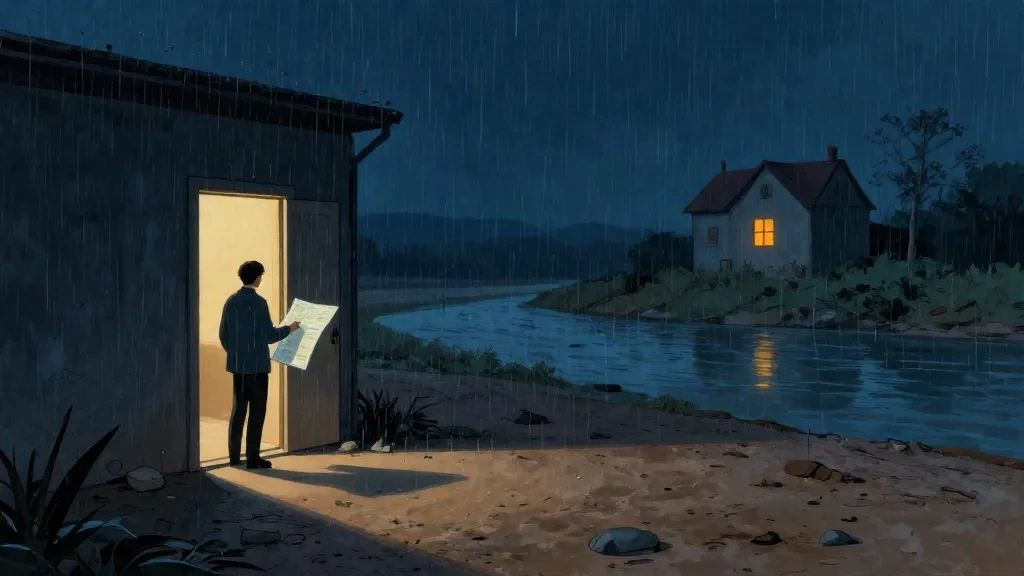
It opened onto the dry riverbed behind the theatre. Silver rain hung in the air without falling. On the opposite bank stood the house from her map, smaller than memory, with one warm amber window.
Three people waited inside: her mother, her father, and a younger Mara who held the silver button. None of them looked at the other two. Each believed the promise had been made on a different night.
Her mother said the river had risen the night her father left. Her father said it had never risen at all. Younger Mara said they had crossed together, and the river had dried before they reached the other side.
“Who waited?” Mara asked.
All three answered: “You.”
The theatre shuddered. A machine began reciting a discarded ending in which the whole family forgot the road. Mara drew their three accounts on separate maps, then laid them over one another. The routes aligned only at the riverbed. Beneath the silver line, she found a fourth path, invisible from every other angle.
It led to the amber window.
A Better Map
Mara stepped through the riverbed with the maps beneath her coat. At the window, her younger self held out the button. “Take it,” the child said. “A promise should travel with the person who leaves.”
Mara understood then. No one had promised the others a destination. They had promised only that the promise would not be abandoned. Her mother had kept it in an envelope. Her father had kept it as an accusation. Her brother had kept it by refusing to ask.
She placed the button on the sill. The silver rain began to fall, each drop carrying a different version of the night. When it struck the earth, the dry riverbed filled with clear water. The unmarked door appeared in the house wall, then in the theatre wall, then in the map Mara had carried since childhood.
She drew a road across the water, using the fourth path, and left space where the family could choose their own crossing. On the back she wrote: “A promise is not a route. It is a lamp.”
By dawn, the theatre had discarded one more ending. The stage manager asked whose it was.
“Mine,” Mara said. “But not the ending I expected.”
She left the theatre with the folded map in her pocket. Behind her, the door opened onto a silver rain, and one warm amber window burned at the far side of the river.





