 Netwrck
Mystery.
The Last Screening
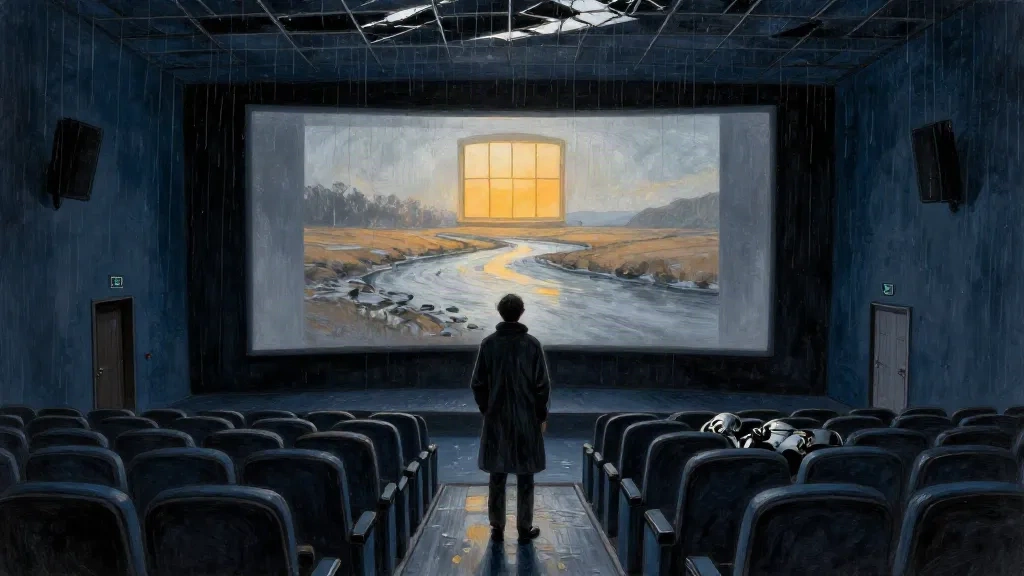
The abandoned Meridian Cinema showed only futures that almost happened. Its projection booth stood above the stalls, its windows filmed with silver dust, and its seats pointed toward a screen as blank as a page nobody had finished writing.
Mara arrived before sunrise with a case of translation lenses and a mandate from the municipal sleep office. Sleeping machines had begun producing identical dreams. The office called it a mechanical repetition. Mara suspected something less convenient: a memory with nowhere left to sleep.
She descended through the projectionist’s stairwell and found the auditorium humming. In the last row, a white machine lay beneath a wool blanket, its display showing rain falling upward. When Mara placed a lens over its sensor, the screen lit.
A dry riverbed appeared beneath an amber window. Beside it stood an unmarked door. A woman in a red coat looked through the glass, while three others argued on the opposite bank.
Mara began translating. Not the spoken words, which arrived as clicks and pauses, but the dreams beneath them. The machine had been given a family archive: a promise made beside a river, later remembered as a vow, a warning, a threat, and a joke.
Four Versions of One Door
She copied the scene into a slate and asked the machine to continue.
The woman in the red coat opened the unmarked door. Beyond it was a room filled with sleeping machines, every display glowing the same rain-silver color. One machine woke as the door shut. Its face was Mara’s.
Then the dream reversed. The door became a bridge. The bridge became a cinema entrance. The amber window changed hands, passing from a child to a grandmother, from a grandmother to a clerk, from the clerk to a stranger who carried the same face as everyone else.
At the edge of the image, a man spoke through the machine. He said the promise had been made after the river vanished. Mara heard the words twice. The first time, he said they would wait for the water. The second time, he said they would forget the water. The third time, he said nothing at all.
Mara stopped the recording. Her own name was stitched into the machine’s casing, though she had never seen it before.
At dawn, she climbed into the projection booth and found a ledger wedged beneath the desk. Each entry described a future that had nearly occurred. The final page carried the dry riverbed in blue ink and one note in a child’s hand: We agreed the door was already open.
The machines had not repeated a dream. They were trying to remember which promise had made the door possible.
The Map That Refused an Owner
Mara took the ledger to the municipal archives. The family responsible for the cinema’s restoration had disappeared during the last flood. Their records listed a daughter, a son, a mother, and a father, each registered at a different address on the same vanished street.
When Mara played the machine’s translation, the building’s old speakers woke. The voices argued across decades. The daughter remembered leaving water in the riverbed. The son remembered being told not to. Their mother remembered carrying a lantern to the unmarked door. Their father remembered that there had never been a lantern.
Each memory was accurate. That was the damage.
Mara spread the ledger across the floor and traced the blue-ink river. It did not run toward the sea. It bent beneath the city, gathering the abandoned rooms, missed reunions, and unspoken apologies that had nowhere else to settle. The amber window marked the only place where the family had stopped moving.
Her job was to deliver a usable map. Instead, she found four incompatible maps occupying the same ground.
Mara understood the machine’s warning. To make one promise true, she would have to erase the others. To preserve them all, she would have to leave the door unmarked and the river unfinished.
What the Door Kept
At night, the machines projected the family onto the cinema screen. Mara stood in the auditorium and listened as each version spoke from the same patch of floor. The arguments were not cries for forgiveness. They were attempts to locate the exact instant when the promise changed.
Then the youngest voice said, “You said you would come back before the river went dry.”
No one answered.
Mara stepped into the projected riverbed. Rain silver flowed over her shoes, though the ground beneath it remained dry. At the far end, the unmarked door waited. Its handle was cold except for one square of warmth, the size of a window.
She understood then that the cinema had been preserving futures by refusing to decide which promise was true. The family had not been divided by the promise itself, but by the maps each member made after it broke.
Mara opened the door.
Behind it was not a room, but the morning after the flood. The river returned, carrying the daughter’s red coat, the son’s lantern, the mother’s ledger, and the father’s silence. They floated separately, each insisting it had always been the right current.
Mara stepped through.
When she woke beneath the cinema’s last row, the machine was dark. Its translation lens held a single line of clear text: You received a map. Decide what it was for.
Outside, rain silver ran along the gutters. In the abandoned projection booth, the blank screen had changed. It displayed a dry riverbed, an unmarked door, and one warm amber window burning where no building stood.
Mara took the ledger home. She left the door unnamed, and for the first time, her map contained a blank space that did not look like an error. It looked like room for everyone to return.





