 Netwrck
Folk Horror.
The Door with a Bad Address
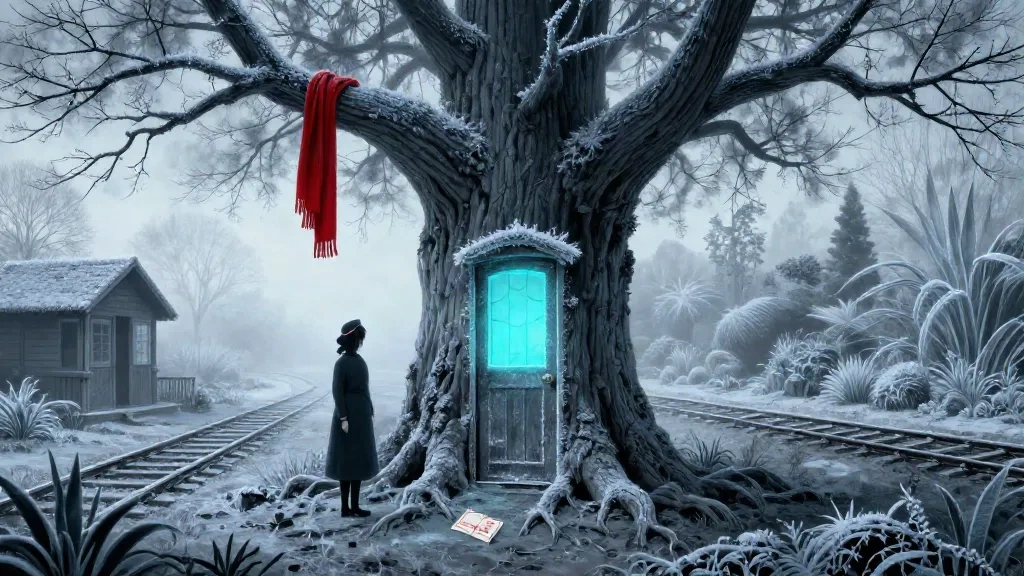
The first frost silvered the glasshouse roofs before the alders lost their leaves. Inside the Orison Botanical Garden, the great door-tree stood black against the pale morning, its bark scored with hinges, latches, handles, and narrow panels of frosted glass. The railway nurserymen pruned its roots in autumn. In winter, the doors opened.
Mara Venn was the village nurse, though a stranger would have called her the doctor of houses. She visited cottages when chimneys sighed, when bedroom stairs developed wet footprints, when a family found its kettle weeping over a childhood no longer lived. Homesick houses were prone to exaggeration. They slammed shutters at the sea, hid spoons, or carried their occupants toward doors they swore they had never noticed.
The door-tree had sent for her before dawn. A red scarf lay snagged on its lowest branch, white with frost. Beneath it rested a train ticket dated the following day, its destination printed as MA, then scrubbed away.
The Stationmaster's Correction
Stationmaster Pell kept the garden halt in a hut made from yellowed timetable cases. He was a lean man with ink-black cuffs and the conviction that tragedy was a clerical fault.
“Every ending,” he said, tapping Mara's ticket, “is a train that failed to arrive on time.”
He believed the door-tree grew an exit for every journey interrupted: a wedding abandoned in a thunderstorm, a soldier detained on the platform, a daughter who boarded in anger and never sent word. Doors opened. Passengers returned. Pell called this correction.
Mara knew one name remained on the morning manifest: ANSA, 07:10.
Ansa was Mara's younger sister. Once, they had shared the room above the village bakery where their mother kept flour bowls beneath the bed. They had promised to mend their quarrel before one of them left for the coast. Ansa had booked a place on the morning train. Mara had watched from the garden wall, too proud to ask her to stay.
That was seven years ago. Ansa had left. Mara had not.
Pell buckled the ticket into his timetable. “No departure has occurred until the timetable says so,” he said. “I can retrieve her if I amend the line.”
A House With No Return
At dusk, Mara entered the smallest door on the tree. It opened not into the garden but into the abandoned bakery, dust furred and benches stacked against the walls. A little house knelt beside the oven, complaining through its windows.
“I have kept both bowls,” it said. “She took one. Then she took the flour. Then the smell.”
Mara unpacked her bag. She opened the oven, warmed the patient's narrow rooms, coaxed smoke from every crack. The house revealed its sickness: a double-sized dent in the shared table, one chair swollen with damp, every door opening toward the room where Mara had refused to knock.
“You cannot cure a house by agreeing with it,” she said.
“Then agree that you were wrong.”
Beyond the walls, a whistle sounded. Pell had arrived early. He nailed Mara's red scarf to the bakery door and set their mother's flour bowl upon the empty chair. Midnight thinned toward dawn. Through the frosted window, the garden sky turned the impossible soft cyan of a day that had not yet consented to happen.
“Departure corrected,” Pell called. “Ansa is waiting.”
What the Morning Carried
Mara climbed into the oven. Its iron mouth was warm, the threshold just wide enough for grief. She crossed the ash pan and the dark space between seasons.
She found Ansa on a station bench with the same red scarf, though its color had faded to iron gray. Seven years had not passed on her. Nor on Mara.
“I came to say I was wrong,” Mara said.
Ansa looked at the ticket in her hand. “I know. I kept waiting.”
Behind her, the train sounded its horn. The trees along the invisible line bent inward, pressing dark leaves against the windows.
“I cannot go back as if nothing happened,” Ansa said.
“I didn't bring you back as if nothing happened.”
Mara sat beside her. They held the ticket between them until the paper softened and split along its old fold, dividing the destination into two pale halves.
Pell frowned when Mara returned. “An incorrect ending,” he said.
“No,” she said. “A changed timetable.”
By sunrise, two doors hung from the tree, facing away from each other. Travellers still used them. Pell insisted they were passing through, though every morning he found flour on his coat and heard two sisters quarrelling gently in the trees.





